
Am I Allergic to Alcohol Quiz
How the Scales are Structured
Who Usually Takes This Test?
See How You Compare
Below is a preview of how scores are typically distributed across each scale.
Example Questions From the Test
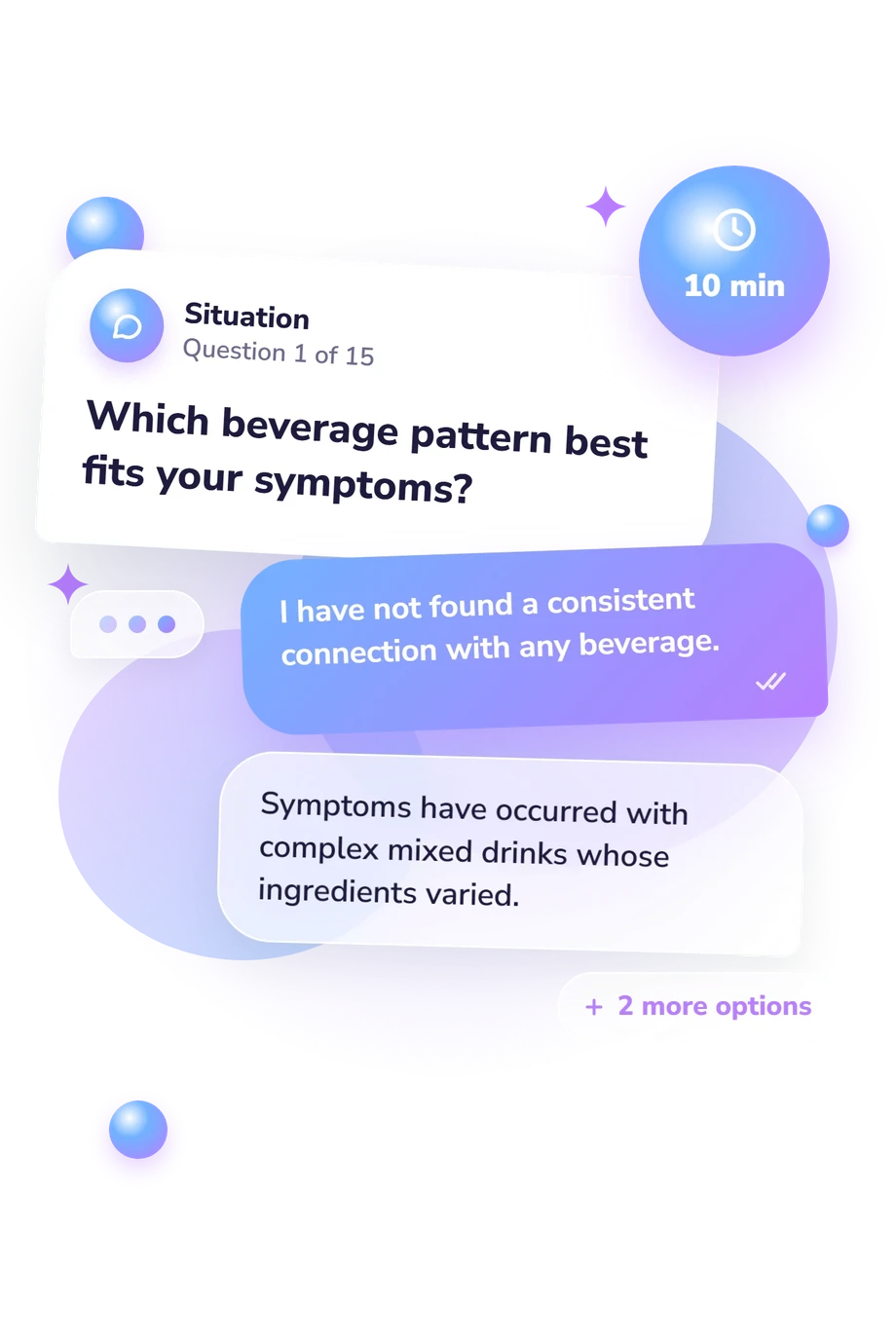
- I have not found a consistent connection with any beverage.
- Symptoms have occurred with complex mixed drinks whose ingredients varied.
- Symptoms repeatedly follow one beverage family, such as wine, beer, or a particular spirit.
- Even tiny amounts across different alcoholic drinks have triggered a clear reaction.
- I have not noticed an unexpected change.
- I have briefly noticed my heartbeat without pain or lasting symptoms.
- I have repeatedly had a racing, pounding, or irregular-feeling heartbeat that concerned me.
- A heartbeat change has occurred with chest pain, fainting, severe breathlessness, or confusion.
- I had no unexpected dizziness, weakness, or change in alertness.
- I felt briefly lightheaded but remained steady and fully alert.
- I became markedly dizzy or weak after an amount that would not usually explain it.
- I fainted, collapsed, became confused, or was difficult to wake.
Am I Allergic to Alcohol Quiz - Description and methodology of the test
Anyone who notices flushing, congestion, stomach upset, skin changes, breathing symptoms, or unusual dizziness after drinking may use the Am I Allergic to Alcohol Quiz to sort possible trigger patterns from immediate warning signs and broader body reactions. This alcohol intolerance quiz helps readers consider whether symptoms relate to a particular drink, amount, timing, or repeated exposure. The result offers a structured way to review what they experienced.
What This Assessment Explores
The questionnaire examines whether symptoms follow particular drinks, ingredients, amounts, or exposure conditions rather than treating every unpleasant experience as the same. For someone considering an alcohol allergy test, the central task is to connect timing and repeatability with bodily responses.
The result groups those observations into three displayed dimensions:
- Exposure and Trigger Pattern (0-15) shows whether beverage type, ingredients, amount, and repetition form a trackable link: No pattern identified (0), Clues to track (1-2), or Avoid and investigate (3-15).
- Immediate Allergy-Like Warning Signs (0-15) captures swelling, hives, breathing difficulty, faintness, confusion, or rapidly worsening symptoms: No listed signs (0), Note and pause (1-2), or Prompt action (3-15).
- Intolerance-Like Body Reactions (0-15) summarizes recurring digestive, flushing, headache, nasal, or other body responses: No reactions endorsed (0), Notable pattern (1-2), or Higher concern pattern (3-15).
Methodology and Scientific Basis
Each item offers four ordered responses, from no unexpected effect through mild or occasional symptoms to repeated or urgent experiences. Prompts address timing, duration, repeatability, smallest triggering amount, body areas, and related alcohol-free products or foods. The four response positions make the alcohol reaction quiz consistent across these topics.
Results are displayed across the three scales, and the supplied bands guide interpretation.
The questionnaire's symptom and trigger themes are conceptually consistent with the questionnaire reported by Vally, De Klerk, and Thompson (1999), but this online questionnaire is not a validated adaptation. Later work by Vally et al. (2000, 2003) provides context on asthma and allergic reactions, while Brooks et al. (2009) examines alcohol flushing.
The scores are unvalidated reflective summaries, not diagnostic or severity cutoffs; answers also depend on recall, current context, and self-awareness. A concerning response matters independently: a single score-3 red-flag response overrides the total, and breathing difficulty, swelling, fainting, chest pain, severe vomiting, or rapidly worsening symptoms call for urgent help.
- Hassan Vally, Nicholas De Klerk, and Philip J. Thompson (1999). Asthma induced by alcoholic drinks: a new food allergy questionnaire. Australian and New Zealand Journal of Public Health, 23(6), 590-594. 10.1111/j.1467-842X.1999.tb01542.x
- Hassan Vally, Nicholas De Klerk, and Philip J. Thompson (2000). Alcoholic drinks: Important triggers for asthma. Journal of Allergy and Clinical Immunology, 105(3), 462-467. 10.1067/mai.2000.104548
- Hassan Vally and Philip J. Thompson (2003). Allergic and asthmatic reactions to alcoholic drinks. Addiction Biology, 8(1), 3-11. 10.1080/1355621031000069828
- Philip J. Brooks, Mary-Anne Enoch, David Goldman, Ting-Kai Li, and Akira Yokoyama (2009). The Alcohol Flushing Response: An Unrecognized Risk Factor for Esophageal Cancer from Alcohol Consumption. PLoS Medicine, 6(3), e1000050. 10.1371/journal.pmed.1000050
Updated: