
Technology Quiz
How the Scales are Structured
Who Usually Takes This Test?
See How You Compare
Below is a preview of how scores are typically distributed across each scale.
Example Questions From the Test
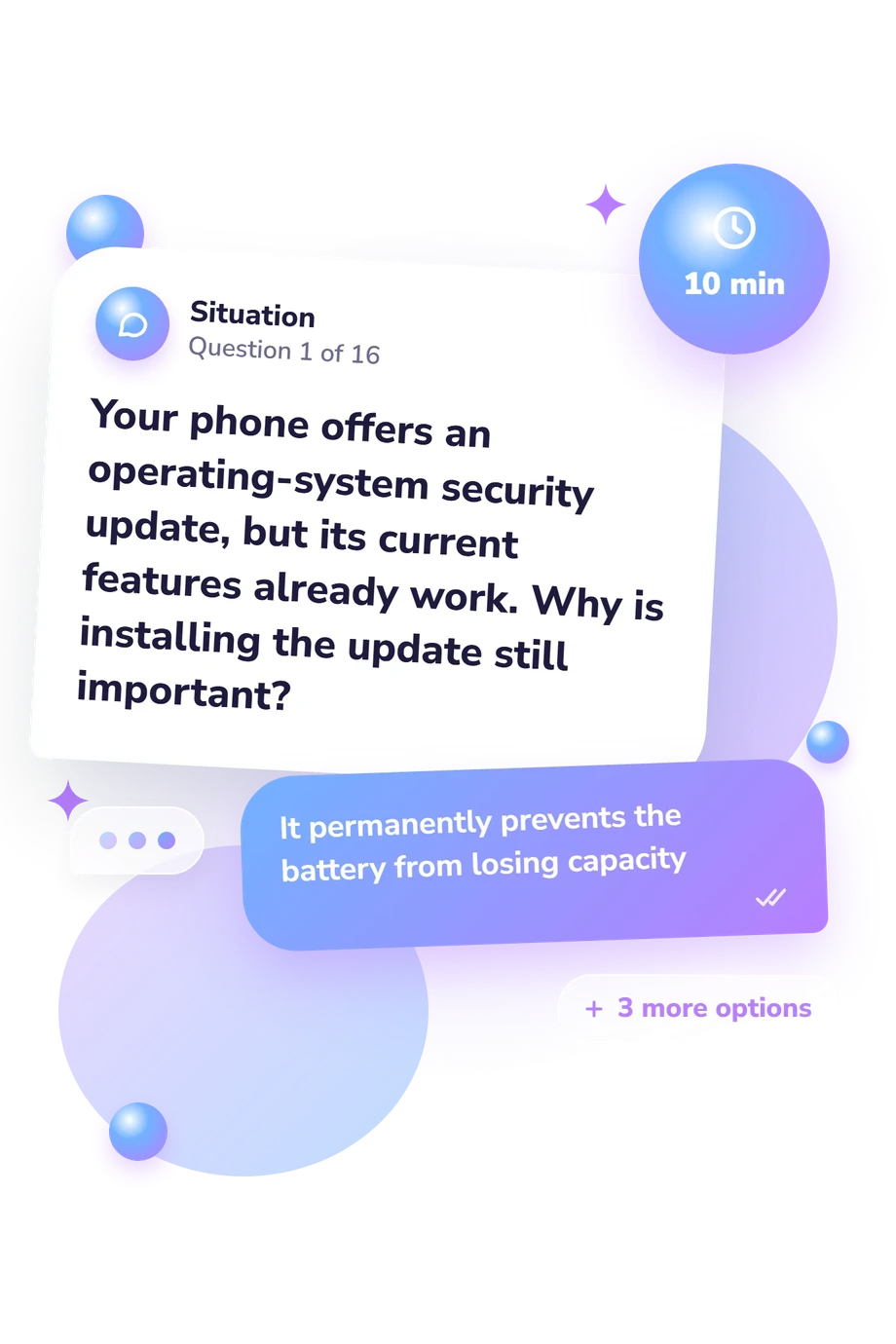
- It permanently prevents the battery from losing capacity
- It may patch vulnerabilities that attackers could exploit
- It guarantees compatibility with every future application
- It converts all locally stored files into cloud backups
- Reply to the sender and ask whether the warning is genuine
- Follow the link but inspect the page before entering the password
- Open the service through its official app or typed web address and check the account there
- Forward the email to a friend to see whether the link works for them
- Whether users have high-resolution displays
- Whether the training data adequately represents the affected accent
- Whether the audio files are stored in alphabetic order
- Whether the interface uses a light or dark color theme
Technology Quiz - Description and methodology of the test
Students, new employees, and curious users may benefit from this technology quiz when they want to gauge how ready they are for everyday digital decisions. As an online technical quiz, it presents situations involving suspicious messages, software updates, backups, file sharing, cloud services, and common hardware, so it suits people without specialist training. The result summarizes performance across core concepts.
What This Assessment Measures
Across its items, this assessment functions as a computer tech quiz that checks practical knowledge rather than personal attitudes. Its questions ask respondents to recognize safe actions, identify basic systems, and choose workable solutions in familiar digital situations. The coverage is broad but remains focused on applied understanding.
The main topic groups are:
- Cybersecurity questions show how the respondent recognizes safer updates, phishing responses, backups, encryption, and secure connections.
- Computing foundations indicate whether CPUs, algorithms, binary, memory, storage, and training-data representation are understood, including why systems may perform unevenly across users.
- Networks and services cover routers, domain-name resolution, cloud computing, and interoperability.
- Data and software practice examines file capacity, compression, open-source licensing, and sharing formats.
The displayed Technology Knowledge scale runs from 0-16: Foundation Builder (0-6), Developing Technologist (7-12), and Strong Technology Knowledge (13-16).
Methodology and Interpretation
Each item offers four answer choices, with one best response to the situation. Topics span computing, security, networks, files, software, and digital systems, so the assessment tests applied recognition rather than coding or hands-on performance.
Scoring is transparent: each correct answer adds one point to the displayed total. Read individually, the raw score indicates how many problems were answered correctly, while the band gives a descriptive summary rather than a population norm. Prior exposure, current context, and carefulness can affect performance, so the result is a snapshot of demonstrated knowledge.
Because it spans computing, security, networks, and data, this general IT quiz is a knowledge check rather than a coding or performance test. Its reference point is Buchan et al. (2024), whose work assesses digital literacy, alongside research on the ST2L and UNESCO’s digital-literacy framework. The questionnaire is conceptually consistent with these works, not an adaptation or validation of them. That relationship does not establish psychometric equivalence or standardization. Honest self-report and limited topic selection mean the result cannot capture every aspect of technical ability.
- Buchan, M. C., Bhawra, J., & Katapally, T. R. (2024). Navigating the digital world: development of an evidence-based digital literacy program and assessment tool for youth. Smart Learning Environments, 11, Article 8. 10.1186/s40561-024-00293-x
- Huggins, A. C., Ritzhaupt, A. D., & Dawson, K. (2014). Measuring information and communication technology literacy using a performance assessment: Validation of the Student Tool for Technology Literacy (ST2L). Computers & Education, 77, 1-12. 10.1016/j.compedu.2014.04.005
- Law, N., Woo, D., de la Torre, J., & Wong, G. (2018). A Global Framework of Reference on Digital Literacy Skills for Indicator 4.4.2 (Information Paper No. 51). UNESCO Institute for Statistics, Montreal, Canada.
Updated: