
Reading Quiz
How the Scales are Structured
Who Usually Takes This Test?
See How You Compare
Below is a preview of how scores are typically distributed across each scale.
Example Questions From the Test
- Lina checked the coop at dawn.
- Fresh fox tracks led to the fence gap and returned toward the woods.
- The coop gate remained latched.
- One hen was missing from the coop.
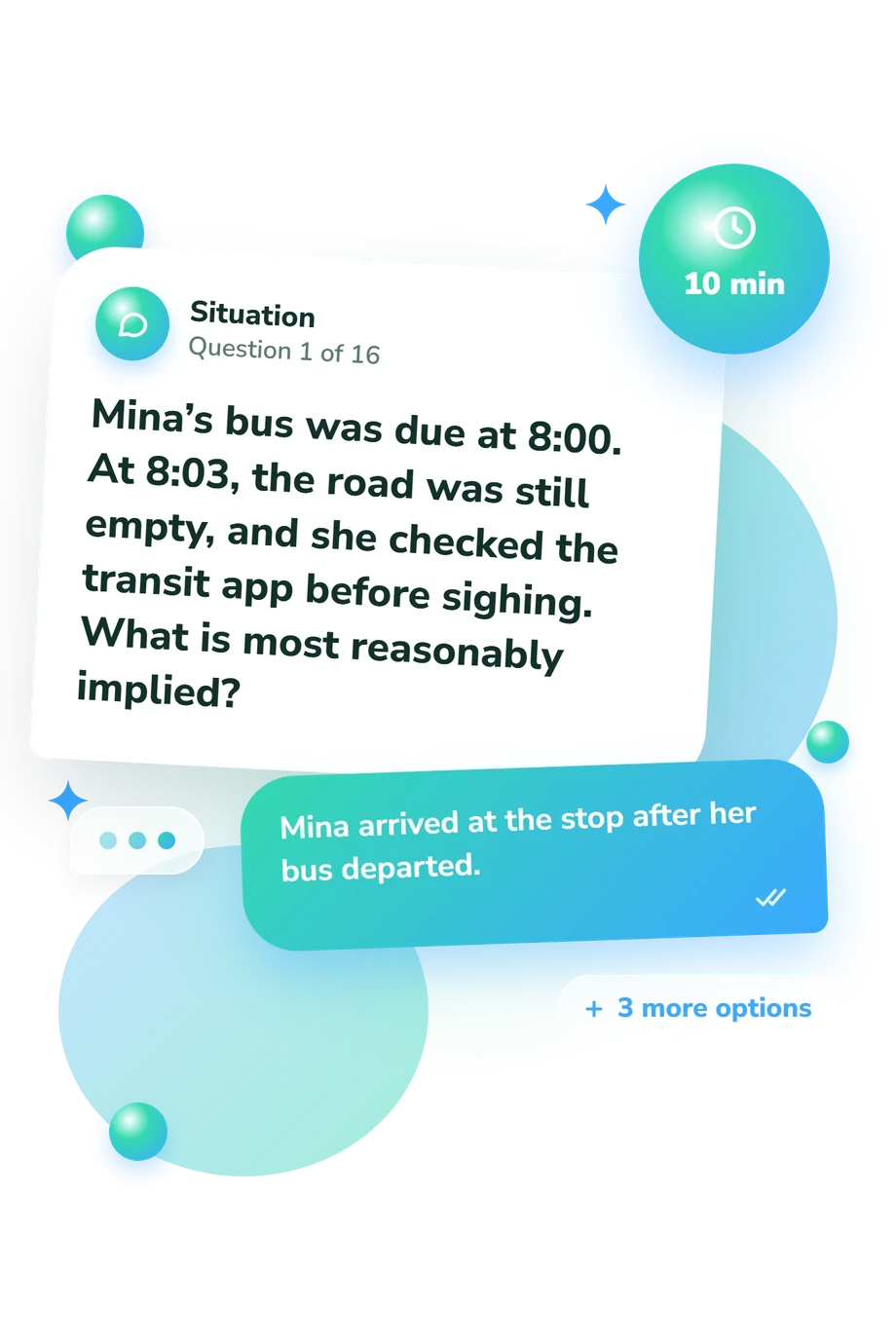
- Mina arrived at the stop after her bus departed.
- The transit app caused Mina to miss the bus.
- The bus had not arrived at its scheduled time.
- Mina had decided to walk instead of taking the bus.
- Weekend opening hours will move from 9 a.m. to 10 a.m.
- The library will close for staff training every Monday.
- The library will open one hour later on weekdays because of staff training.
- The library is adding an extra hour to its weekday schedule.
Reading Quiz - Description and methodology of the test
Readers who want to see how they handle evidence, inference, and text meaning can use this reading quiz to examine performance across varied short texts. It suits learners, teachers, and curious readers interested in how clearly they select meaning supported by the words on the page. In this online reading comprehension quiz, the represented tasks invite reflection on reading processes rather than separate skill scores.
What This Assessment Explores
Short texts ask you to identify main ideas, infer meaning, connect claims with evidence, interpret vocabulary in context, and recognize purpose, structure, reference, or tone. Notices, narratives, schedules, and explanations represent reading processes sampled by these items.
As a reading comprehension assessment, this questionnaire samples whether you select the best-supported interpretation when distractors sound plausible. It suits learners, teachers, and curious readers reviewing performance across varied tasks.
The represented task groups are:
- Main idea and summary are tested through questions about retaining a text’s central message.
- Inference and evidence are tested through questions about whether clues support a conclusion.
- Vocabulary and reference are tested through questions about how context clarifies meaning.
- Purpose, structure, and tone are tested through questions about how organization shapes interpretation.
Reading Knowledge ranges from 0-16: Foundations to strengthen (0-6), Developing comprehension (7-12), and Strong comprehension (13-16).
Methodology and Evidence Base
Each item presents a short passage, sentence, notice, schedule, or other text with four answer choices. Choosing the best-supported option makes the task an objective comprehension exercise rather than a self-rating. The items sample meaning, evidence, vocabulary, purpose, sequence, reference, and tone.
The displayed total summarizes correct answers across the complete quiz. It is a single overall comprehension score for this set of texts. As a comprehension skills quiz, it gives one combined result for the represented tasks.
Content is conceptually consistent with the Adolescent Comprehension Evaluation (ACE), which examines related processes, and with the OECD’s PISA 2018 framework, which describes purposeful understanding, evaluation, and reflection. This questionnaire is not presented as an adaptation, validation, or normed administration of either source; they clarify its construct.
Attention, vocabulary, topic familiarity, current context, and distractor plausibility can affect selected answers. Interpret the result as performance on this varied set of texts, not as a formal measure of overall reading ability.
- Severino, Lori, Mary Jean Tecce DeCarlo, Toni Sondergeld, Meltem Izzetoglu, and Alia Ammar. 2018. “A Validation Study of a Middle Grades Reading Comprehension Assessment.” RMLE Online 41(10): 1-16. 10.1080/19404476.2018.1528200
- OECD. 2019. PISA 2018 Assessment and Analytical Framework. Paris: OECD Publishing. 10.1787/b25efab8-en
Updated: