
Psychometrics Quiz
How the Scales are Structured
Who Usually Takes This Test?
See How You Compare
Below is a preview of how scores are typically distributed across each scale.
Example Questions From the Test
- Social-desirability or impression-management bias
- Inter-rater disagreement
- Practice effects
- Restriction of range
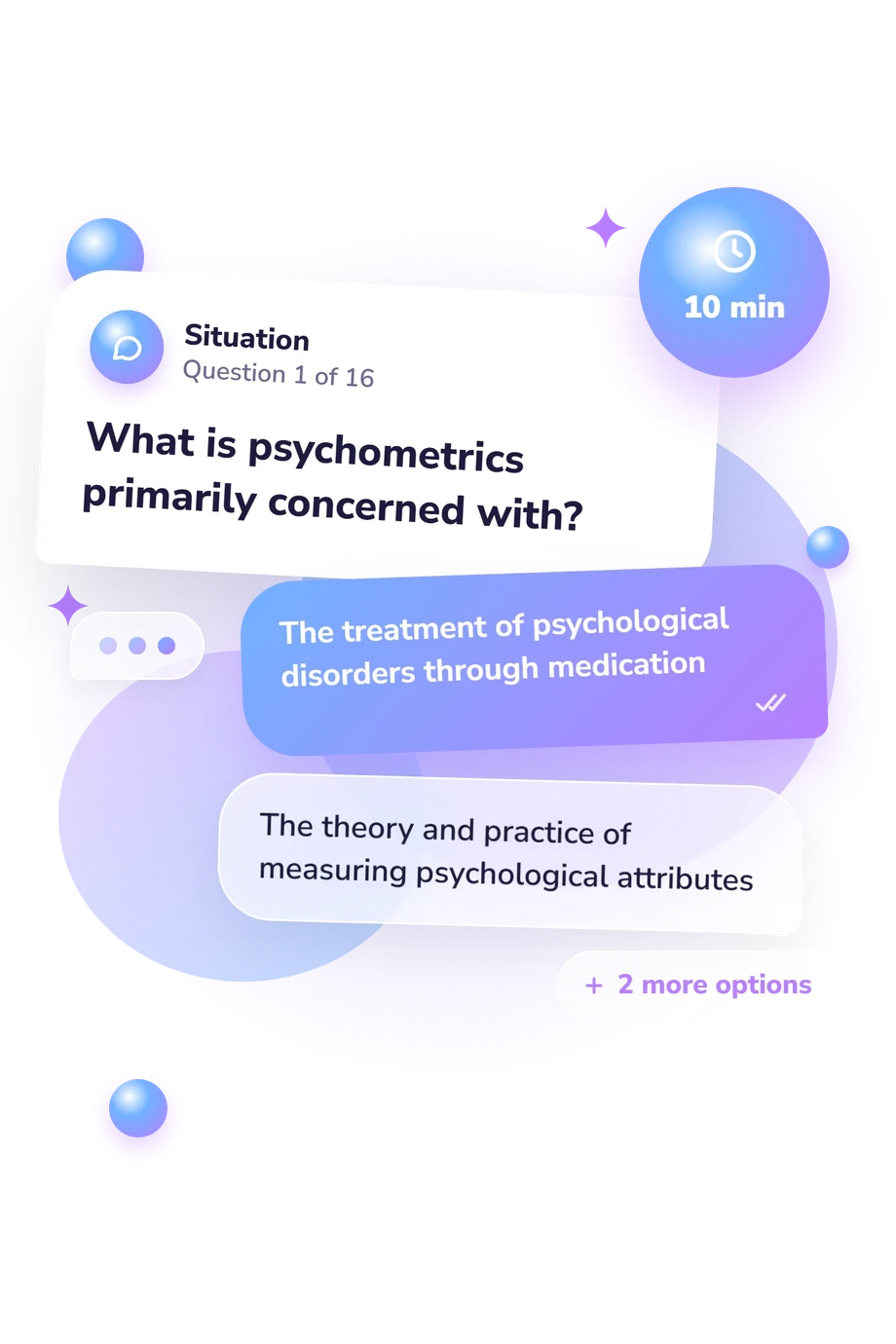
- The treatment of psychological disorders through medication
- The theory and practice of measuring psychological attributes
- The biological classification of brain structures
- The study of group behavior without using measurement
- A score 1.5 standard deviations above the mean
- A score 1.5 raw points above the highest possible score
- A score achieved by exactly 1.5% of the reference group
- A score with 1.5 times the test's reliability
Psychometrics Quiz - Description and methodology of the test
People learning about, teaching, or interpreting psychological tests can use this psychometrics quiz to examine practical knowledge of how psychological measurement works rather than personal traits. By applying measurement concepts to brief scenarios, this psychometrics practice quiz identifies topics worth revisiting and supports a more confident approach to reading psychological tests.
What This Assessment Explores
The questions focus on psychological measurement rather than symptoms or personality. Practical scenarios ask readers to recognize reliability, validity, standardization, reference groups, measurement error, response bias, fairness, and norm- versus criterion-referenced decisions. The emphasis is conceptual understanding applied to short testing situations.
The questionnaire covers these question themes and skill areas:
- Psychometrics Knowledge (0-16) reflects your grasp of foundational measurement principles: Foundations to build (0-6), Developing literacy (7-12), or Strong literacy (13-16).
- Reliability and validity questions test how well you distinguish consistency, uncertainty, and evidence supporting an intended interpretation.
- Bias and score-use questions test whether you can notice impression management, inconsistent conditions, group-related item concerns, and competence standards.
Students can use the result as feedback from a psychometrics knowledge test when deciding which concepts deserve review. It describes performance on this educational questionnaire, not a fixed personal trait.
Methodology and Scientific Basis
Each item presents a measurement scenario with four answer choices and asks for the best interpretation. The format tests applied recognition: respondents distinguish internal consistency from test-retest reliability, validity from reliability, norm- from criterion-referenced interpretation, and score differences from measurement uncertainty. Responses combine into the displayed knowledge score; the range does not reveal a point-by-point scoring rule.
Cohen and Swerdlik's psychometrics textbook provides a framework for the concepts tested. AERA, APA, and NCME (2014) support treatment of validity, fairness, and score interpretation. Cronbach and Meehl's construct-validity framework explains why convergent and discriminant relationships matter. These sources provide conceptual framework for the tested ideas; they do not establish the reliability, validity, or norms of this online questionnaire.
Applying concepts to scenarios provides psychometric test practice, while the bands show whether foundational review, broader application, or consolidation may help. They are educational categories rather than published norms or a professional qualification. Guessing, prior knowledge, attention, and online testing conditions can affect performance, so the result is best used to target review of reliability, validity, and score interpretation.
- Cohen, Ronald Jay, & Swerdlik, Mark E. (2018). Psychological Testing and Assessment: An Introduction to Tests and Measurement (9th ed.). McGraw-Hill Education.
- American Educational Research Association, American Psychological Association, & National Council on Measurement in Education. (2014). Standards for Educational and Psychological Testing. Washington, DC: American Educational Research Association.
- Cronbach, L. J., & Meehl, P. E. (1955). Construct validity in psychological tests. Psychological Bulletin, 52(4), 281-302. 10.1037/h0040957.
Updated: