
PSAT Practice Quiz
How the Scales are Structured
Who Usually Takes This Test?
See How You Compare
Below is a preview of how scores are typically distributed across each scale.
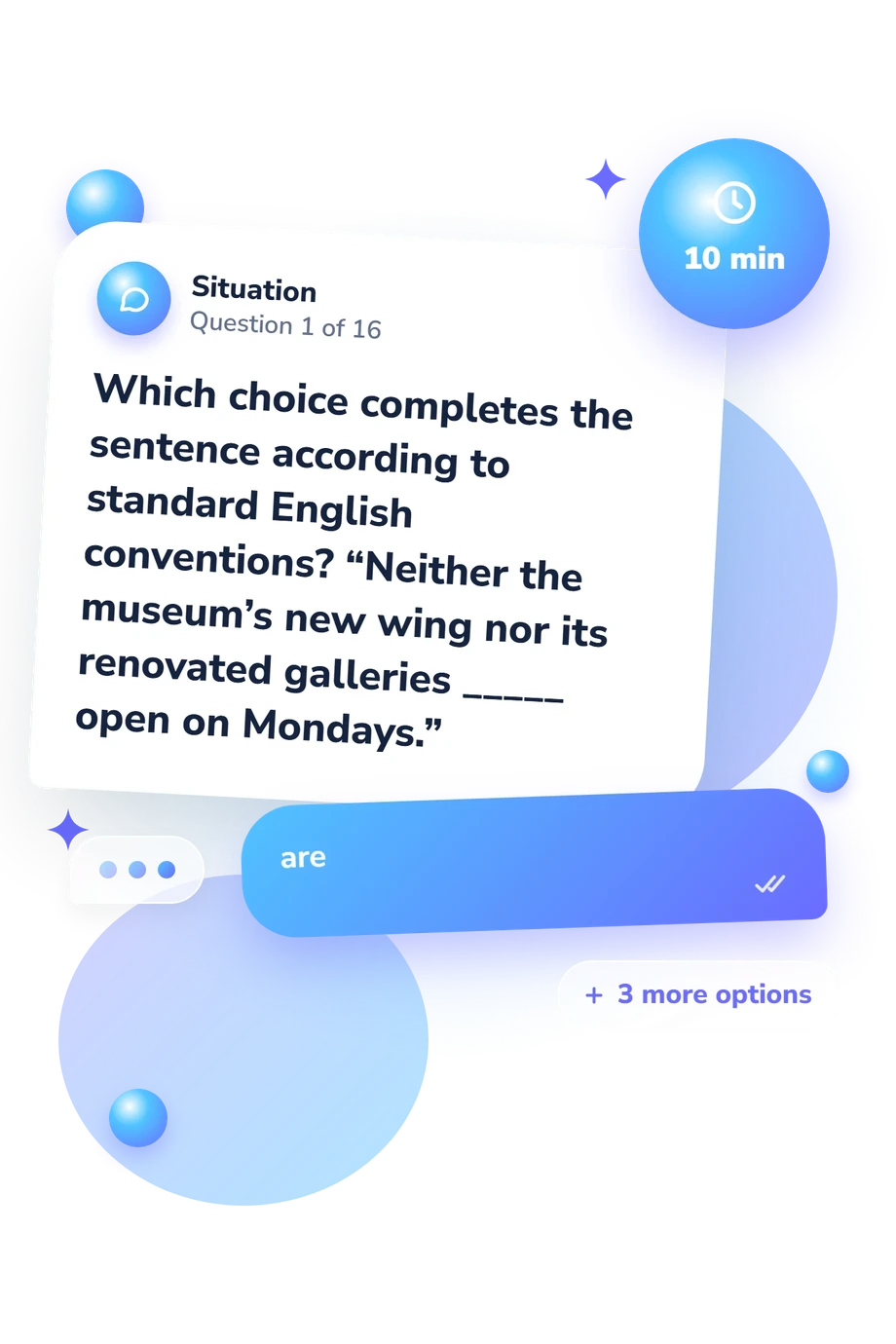
Example Questions From the Test
- 0
- 4
- 2
- 6
- 12π square units
- 72π square units
- 36π square units
- 144π square units
- $20
- $60
- $55
- $65
PSAT Practice Quiz - Description and methodology of the test
Students reviewing core academic skills can use the PSAT Practice Quiz to decide what kind of preparation to pursue next. It is suited to learners planning their next study step, teachers seeking a compact practice prompt, and anyone who wants a focused PSAT quiz before moving to longer materials. The overall result can indicate whether targeted review or broader timed practice is the more useful next step.
What This Assessment Measures
The questionnaire samples reasoning across reading, writing, language, mathematics, and evidence rather than one subject. PSAT practice questions ask the respondent to interpret passages, revise sentences, solve algebraic and geometric problems, read data, and draw supported conclusions. Together, these sampled areas contribute to one overall result, not separate concept scores.
Its single scale, PSAT Knowledge, runs from 0-16. The catalogue defines it as performance on this compact mixed-skills quiz, not an official or predicted PSAT score. Bands are Foundations to build (0-6), Developing command (7-12), and Strong command (13-16).
The sampled task areas contributing to that result are:
- Reading shows how well the respondent identifies meaning and support in passages.
- Writing and language show how well the respondent applies grammar, transitions, and revision.
- Mathematics shows how well the respondent uses algebra, geometry, percentages, and data.
- Evidence-based reasoning assesses whether conclusions follow from the information provided.
Methodology and Evidence Base
Each item presents a short prompt and four answer choices; the respondent selects the option that best completes, solves, or supports it. Skills questions sit alongside brief evidence-based scenarios, so the single score reflects several task forms. No separate weighting or conversion to an official PSAT scale is stated.
A College Board Digital SAT cognitive lab study examines reasoning demands in assessment questions. Its 2024 assessment framework and technical manual describe reading and writing, mathematics, and evidence-based demands relevant to this sample. A SAT factor-structure study by Wiley, Shavelson, and Kurpius discusses broader college-readiness dimensions in SAT results. These sources support the sampled skills, but do not establish that this questionnaire is an adaptation, equated form, or standardized PSAT measure.
Interpret the band as feedback on sampled performance and a guide for PSAT preparation, not a forecast of test-day performance. The displayed bands are descriptive categories for this compact quiz, not official PSAT norms, and results may vary with instruction, concentration, and familiarity with item types. Reviewing missed questions and completing full-length timed practice can provide a broader picture.
- College Board, with contributions from Jim Patterson, Dona Carling, Michael Gosche, Juliette Cabrera, Jay Happel, Beth Oxler, Georgina Keenan, and Nancy Burkholder. 2024. The Cognitively Complex Thinking Required by Select Digital SAT Suite Questions. New York: College Board.
- College Board. 2024. Assessment Framework for the Digital SAT Suite, version 3.01 (August 2024). New York: College Board.
- College Board, with chapter leads Angela DelBrocco, Jim Patterson, Thomas Proctor, Emily Shaw, and Mark Syp. 2024. Digital SAT Suite of Assessments Technical Manual. New York: College Board.
- Wiley, Edward W., Richard J. Shavelson, and Amy A. Kurpius. 2014. On the Factorial Structure of the SAT and Implications for Next-Generation College Readiness Assessments. Educational and Psychological Measurement 74 (5): 859-874. 10.1177/0013164414528332.
Updated: