
Present Simple Quiz
How the Scales are Structured
Who Usually Takes This Test?
See How You Compare
Below is a preview of how scores are typically distributed across each scale.
Example Questions From the Test
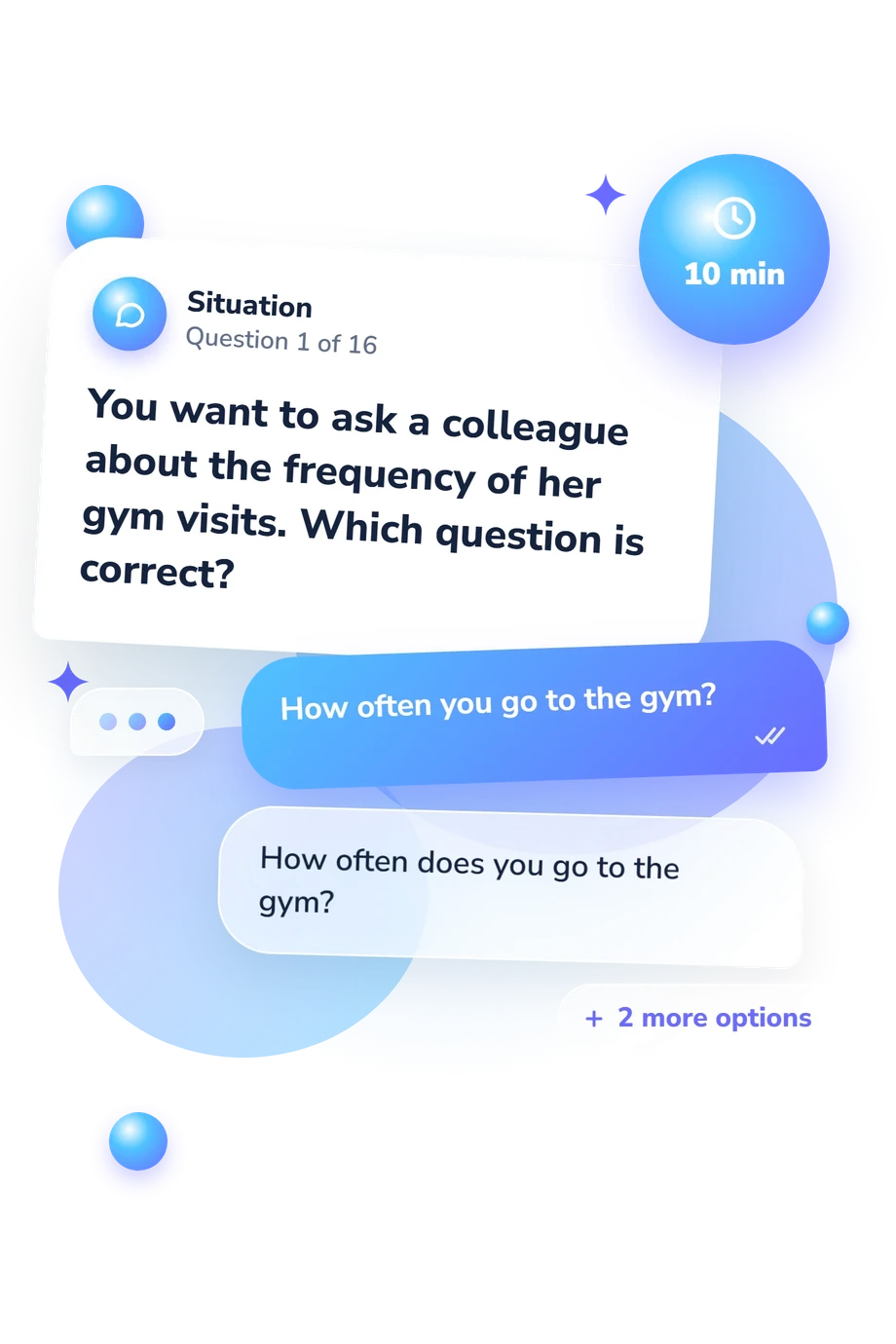
- How often you go to the gym?
- How often does you go to the gym?
- How often are you go to the gym?
- How often do you go to the gym?
- is playing every day
- plays
- does play
- play
- Diaz pass to Chen, and Chen shoot.
- Diaz is pass to Chen, and Chen is shoot.
- Diaz does passes to Chen, and Chen does shoots.
- Diaz passes to Chen, and Chen shoots.
Present Simple Quiz - Description and methodology of the test
Designed for learners who want a clearer picture of their everyday grammar, this present simple quiz focuses on the forms used for routines, facts, states, timetables, and instructions. It can help a student or independent English user identify which rules feel secure and which deserve practice. Presented as a present simple online quiz, this questionnaire turns common sentence choices into a focused check of practical accuracy.
What This Assessment Explores
As a simple present tense quiz, the questionnaire examines how well you use the present simple in everyday contexts. Its items cover do/does questions, third-person endings, be, stative verbs, negatives, frequency adverbs, habits, general truths, instructions, and schedules. This suits learners reviewing core grammar, with emphasis on choosing forms that fit both meaning and structure.
The result appears on the Present Simple Knowledge scale (0-16) and uses three bands:
- Foundations to review (0-6) indicates that basic forms, questions, negatives, and common uses need attention.
- Developing knowledge (7-12) shows that core rules are present, while endings, auxiliaries, or adverb placement may still cause errors.
- Strong knowledge (13-16) reflects accurate use across most routine, factual, and contextual situations.
For this questionnaire, the single result highlights present-simple topics to revisit instead of treating one score as complete language knowledge.
Methodology and Scientific Basis
Each item presents a sentence or situation with four answer choices. Respondents select the form that best fits meaning and grammar, including do/does questions, negatives, be, verb endings, and adverb position. This simple present tense online quiz measures controlled recognition rather than extended writing.
The displayed score is interpreted through the bands. No separate weighting rule is stated, so points cannot be inferred beyond the published score. For this questionnaire, the four choices make the task one of selecting the grammatically correct form; the result does not measure speaking, listening, writing, or every use of the tense.
Grammar coverage is conceptually consistent with auxiliaries, lexical verbs, be, and stative meanings described by Biber and colleagues (2009) and by Huddleston and Pullum (2002). These sources support the categories used here; they do not establish a standardized adaptation.
Use the result as a learning indicator: attention, recent study, confidence, and test conditions can influence performance, so the score reflects selected-form recognition rather than communicative mastery.
- Biber, Douglas, Susan Conrad, and Geoffrey Leech. Longman Student Grammar of Spoken and Written English. Harlow: Longman, 2002.
- Huddleston, Rodney D., and Geoffrey K. Pullum. The Cambridge Grammar of the English Language. Cambridge: Cambridge University Press, 2002. 10.1017/9781316423530.
Updated: