
Present Continuous Quiz
How the Scales are Structured
Who Usually Takes This Test?
See How You Compare
Below is a preview of how scores are typically distributed across each scale.
Example Questions From the Test
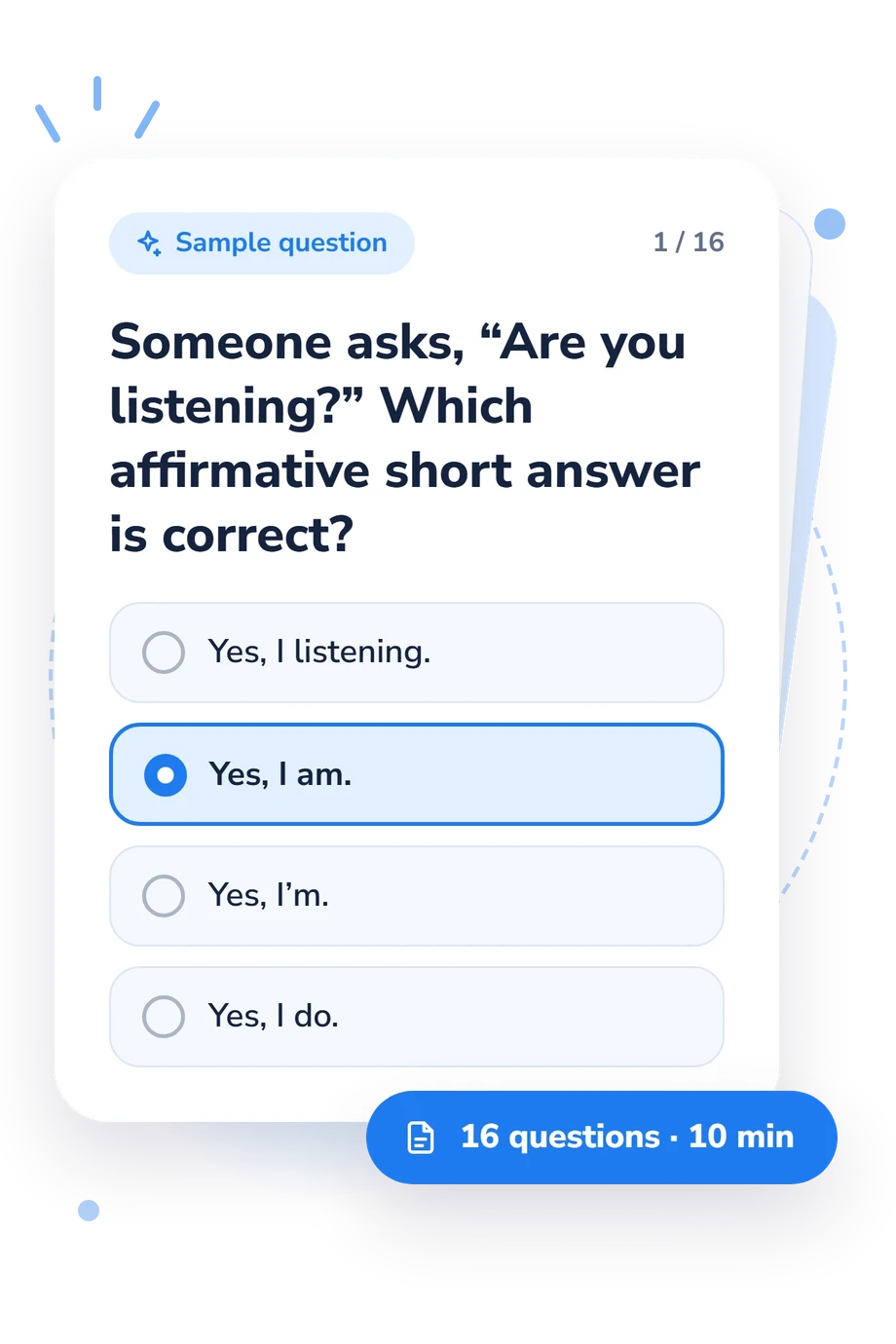
- Yes, I listening.
- Yes, I am.
- Yes, I’m.
- Yes, I do.
- Omar stays in Madrid this month right now.
- Omar is staying in Madrid this month.
- Omar staying in Madrid this month.
- Omar does stay in Madrid this month now.
- Why he isn't wearing a coat?
- Why isn't he wearing a coat?
- Why doesn't he wearing a coat?
- Why isn't he wear a coat?
Present Continuous Quiz - Description and methodology of the test
Designed for learners who want a clearer grasp of everyday English grammar, this present continuous quiz checks whether you can recognise and form the tense in realistic situations. It suits students, independent learners, and anyone reviewing basic-to-intermediate usage. The result gives an overall indication of performance across form, word order, spelling, and tense-choice questions. By bringing these forms together, this continuous tense quiz helps direct the next stage of practice.
What This Assessment Explores
Rather than measuring fluency in general, this assessment focuses on everyday decisions about what is happening now, what is temporary, or what has been arranged. It also tests whether learners can distinguish present continuous from simple present in states, routines, and changing trends.
The main content areas are:
- Current actions show whether activities happening at the moment are expressed affirmatively.
- Temporary situations show whether limited circumstances are described with the appropriate form.
- Questions and negatives test auxiliary be, word order, contractions, and not.
- Future arrangements show whether the tense can describe a fixed plan.
- Spelling and verb choice test forms such as running, lying, and knowing.
These areas are combined in the Present Continuous Knowledge scale (0-16). Results are labelled Foundations to review (0-6), Developing knowledge (7-12), or Strong knowledge (13-16). Because this present continuous grammar test combines these areas, its band is most useful as an overall guide to practice.
Methodology and Scientific Basis
Each question gives a context or sentence with four answer choices. The respondent selects the form that fits grammar and meaning. Options may differ in auxiliary use, word order, contractions, verb endings, or spelling, so the task tests form and context together.
The content is consistent with Cambridge Grammar of English, especially its treatment of current activity, temporary situations, arrangements, and states. Murphy's English Grammar in Use provides a reference for tense formation and usage. This questionnaire is conceptually consistent with these works, not an adaptation of either book.
Results are presented as one overall knowledge score, interpreted through the three bands to indicate how securely the tested forms and uses are handled. Hughes offers general guidance on clear items, consistent answer options, and cautious interpretation in language assessment.
Because this questionnaire serves as a present continuous practice test, it covers a narrow range of forms and uses, so performance may be affected by attention or recent practice.
- Carter, Ronald, and Michael McCarthy. Cambridge Grammar of English: A Comprehensive Guide. Cambridge University Press, 2006. ISBN 9780521857673.
- Murphy, Raymond. English Grammar in Use: A Self-Study Reference and Practice Book for Intermediate Learners of English. 5th ed. Cambridge University Press, 2019. ISBN 9781108457651.
- Hughes, Arthur. Testing for Language Teachers. 2nd ed. Cambridge University Press, 2003. ISBN 9780521484954. 10.1017/CBO9780511732980.
Updated: