
Port Number Quiz
How the Scales are Structured
Who Usually Takes This Test?
See How You Compare
Below is a preview of how scores are typically distributed across each scale.
Example Questions From the Test
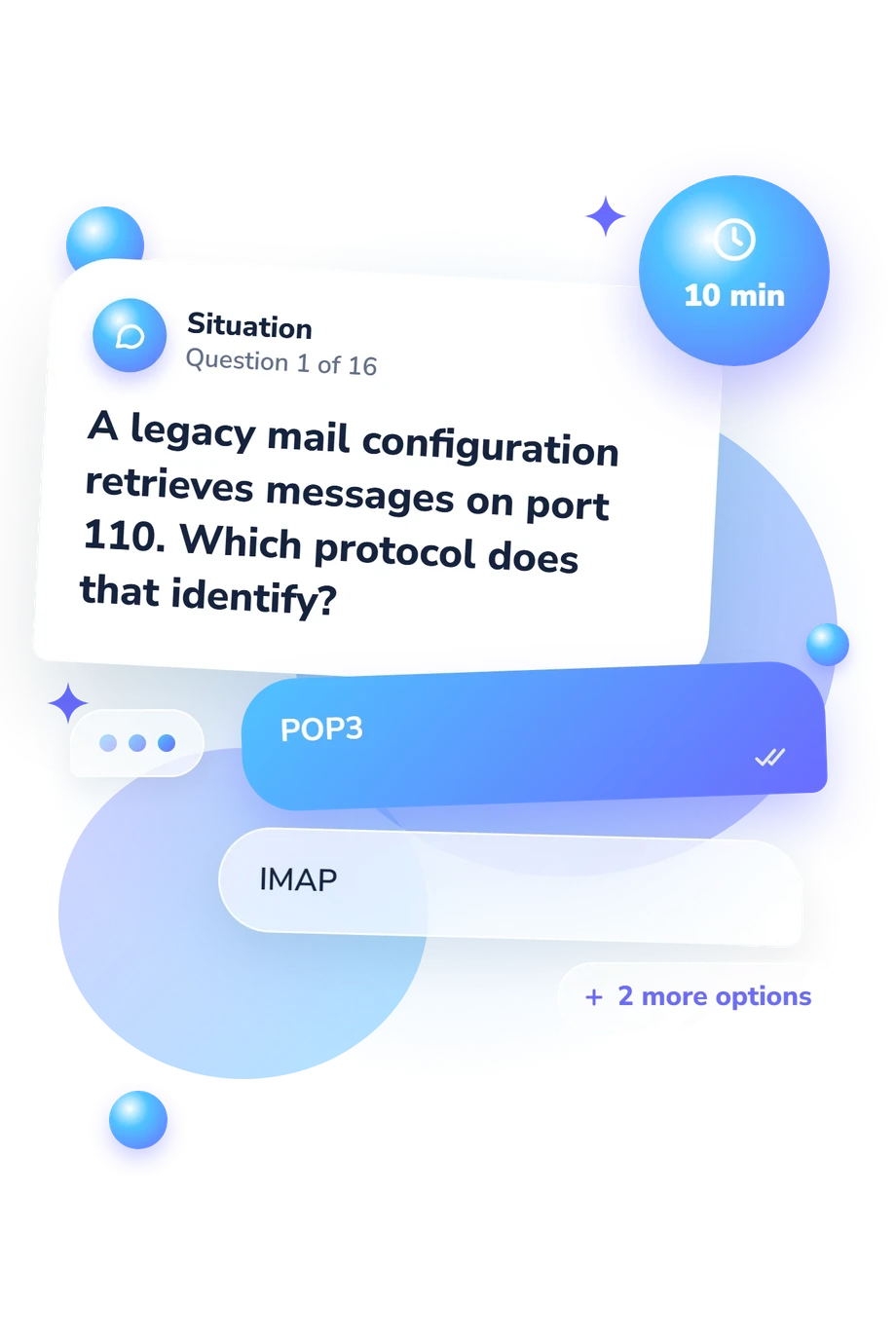
- POP3
- IMAP
- SMTP
- NNTP
- 53
- 68
- 69
- 67
- 110
- 993
- 995
- 143
Port Number Quiz - Description and methodology of the test
People who configure firewalls, study networking, or troubleshoot services can use this port number quiz to check whether familiar service names connect to the right default ports. It is intended for learners, junior administrators, and practitioners who want a focused knowledge check rather than a broad networking exam. This network port quiz gives learners a focused check of common service-port associations.
What This Test Measures
The questionnaire examines recognition of established service-port pairings used in everyday TCP and UDP networking. Its scenarios resemble firewall rules and routine service setup, so it is useful for learners and practitioners checking practical knowledge rather than broad networking theory.
The port quiz organizes its questions into three practical thematic groups:
- Web and email services show whether you connect HTTP, HTTPS, POP3, IMAP, and SMTP with their usual ports.
- Core infrastructure indicates how well you recognize DHCP, DNS, NTP, and SNMP associations used by shared network services.
- Administration and data services reveal recall of SSH, FTP, LDAP or LDAPS, RDP, and PostgreSQL endpoints.
Port Number Knowledge ranges from 0 to 16 and reflects correct answers about established default or well-known service ports; real systems may be configured differently. Foundational (0-6) points to core review, Developing (7-12) indicates useful knowledge with some gaps, and Strong (13-16) reflects accurate identification across practical scenarios.
Methodology and Evidence Base
Each item presents a networking scenario, four answer choices, and one best port or protocol association. The format tests recognition rather than packet capture, command-line configuration, or live-system diagnosis. The displayed result reflects correct answers about established default or well-known service ports.
The reference point is the IANA Service Name and Port Number Registry, which records service names, transport protocols, and assigned port numbers. RFC 6335 explains how these registrations are managed and why assigned values provide a standard reference. The questionnaire is conceptually consistent with those sources, but it is not a direct adaptation or standardized version of either publication.
This port number test presents a descriptive performance band summarizing recognition of established defaults across the service associations covered here. A strong result suggests accurate recall of common defaults across practical scenarios, while a lower result suggests that reviewing common service defaults may help. Because established defaults can differ from custom deployments, performance also varies with memory, wording, prior study, and familiarity with service conventions. Pair the result with hands-on configuration practice and broader technical assessment.
- Internet Assigned Numbers Authority (IANA). Service Name and Transport Protocol Port Number Registry. IANA, current version accessed September 23, 2026.
- Michelle Cotton, Lars Eggert, Joe Touch, Magnus Westerlund, and Stuart Cheshire. Internet Assigned Numbers Authority (IANA) Procedures for the Management of the Service Name and Transport Protocol Port Number Registry. RFC 6335, Internet Engineering Task Force, August 2011. 10.17487/RFC6335
Updated: