
Poetry Quiz
How the Scales are Structured
Who Usually Takes This Test?
See How You Compare
Below is a preview of how scores are typically distributed across each scale.
Example Questions From the Test
- Blank verse
- Free verse
- Heroic couplets
- A prose poem
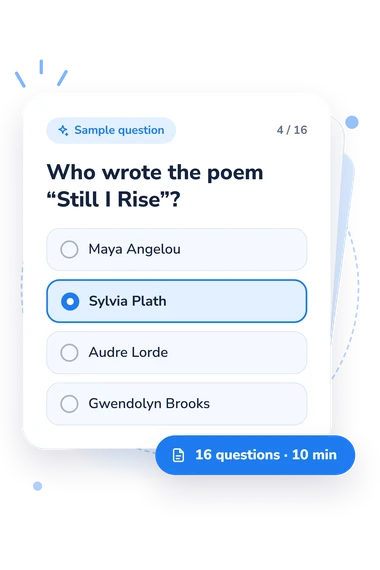
- Maya Angelou
- Sylvia Plath
- Audre Lorde
- Gwendolyn Brooks
- Edmund Spenser
- William Blake
- John Milton
- Geoffrey Chaucer
Poetry Quiz - Description and methodology of the test
Readers who want to check how confidently they recognize poetic form, language, sound, and literary history can use the poetry quiz as a focused knowledge check. It suits learners, teachers, and curious readers seeking a clear starting point for further study. The overall result from this poem quiz can indicate whether further study may be useful.
What This Assessment Explores
The assessment focuses on whether a reader can recognize how poems work, rather than on personal taste or creative writing ability. Its poem quiz questions combine terminology, brief situations, quoted lines, and author-and-work prompts.
The items represent these main dimensions:
- Forms and structure show whether you distinguish dramatic monologue, blank verse, sonnets, and enjambment.
- Poetic devices show whether you identify metaphor, simile, alliteration, and related techniques.
- Meter and rhyme show whether you recognize stress patterns, metrical feet, rhyme schemes, and near rhyme.
- Literary history shows whether you connect influential poets with major works and traditions.
Together, these dimensions produce the Poetry Knowledge scale, scored from 0-16: Emerging Foundation (0-6) indicates concepts that need reinforcement; Developing Range (7-12) reflects recognition with some gaps; Strong Command (13-16) indicates broad, consistent knowledge of poetic language, structure, analysis, and literary history.
Methodology and Evidence Base
Each item presents a short literary situation, definition, quotation, or author-and-work prompt with four answer choices. The respondent selects the best answer from related alternatives, so the format emphasizes recognition of concepts and examples rather than extended written analysis. Results are summarized as one displayed overall score with no displayed subscale scores.
The questionnaire is conceptually consistent with Turner’s study of poetry-analysis knowledge but is not an adaptation of it. Greene and colleagues provide a reference framework for terminology used here, including dramatic monologue, volta, enjambment, meter, rhyme, and figurative comparison.
As a poetry knowledge test, this questionnaire’s overall result can indicate whether further study may be useful, without identifying separate topic-level strengths or gaps. The score describes performance on this set of questions, not overall literary ability. Prior reading, memory, attention, and uncertainty between plausible options can affect performance; the result should therefore be interpreted as performance on this question set, which samples poetic form, sound, figurative language, and literary history.
- Ellen Turner. “An investigation into students’ attitudes towards the value of poetry and their knowledge of poetry analysis.” Lund Journal of English Studies, vol. 1, 2020, pp. 58-92. 10.48148/ljes.v1i.22275
- Roland Greene, Stephen Cushman, Clare Cavanagh, Jahan Ramazani, Paul Rouzer, Harris Feinsod, David Marno, and Alexandra Slessarev, editors. The Princeton Encyclopedia of Poetry and Poetics: Fourth Edition. Princeton University Press, 2012. 10.1515/9781400841424