
Phone Ready Quiz
How the Scales are Structured
Who Usually Takes This Test?
See How You Compare
Below is a preview of how scores are typically distributed across each scale.
Example Questions From the Test
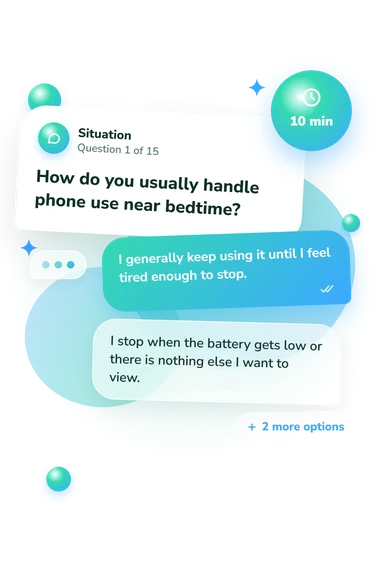
- I generally keep using it until I feel tired enough to stop.
- I stop when the battery gets low or there is nothing else I want to view.
- I choose a rough stopping time and follow it on most nights.
- I have a reliable stopping and charging routine that protects my sleep time.
- Keep chatting while avoiding only the questions that feel too personal.
- Share limited information first to work out whether they seem trustworthy.
- Stop responding and ask a trusted person for perspective before doing anything else.
- Do not share the material, preserve relevant evidence if needed, and block or report the contact.
- Send several quick messages so my point is completely clear.
- Stop replying and wait for the other person to restart the conversation.
- Pause until I am calmer, then send a more considered response.
- Suggest a call or in-person conversation when text is making the conflict harder.
Phone Ready Quiz - Description and methodology of the test
For families considering a first personal device, the Phone Ready Quiz offers a structured way to think about whether a young person is prepared for everyday phone responsibilities. It focuses on habits and judgment that matter beyond simply wanting a device. Someone facing the question-Am I ready for a phone quiz?-can use the result to discuss expectations, supervision, and gradual independence.
What the Questionnaire Measures
Readiness means more than operating a device. The questions examine expectations, attention, communication, maintenance, privacy, unfamiliar contacts, and changing plans. They suit a young person considering a first phone, while allowing for different levels of support. For a parent facing the question-Is my child ready for a phone quiz?-this quiz shows where practice may help.
The result uses three catalogue scales:
- Communication and Accountability (0-15) shows handling of expectations, conflicts, mistakes, and phone use around others. Bands: Shared Structure Helpful (0-5), Building Reliability (6-10), and Consistent Accountability (11-15).
- Device Self-Management (0-15) reflects charging, limits, attention, maintenance, and disruptions. Bands: Support Needed (0-5), Developing Routines (6-10), and Established Management (11-15).
- Digital Judgment and Privacy (0-15) reflects checking requests, protecting information, spotting risk, and respecting boundaries. Bands: Guidance Important (0-5), Growing Judgment (6-10), and Thoughtful Digital Decisions (11-15).
Methodology and Scientific Basis
Each item presents an everyday situation with four response options. Choices cover preparation, independence, communication, and caution in scenarios involving bedtime use, urgent messages, public networks, permissions, shared activities, lost devices, and unexpected costs. Responses are grouped into three displayed scales, but no rule states how each option contributes points, so answer values should not be reverse-engineered.
This is an original, scenario-based online self-reflection questionnaire with catalogue-defined scales, not a published instrument or adaptation; it has no established instrument-level validation or standardized norms. Moreno et al. (2019) provide context for smartphone ownership and family expectations; Richter et al. (2022) discuss readiness and age decisions. Shin and Kang (2016) cover privacy, disclosure, guidance, and online risk, while Radesky (2022) addresses practical first-phone considerations. Together, they offer context rather than validating this scoring.
Because the question-What age should I get a phone quiz?-has no universal answer about phone ownership, use the profile to identify routines, conversations, and safeguards to revisit. Self-report can reflect current circumstances, self-awareness, and willingness to disclose; the questionnaire offers no guarantee of behavior in every setting.
- Moreno, M. A., Kerr, B. R., Jenkins, M., Lam, E., & Malik, F. S. (2019). Perspectives on Smartphone Ownership and Use by Early Adolescents. Journal of Adolescent Health, 64(4), 437-442. DOI 10.1016/j.jadohealth.2018.08.017
- Richter, A., Adkins, V., & Selkie, E. (2022). Youth Perspectives on the Recommended Age of Mobile Phone Adoption: Survey Study. JMIR Pediatrics and Parenting, 5(4), e40704. DOI 10.2196/40704
- Shin, W., & Kang, H. (2016). Adolescents' Privacy Concerns and Information Disclosure Online: The Role of Parents and the Internet. Computers in Human Behavior, 54, 114-123. DOI 10.1016/j.chb.2015.07.062
- Radesky, J. (2022). Your Child’s First Phone: Are They Ready?, American Academy of Pediatrics.