
PE Quiz
How the Scales are Structured
Who Usually Takes This Test?
See How You Compare
Below is a preview of how scores are typically distributed across each scale.
Example Questions From the Test
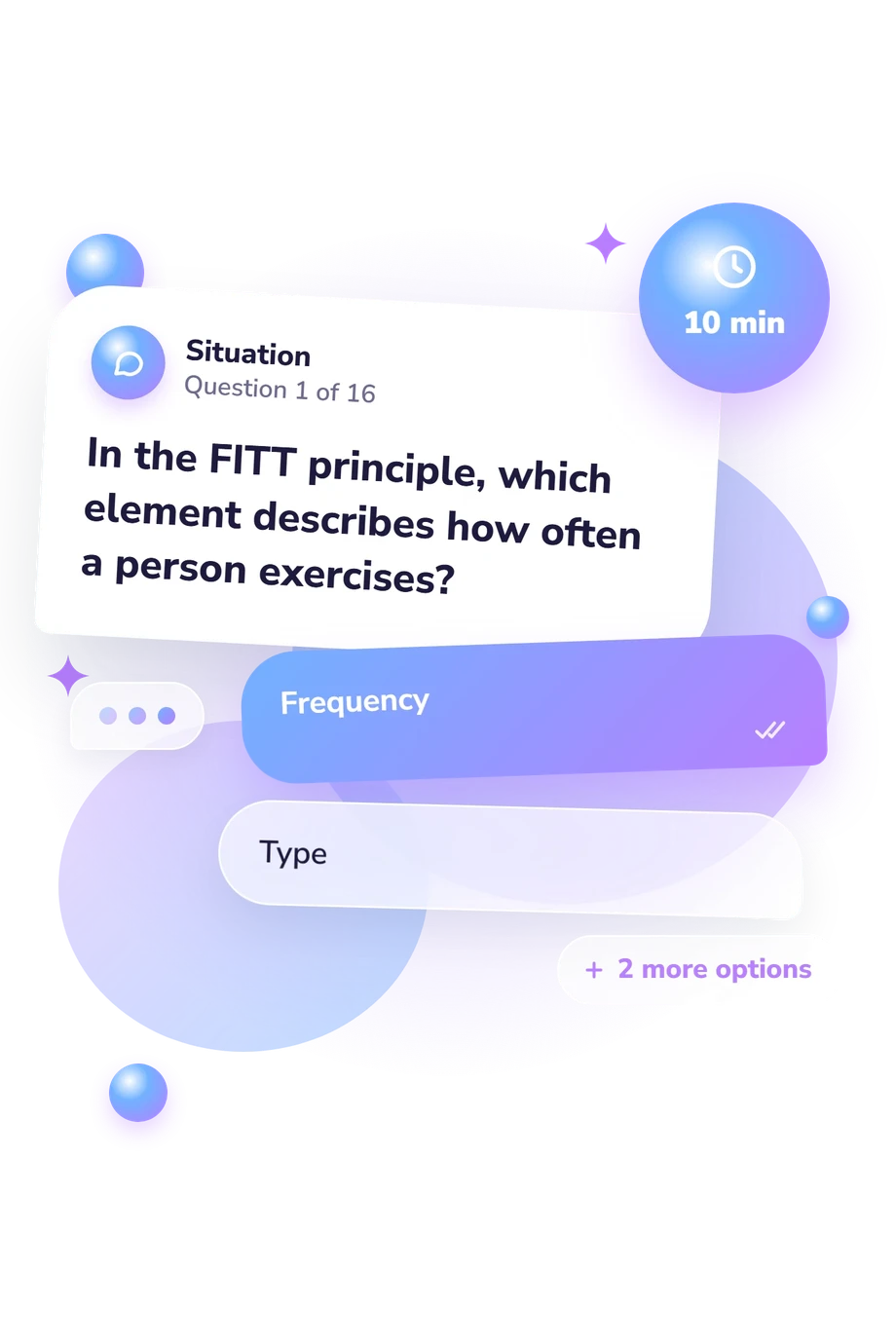
- Frequency
- Type
- Intensity
- Time
- Remaining seated but changing chairs
- Waiting until the weekend to do all planned movement
- Taking a short active break to walk and move the major joints
- Replacing sleep with a late-night intense workout
- Stopping suddenly and sitting down immediately
- Beginning another maximum-effort activity
- Walking slowly and allowing breathing to settle
- Holding the breath while standing still
PE Quiz - Description and methodology of the test
For learners, educators, or anyone reviewing practical physical-education knowledge, the PE Quiz turns familiar activity decisions into a structured self-assessment. This physical education quiz checks whether learners can apply classroom concepts to everyday activity choices, helping them guide study or lesson preparation from the result rather than treating one score as a complete picture.
What This Assessment Explores
This assessment examines applied knowledge rather than athletic performance. The questions connect concepts with situations: adding useful movement, recognizing training principles, interpreting exercise intensity, warming up, recovering, staying hydrated, using safe technique, and responding appropriately to pain or an opponent’s fall. Sportsmanship and fitness vocabulary broaden the result beyond exercise physiology.
Learners can use this assessment as a PE knowledge quiz to test recognition of sound physical-education practices. It measures knowledge about activity and participation, not physical ability.
The result is reported on the PE Knowledge scale (0-16), with three bands:
- Foundations to build (0-6) indicates that some ideas are recognized, while core principles need review.
- Developing knowledge (7-12) indicates understanding of many concepts, with gaps in applications.
- Strong knowledge (13-16) indicates a consistent grasp of concepts and their practical use.
Methodology and Scientific Basis
Each item presents a short situation or concept with four alternatives, and the respondent selects the best answer. The overall score summarizes performance across the item set; it does not estimate athletic ability or depend on self-rated fitness. This makes the PE test a direct knowledge check, although uncertainty can remain when two choices seem plausible.
Its content is conceptually consistent with PEKQ-S (Pastor-Cisneros et al., 2025), a published physical-education knowledge questionnaire, but this questionnaire is not PEKQ-S: validation findings for that instrument do not establish validity for this online version, so PEKQ-S serves only as contextual support. The topics also reflect the educational framework described by Couturier, Chepko, and Holt/Hale (2014), while the hydration guidance is consistent with exercise-fluid principles from the American College of Sports Medicine and colleagues (2007).
No population norms, reliability estimates, or clinical cutoffs are provided for this version, so the displayed bands are interpretive categories rather than standardized rankings. Guessing, reading comprehension, previous instruction, and familiarity with terminology can affect performance. Use the result to identify learning priorities, not as a complete measure of competence.
- Pastor-Cisneros, R., Mendoza-Muñoz, M., López-Gil, J. F., & Carlos-Vivas, J. (2026). Development of the physical education knowledge questionnaire-Spain (PEKQ-S): feasibility, validity and reliability for Spanish children aged 6-12 years. Frontiers in Sports and Active Living, 7, 1737905. 10.3389/fspor.2025.1737905
- Couturier, L. M., Chepko, S., & Holt/Hale, S. A. (2014). National standards & grade-level outcomes for K-12 physical education. Champaign, IL: Human Kinetics.
- American College of Sports Medicine, Sawka, M. N., Burke, L. M., Eichner, E. R., Maughan, R. J., Montain, S. J., & Stachenfeld, N. S. (2007). American College of Sports Medicine position stand. Exercise and fluid replacement. Medicine & Science in Sports & Exercise, 39(2), 377-390. 10.1249/mss.0b013e31802ca597
Updated: