
Newton's Laws Quiz
How the Scales are Structured
Who Usually Takes This Test?
See How You Compare
Below is a preview of how scores are typically distributed across each scale.
Example Questions From the Test
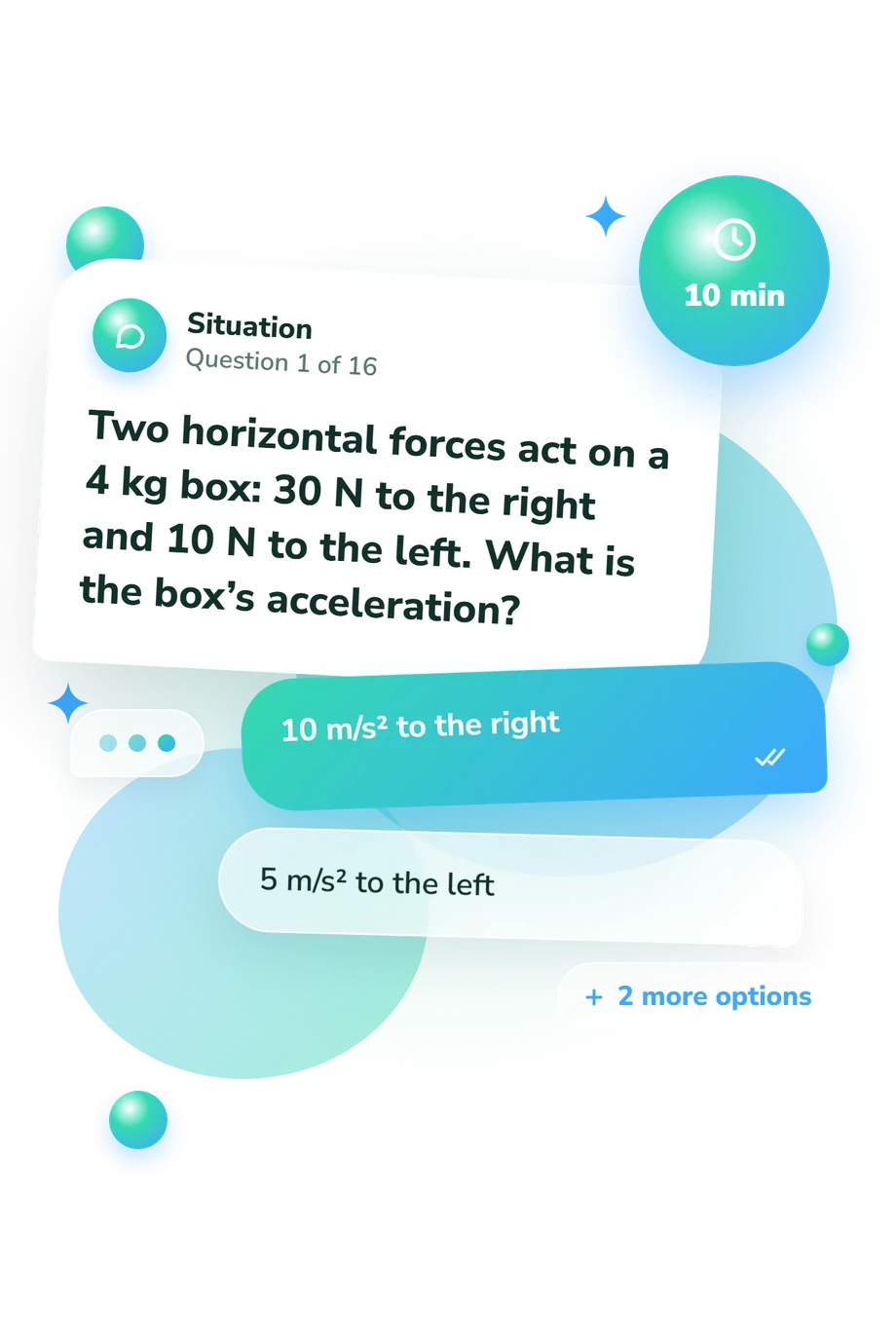
- 10 m/s² to the right
- 5 m/s² to the left
- 5 m/s² to the right
- 0 m/s² because both forces are horizontal
- 8 m/s²
- 33 m/s²
- 3 m/s²
- 48 m/s²
- It moves at constant velocity because the force is constant.
- Its mass gradually decreases as its speed increases.
- It accelerates in the direction opposite the net force.
- It accelerates in the direction of the net force.
Newton's Laws Quiz - Description and methodology of the test
Students revising classical mechanics, teachers checking conceptual understanding, and curious learners can use Newtons Laws Quiz to connect equations with physical situations. When taking this Newton’s Laws of Motion quiz, you can see whether net force, inertia, and acceleration make sense beyond memorized definitions. The result highlights concepts worth revisiting through examples such as braking passengers, carts, and colliding vehicles.
What This Assessment Measures
Questions test recognition of Newtonian mechanics in situations, not recall alone. This Newton’s Laws assessment is a law of motion quiz combining conceptual judgments with calculations about force, mass, acceleration, and net force. Scenarios cover braking, constant velocity, elevators, collisions, and propulsion.
The main themes are:
- Inertia and balance show whether zero net force allows rest or constant velocity.
- Force, mass, and acceleration show whether acceleration follows net force in size and direction.
- Interaction pairs show whether equal and opposite forces belong to different bodies.
Newton’s Laws Knowledge is the single scale, scored 0-16. Foundations to build (0-6) marks core ideas to review; Developing understanding (7-12) reflects partial application; Strong understanding (13-16) reflects accurate application across calculations and scenarios. It is educational feedback, not an official physics qualification.
Methodology and Evidence Base
Each item presents a brief physical situation and four answer choices. The learner may calculate acceleration, identify net force, explain motion during braking, or distinguish balanced forces from an action-reaction pair. Responses are combined into the single knowledge result; the themes do not receive separate displayed scores.
The approach is conceptually consistent with the Force Concept Inventory, which targets common alternative ideas in introductory mechanics. This questionnaire is not presented as an adaptation of that instrument. Newton’s Principia supplies the classical framework for the three laws, while Bao and Fritchman’s 2021 study is relevant to the way action-reaction wording can invite causal confusion. Together, the questions turn this into a practical Newtons 3 Laws Quiz: reasoning about objects and interactions matters more than merely naming a law.
The score bands provide educational guidance, and the result is not an official physics qualification. They can show which ideas deserve practice, but a single online result cannot establish durable mastery. Guessing, attention, prior coursework, and the learner’s reading of a short scenario may all affect performance, so the result is best considered alongside worked problems or classroom evidence.
- Hestenes, David, Malcolm Wells, and Gregg Swackhamer. "Force concept inventory." The Physics Teacher 30, no. 3 (1992): 141-158. 10.1119/1.2343497.
- Newton, Isaac. Sir Isaac Newton's Mathematical Principles of Natural Philosophy and His System of the World. Translated by Andrew Motte and revised by Florian Cajori. University of California Press, 1934.
- Bao, Lei, and Joseph C. Fritchman. "Knowledge integration in student learning of Newton's third law: Addressing the action-reaction language and the implied causality." Physical Review Physics Education Research 17, no. 2 (2021): 020116. 10.1103/PhysRevPhysEducRes.17.020116
Updated: