
My YouTuber Boyfriend Quiz
How the Scales are Structured
Who Usually Takes This Test?
See How You Compare
Below is a preview of how scores are typically distributed across each scale.
Example Questions From the Test
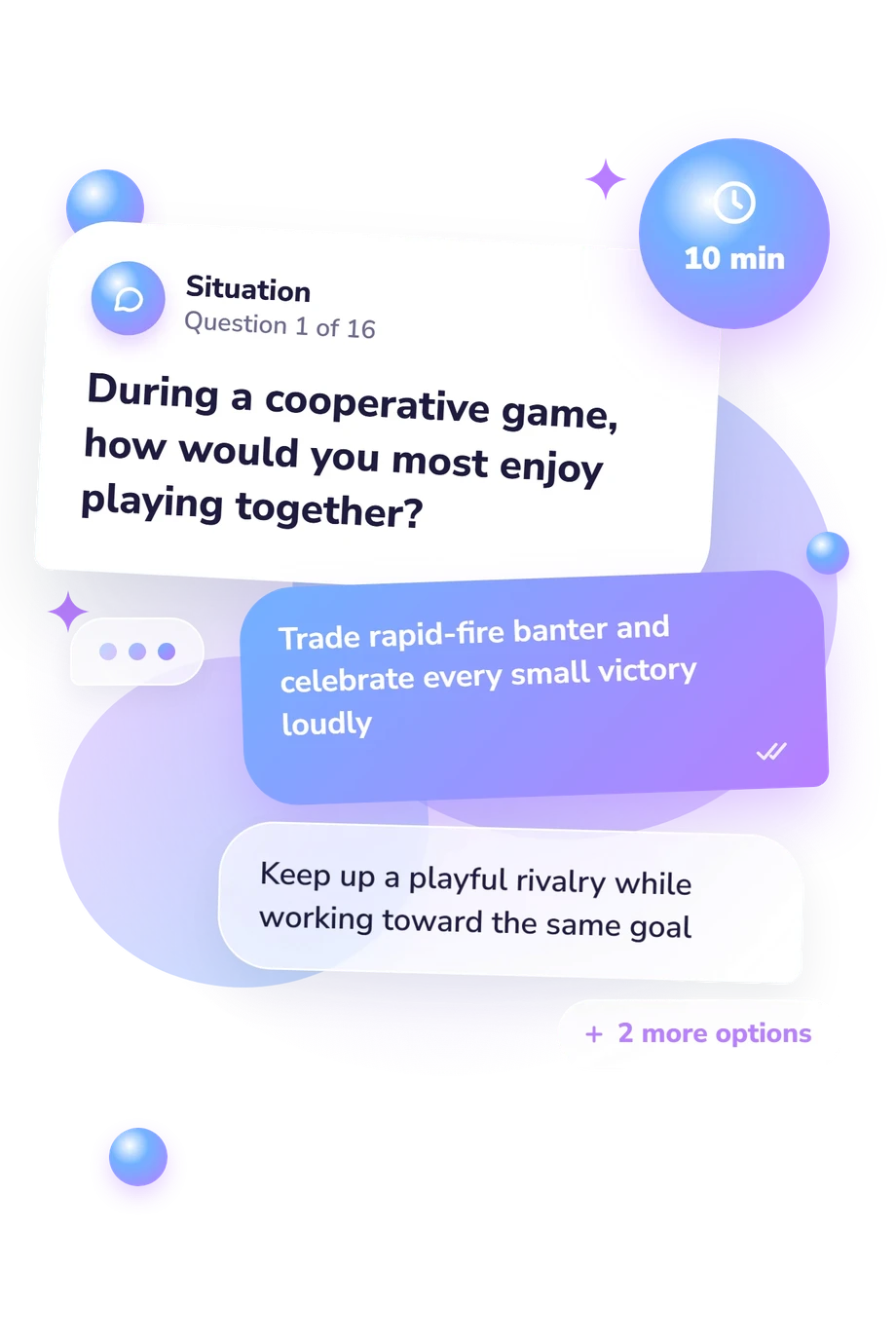
- Trade rapid-fire banter and celebrate every small victory loudly
- Keep up a playful rivalry while working toward the same goal
- Focus on strategy and talk mainly when coordination is needed
- Explore slowly and enjoy the atmosphere without much commentary
- A narrative horror game with dramatic reactions and running jokes
- A strange indie game with a memorable story to discuss afterward
- A fast competitive game that produces funny mistakes
- A calm travel or everyday-life video
- Big expressive humor followed by direct, heartfelt encouragement
- Playful chaos that ends on an optimistic note
- Gentle comedy followed by a thoughtful observation
- A consistently calm tone without a major emotional shift
My YouTuber Boyfriend Quiz - Description and methodology of the test
People who want a playful way to compare relationship preferences with creator-inspired personalities can use the My YouTuber Boyfriend Quiz as a guided self-reflection exercise. It suits viewers curious about who my YouTuber boyfriend might be, especially when humor, conversation, teamwork, and shared activities matter more than a literal prediction. The result describes a fictional style that fits the choices you make.
What This Assessment Explores
The scenarios examine how you respond to ordinary shared moments, including games, parties, creative projects, stressful weeks, and unexpected changes of plan. They are aimed at viewers who want to compare preferred relationship energy with familiar online-persona styles. In this YouTube boyfriend quiz, the result dimensions are:
- Dan Howell Affinity (0-12) shows whether dry humor, introspection, and internet-culture conversation suit you: Different wavelength (0-4), Wry connection (5-8), or Existential match (9-12).
- Jacksepticeye Affinity (0-12) reflects your fit with expressive encouragement and rapid banter: Different wavelength (0-4), Upbeat connection (5-8), or High-energy match (9-12).
- Markiplier Affinity (0-12) measures appeal of theatrical gaming and heartfelt creativity: Different wavelength (0-4), Creative connection (5-8), or Theatrical match (9-12).
- MrBeast Affinity (0-12) captures attraction to ambitious teamwork and large-scale experiences: Different wavelength (0-4), Shared spark (5-8), or Spectacle match (9-12).
Methodology and Evidence Base
Each item presents a situation with four preferences or reactions. The options contrast energetic banter, thoughtful discussion, theatrical humor, practical coordination, and quiet companionship. Selections across four fictional profiles create comparative affinity scores, not one personality total.
The highest score identifies the strongest match. Scores within one point of the highest are interpreted as a blended result. For anyone wondering who your YouTube boyfriend might be, this makes the outcome a comparison of chosen interaction patterns.
Tolbert and Drogos (2019) provide the closest context for audience identification with YouTube creators and one-sided media relationships. Hoffner and Buchanan (2005) connect wishful identification with perceived similarity and character attributes, while Rihl and Wegener (2019) examine parasocial interaction and audience feedback around YouTube celebrities. This questionnaire is conceptually consistent with those works, but it is not an adaptation or validation of a published instrument.
As an online self-report tool, it uses catalogue-defined bands rather than established population norms. Current mood, familiarity with public personas, and preferred self-image may influence answers, so the result is a current preference profile rather than a clinical conclusion.
- Tolbert, Amanda N., and Kristin L. Drogos. “Tweens’ Wishful Identification and Parasocial Relationships With YouTubers.” Frontiers in Psychology 10 (2019): 2781. 10.3389/fpsyg.2019.02781
- Hoffner, Cynthia, and Martha Buchanan. “Young Adults’ Wishful Identification With Television Characters: The Role of Perceived Similarity and Character Attributes.” Media Psychology 7, no. 4 (2005): 325-351. 10.1207/S1532785XMEP0704_2
- Rihl, Alexander, and Claudia Wegener. “YouTube Celebrities and Parasocial Interaction: Using Feedback Channels in Mediatized Relationships.” Convergence 25, no. 3 (2019): 554-566. 10.1177/1354856517736976
Updated: