
Muscular System Quiz
How the Scales are Structured
Who Usually Takes This Test?
See How You Compare
Below is a preview of how scores are typically distributed across each scale.
Example Questions From the Test
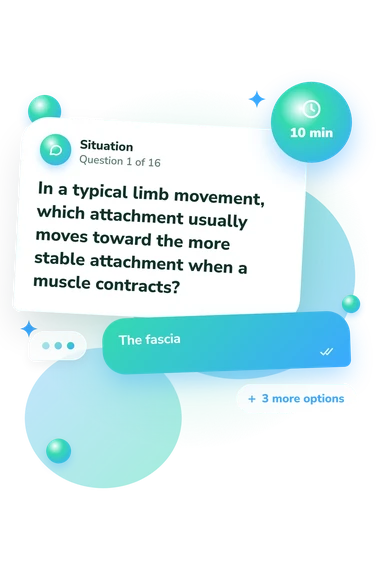
- The fascia
- The origin
- The insertion
- The ligament
- It relaxes and rises, reducing chest volume
- It contracts and rises, reducing chest volume
- It relaxes and flattens, increasing chest volume
- It contracts and flattens, increasing chest volume
- Sarcomere
- Fascicle
- Tendon
- Motor neuron
Muscular System Quiz - Description and methodology of the test
Students, trainees, and curious learners can use this muscular system quiz to check how well they connect muscle structure with movement and contraction. This assessment provides a focused knowledge snapshot for anyone reviewing foundational anatomy or physiology. Your quiz answers about the muscular system can point to concepts worth revisiting, from tissue types and motor units to the mechanics that make movement possible.
What This Assessment Measures
The assessment checks educational knowledge of muscle organization, tissue types, contraction, and movement rather than symptoms or treatment. It suits learners reviewing anatomy and physiology who want to connect facts about structures, signaling, and force production.
Questions touch on origins and insertions, tendons, sarcomeres, motor units, muscle tissues, neuromuscular signaling, muscle spindles, agonists, antagonists, and three contraction types. As a muscle anatomy quiz, it reflects breadth and accuracy of knowledge rather than strength, fitness, or disease.
The result uses the Muscular System Knowledge scale (0-16) and shows three levels:
- Foundational (0-6) indicates basic recognition with key topics to review.
- Developing (7-12) indicates useful working knowledge with details to strengthen.
- Strong (13-16) indicates broad, accurate understanding of muscle structures and functions.
Methodology and Evidence Base
Across this muscular system test, each item presents a short anatomy or physiology situation with four answer choices and one best response. The format combines recognition with application: questions ask for terms or require interpretation of inhalation, reflexes, cross-bridge cycling, and controlled movement. Scoring is direct: every correct answer contributes one point to a total of correct responses.
The content is conceptually consistent with Betts et al. (2022), which covers muscle tissues, organization, signaling, and contraction tested through questions about anatomy and physiology. It also aligns with Huxley and Niedergerke (1954) on structural changes associated with muscle-fiber contraction. The questionnaire is not an adaptation of either work, and no psychometric validation is stated for it.
Interpretation is simple: a higher total means more tested concepts were answered correctly, while an error may mark a narrow gap rather than a general weakness. No stated population norms, reliability estimates, or diagnostic threshold accompany the questionnaire; prior instruction, guessing, and momentary attention can also affect performance. Use the result to guide topic review, not conclusions about medical status.
- Betts, J. Gordon, Kelly A. Young, James A. Wise, Eddie Johnson, Brandon Poe, Dean H. Kruse, Oksana Korol, Jody E. Johnson, Mark Womble, and Peter Desaix. Anatomy and Physiology 2e. OpenStax, Houston, Texas, 2022.
- Huxley, A. F., and R. Niedergerke. "Structural Changes in Muscle During Contraction: Interference Microscopy of Living Muscle Fibres." Nature, vol. 173, no. 4412, 1954, pp. 971-973. 10.1038/173971a0
Updated: