
Millennial Quiz
How the Scales are Structured
Who Usually Takes This Test?
See How You Compare
Below is a preview of how scores are typically distributed across each scale.
Example Questions From the Test
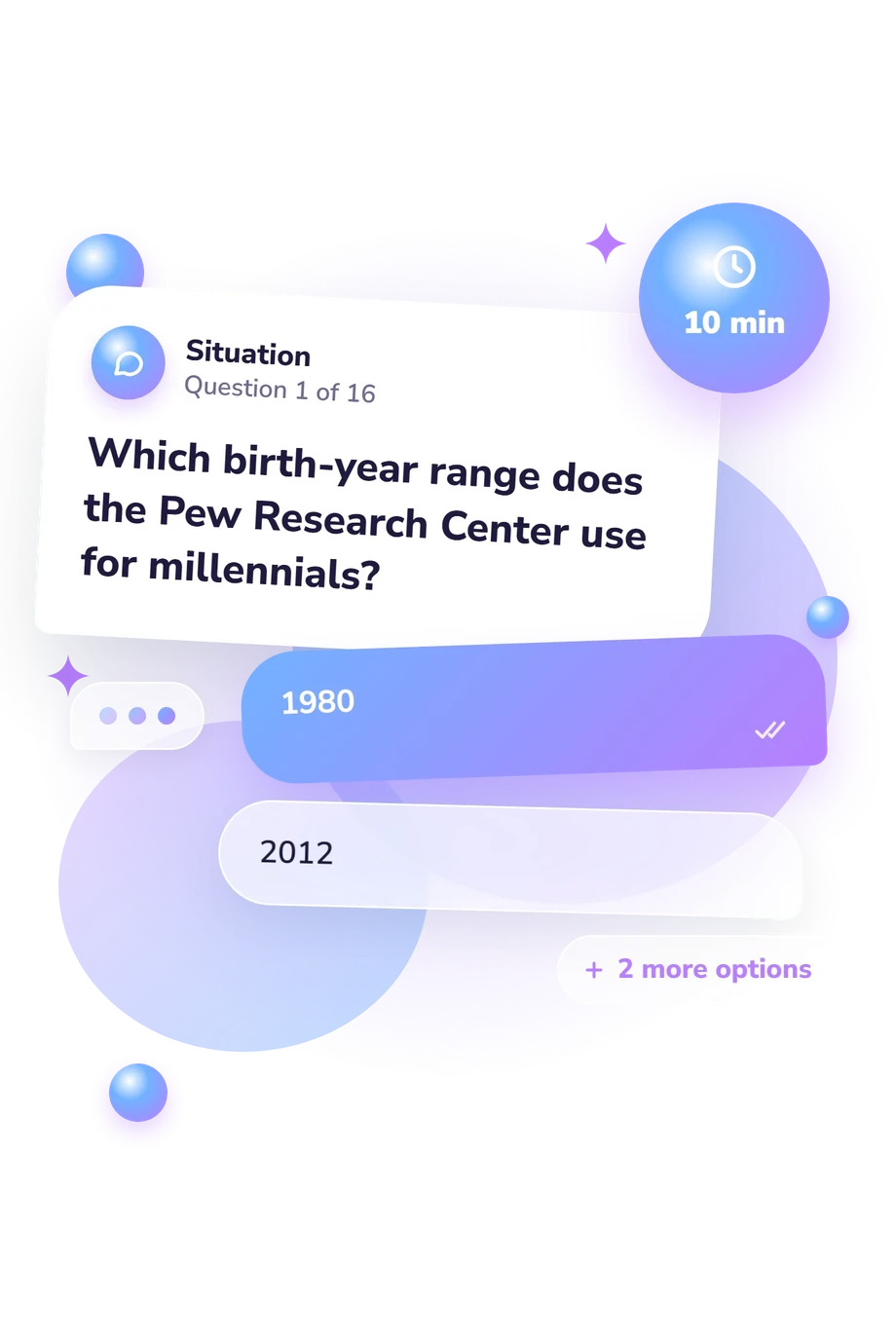
- 1980
- 2012
- 1996
- 1964
- Share digital music files through a peer-to-peer service
- Buy individual songs directly from record labels
- Create short looping videos for mobile phones
- Stream subscription television without downloading files
- The News Feed
- The Top 8
- The Close Friends story
- The Following list
Millennial Quiz - Description and methodology of the test
Designed for readers who enjoy cultural history and want to test familiarity with a cohort’s defining touchstones, the Millennial Quiz turns everyday memories into a focused knowledge check. It suits anyone who wants a quiz about the millennial generation, whether they lived through these changes or encountered them later. The result summarizes recognition of major references while keeping cultural knowledge separate from personal generational identity.
What This Assessment Explores
Rather than assigning a generational identity, the questionnaire measures recognition of cultural and technological markers associated with millennial-era life. Its questions move through dial-up internet, early social platforms, physical media, smartphones, video games, films, Y2K, economic change, and generational terminology. The reader may know these touchstones from personal experience, education, or later cultural exposure.
Taken together, the questions in a quiz about millennials examine whether a respondent recognizes these references, not whether they possess a particular identity. The single displayed scale organizes the result in three bands:
- Millennial Knowledge (0-16) shows how accurately the respondent recognizes touchstones across technology, media, history, and pop culture; Starting Point (0-6) indicates some familiarity, Developing Knowledge (7-12) indicates many recognized touchstones with details to strengthen, and Trivia Standout (13-16) indicates broad, accurate coverage. The score measures trivia knowledge, not generational identity.
Methodology and Evidence Base
Each prompt presents a short historical or cultural scenario with four answer choices, so the questions and answers for a quiz about millennials operate as a best-response knowledge check rather than a self-rating inventory. The format tests recognition through selected responses; it does not ask the reader to rate symptoms, attitudes, or personality traits.
The displayed outcome is one aggregate knowledge score, not a multi-trait profile. Because the scoring presentation does not establish psychometric norms or reliability estimates, the result is best read as a structured snapshot of familiarity with the chosen material.
Schulz et al. (2019) offers the closest conceptual context for discussing millennials through media, technology, and social experience. Pew Research Center (2014) and Dimock (2019) support the cohort framing and boundary convention used by several prompts, while Howe and Strauss (2000) represents an earlier generational framework. These sources support the questionnaire’s subject matter and framing; they do not make this online tool a standardized adaptation of any one published instrument.
Performance can vary with media exposure, education, memory, and personal interest, and a wrong answer may reflect unfamiliarity with a reference rather than lack of cultural understanding.
- Schulz, Jeremy, Laura Robinson, Aneka Khilnani, John Baldwin, Heloisa Pait, Apryl A. Williams, Jenny Davis, and Gabe Ignatow, eds. Mediated Millennials. Studies in Media and Communications, vol. 19. Emerald Publishing Limited, 2019. 10.1108/S2050-2060201919
- Pew Research Center. Millennials in Adulthood: Detached from Institutions, Networked with Friends. Pew Research Center, 2014.
- Dimock, Michael. Defining Generations: Where Millennials End and Generation Z Begins. Pew Research Center, 2019.
- Howe, Neil, and William Strauss. Millennials Rising: The Next Great Generation. Vintage Books, 2000.
Updated: