
Memory Quiz
How the Scales are Structured
Who Usually Takes This Test?
See How You Compare
Below is a preview of how scores are typically distributed across each scale.
Example Questions From the Test
- Prospective memory
- Iconic memory
- Semantic memory
- Procedural memory
- Retroactive interference
- The misinformation effect
- Proactive interference
- Source confusion
- Procedural memory
- Semantic memory
- Episodic memory
- Working memory
Memory Quiz - Description and methodology of the test
Designed for readers who want to understand how remembering works, this memory quiz offers a focused way to check knowledge of core memory systems, processes, and learning principles. It suits students, independent learners, and anyone reviewing study habits. The format keeps this memory test quiz free from clinical claims, so the result points to topics for further learning rather than personal ability.
What This Assessment Explores
Questions move across the main mechanisms that determine what is encoded, retained, retrieved, and altered by context. They include working, episodic, semantic, procedural, iconic, and prospective memory, as well as interference, spacing, retrieval practice, chunking, misinformation, and sleep-related consolidation.
The thematic groups represented here are:
- Memory systems show which forms support facts, personal events, skills, sensory traces, and future intentions.
- Learning principles show how spacing, retrieval practice, and chunking affect retention.
- Interference and context show why earlier learning, later learning, or surroundings can alter recall.
- Retrieval processes show how recognition, recall, rehearsal, consolidation, and encoding differ.
This is not a memory loss quiz; it checks concepts, not changes in everyday functioning. The displayed result is Memory Knowledge (0-16): Foundations to build (0-6), Developing knowledge (7-12), or Strong knowledge (13-16). The bands describe educational understanding, not memory ability or health.
Methodology and Scientific Basis
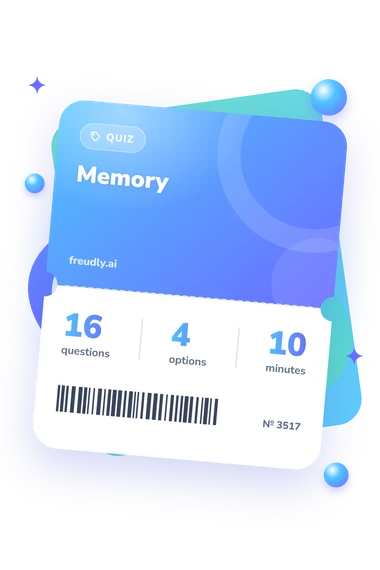
Each item presents a short question or learning scenario with four answer choices. The respondent selects the term or principle that best fits, distinguishing proactive from retroactive interference and recognition from recall.
Scoring is direct: each correct answer adds one point, and the total is read through the educational bands shown above. These are descriptors rather than population norms, so prior study, attention, guessing, and familiarity with terminology can affect the result.
Its conceptual framework is consistent with the memory systems and processes described by Baddeley, Eysenck, and Anderson (2020), but the online questionnaire is a separate item set, not an adaptation of that book. Roediger and Karpicke (2006) support retrieval practice, Cepeda and colleagues (2006) support distributed practice, and Rasch and Born (2013) explain sleep's relevance to consolidation. These sources support the content, not the quiz's own standardization or clinical validity.
Used as a memory knowledge quiz, it can identify topics for review and help organize study. Interpret the result with the person's context and goals, not as a fixed description of memory performance.
- Baddeley, Alan D., Michael W. Eysenck, and Michael C. Anderson. Memory. 3rd ed. Routledge, 2020. ISBN 978-1-138-32609-5.
- Roediger, Henry L., and Jeffrey D. Karpicke. “Test-enhanced learning: Taking memory tests improves long-term retention.” Psychological Science 17, no. 3 (2006): 249-255. 10.1111/j.1467-9280.2006.01693.x
- Cepeda, Nicholas J., Harold Pashler, Edward Vul, John T. Wixted, and Doug Rohrer. “Distributed practice in verbal recall tasks: A review and quantitative synthesis.” Psychological Bulletin 132, no. 3 (2006): 354-380. 10.1037/0033-2909.132.3.354
- Rasch, Bjorn, and Jan Born. “About Sleep’s Role in Memory.” Physiological Reviews 93, no. 2 (2013): 681-766. 10.1152/physrev.00032.2012