
Medication Administration Quiz
How the Scales are Structured
Who Usually Takes This Test?
See How You Compare
Below is a preview of how scores are typically distributed across each scale.
Example Questions From the Test
- The check may be completed after administration if the medication is time-sensitive
- The administrator should calculate the dose twice without showing the work to anyone
- A second person should confirm only that the medication name sounds correct
- A second qualified person should independently verify the required elements before administration according to policy
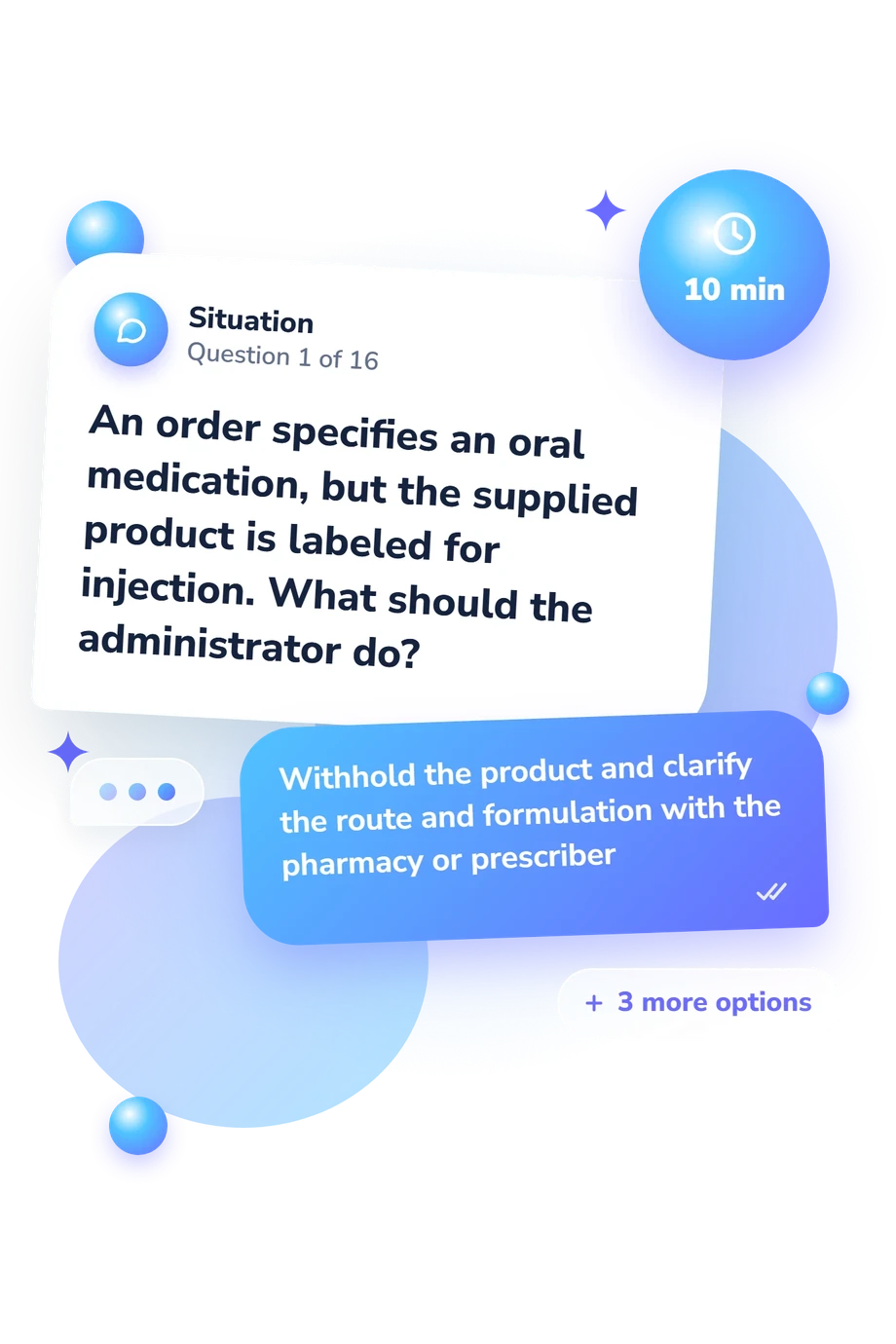
- Withhold the product and clarify the route and formulation with the pharmacy or prescriber
- Use the injectable product orally if the dose strength is equivalent
- Administer the product by injection because the manufacturer's label is more specific
- Ask the patient which route was used previously and follow that preference
- Confirm the patient's room number, compare the package with the administration record, and ask whether the medication looks familiar
- Use two approved patient identifiers, compare the medication with the current order and administration record, and check documented allergies
- Ask another staff member to recognize the patient, then verify the medication name on the package
- Use one approved identifier if the patient verbally confirms that the medication is expected
Medication Administration Quiz - Description and methodology of the test
People who handle or study medication administration can use the medication administration quiz to examine their reasoning in realistic safety decisions. This med administration quiz focuses on when a person should verify, clarify, pause, document, reassess, or escalate, helping identify areas for focused review and supervised discussion. It captures judgment in selected scenarios rather than hands-on competence and keeps local policy central.
What This Assessment Explores
These scenarios address prevention of avoidable medication errors before, during, and after administration. Medication safety questions test reasoning about when to verify, clarify, pause, document, reassess, or escalate, rather than observing practical handling.
The main content areas are:
- Patient and order verification requires matching identifiers, orders, allergies, and barcode alerts before proceeding.
- Preparation and administration safety covers routes, measurements, notation, expired products, dosage forms, vials, and interruptions.
- Documentation and reconciliation test reasoning about omitted doses, refusals, transitions, and reporting.
- Monitoring and urgent response assess follow-up after as-needed medication and action when serious reactions appear.
The result is reported on the Medication Administration Knowledge scale, 0-16, with Foundational gaps (0-6), Developing knowledge (7-12), and Strong knowledge (13-16). Foundational gaps indicate several core principles need review; Developing knowledge indicates generally safe understanding with some situations to revisit; Strong knowledge indicates consistent understanding of these general principles. It supports self-directed learning and workplace review.
Methodology and Evidence Base
Each item presents a clinical situation with four answer choices. The options contrast safer actions with plausible shortcuts, emphasizing applied judgment rather than isolated terms. Scenario-based prompts in this medication administration assessment can guide the respondent's own review of policy-dependent decisions, communication, and escalation.
The questionnaire displays one overall knowledge result; it does not claim a standardized competency cutoff or clinical validation. Read it as an educational indication, not evidence of hands-on competence.
Conceptually, this questionnaire is closest to the Goodstone Medication Administration Safety Assessment Tool because both address observable medication-safety decisions; this questionnaire is not an adaptation of that instrument. Work by Agoglia, Kelly, Kelman, and VanPatten connects to competency-based education and error reporting, while Billstein-Leber, Carrillo, Cassano, Moline, and Robertson addresses hospital medication-error prevention.
Responses can reflect current context, self-awareness, and scenario wording, while an online questionnaire cannot assess hands-on technique, patient-specific orders, or every local procedure. Use findings to direct review and supervised practice, following protocols when an error or serious reaction is suspected.
- Lori Goodstone and Michael S. Goodstone. Use of Simulation to Develop a Medication Administration Safety Assessment Tool. Clinical Simulation in Nursing, 9(12), e609-e615, 2013. 10.1016/j.ecns.2013.04.017
- Mary Agoglia, Kathleen Kelly, Glenda Kelman, and Rosemarie VanPatten. Competency-Based Medication Administration and Error Reporting. Journal of Nursing Education, 63(5), 320-327, 2024. 10.3928/01484834-20240305-07
- Molly Billstein-Leber, Jorge D. Carrillo, Angela T. Cassano, Kym Moline, and Jennifer J. Robertson. ASHP Guidelines on Preventing Medication Errors in Hospitals. American Journal of Health-System Pharmacy, 75(19), 1493-1517, 2018. 10.2146/ajhp170811
Updated: