
Medical Billing Quiz
How the Scales are Structured
Who Usually Takes This Test?
See How You Compare
Below is a preview of how scores are typically distributed across each scale.
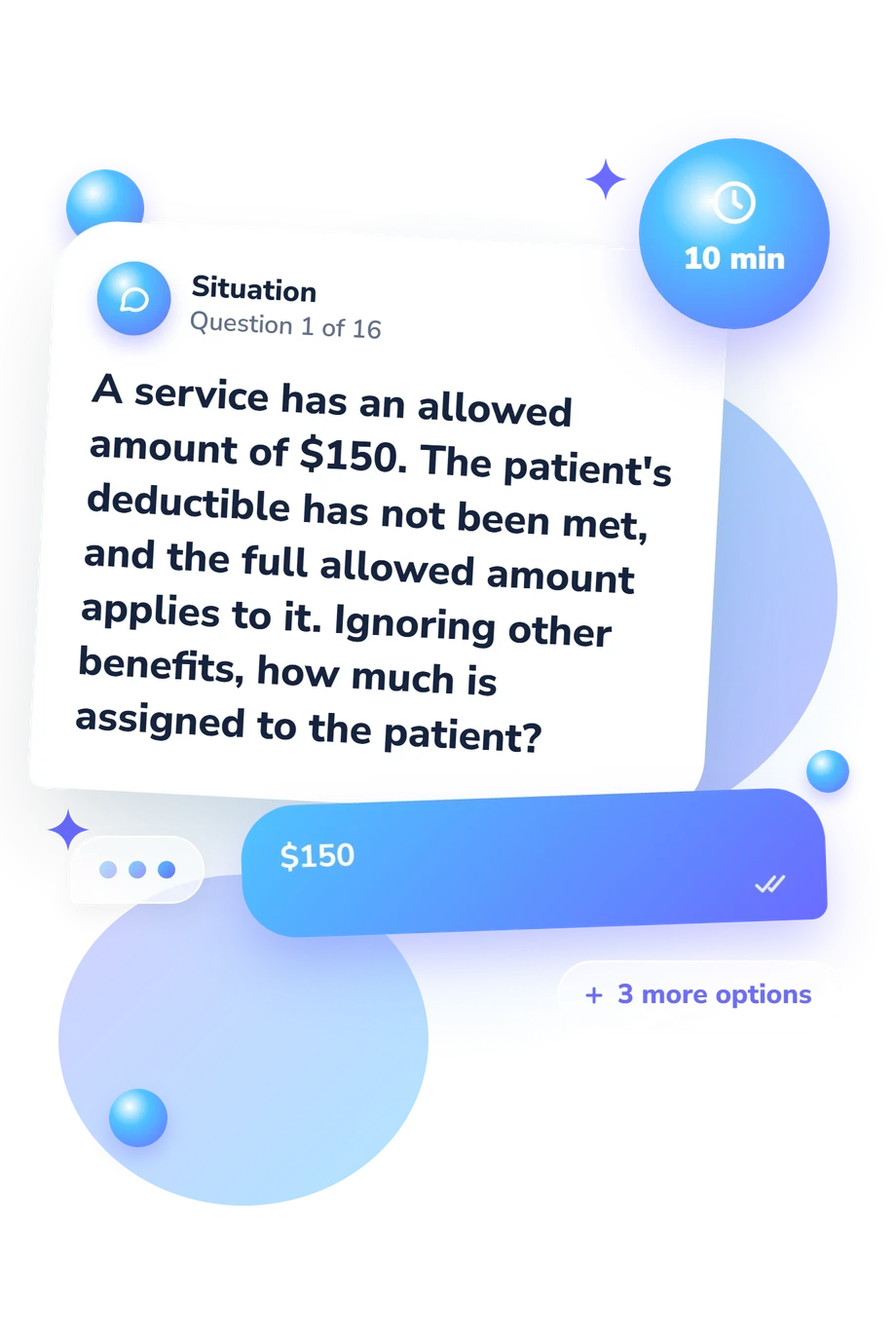
Example Questions From the Test
- CPT
- ICD-10-CM
- HCPCS Level II
- CDT
- ICD-10-PCS
- Revenue codes
- Place-of-service codes
- HCPCS Level II
- To describe medical procedures and professional services
- To identify the patient's insurance plan
- To explain why a claim was denied
- To record inpatient room charges only
Medical Billing Quiz - Description and methodology of the test
People who work with claims, coverage rules, and code sets can use a medical billing quiz to check whether their foundational knowledge matches common U.S. billing situations. It is suited to learners, new billers, and anyone reviewing core terminology before further study. The questions connect billing terminology with decisions about patient responsibility, claims, and payer requirements, giving this medical billing and coding quiz a practical focus.
What This Assessment Measures
The items test practical decisions about allowed amounts, deductibles, coinsurance, patient liability, coordination of benefits, authorization, denials, and filing limits. Questions in this medical billing terminology quiz also check recognition of CPT, ICD-10-CM, HCPCS Level II, NPI, modifiers, clean claims, EOBs, and ABNs.
These themes are thematic areas, not separate subscores:
- Claim and payment concepts show understanding of responsibility and allowed charges in common claims.
- Coding literacy indicates recognition of diagnosis, procedure, supply, and provider codes.
- Payer-process knowledge covers authorization, adjudication, denials, and filing limits before and after submission.
- Documentation and compliance awareness covers clean claims, modifiers, notices, and supporting records.
Together, they suit learners and new billers who want to connect terminology with routine claim-handling choices.
Methodology and Evidence Base
Each item presents a billing scenario with four answer choices. As a medical billing knowledge test, it presents one Medical Billing Knowledge result from 0-16, not separate subscores. Foundation Builder (0-6) means some billing concepts are recognized and review of code-set roles, claim terminology, and payer processes may help; Developing Knowledge (7-12) shows many essentials with room for targeted review; Strong Knowledge (13-16) shows solid command of foundational U.S. concepts and common scenarios. This educational result is not a professional credential; current official coding guidance and payer policies should be verified.
Content is conceptually consistent with Smith and Fassett (2024), whose work covers medical insurance and billing terminology and workflow; this questionnaire is not its adaptation. CMS guidance in the Medicare Claims Processing Manual covers claims, coding, provider identifiers, and filing rules; Chapter 30 addresses financial-liability protections and ABNs. Bang and Bahl (2018) offer limited coding-education context, not validation or bands.
Performance may reflect recent study, payer conventions, attention, and question interpretation. Changing billing policies and coding guidance make official CMS and payer instructions the priority when a claim is involved.
- Smith, Linda M., and Cheryl Fassett. Fordney's Medical Insurance and Billing. 17th ed., Saunders/Elsevier, 2024. ISBN 978-0-443-10878-5.
- Bang, Sunny, and Amit Bahl. "Impact of Early Educational Intervention on Coding for First-year Emergency Medicine Residents." AEM Education and Training, vol. 2, no. 3, 2018, pp. 213-220. 10.1002/aet2.10102.
- Centers for Medicare & Medicaid Services. Medicare Claims Processing Manual, Chapter 1: General Billing Requirements. Publication 100-04, Revision 13287, June 25, 2025.
- Centers for Medicare & Medicaid Services. Medicare Claims Processing Manual, Chapter 23: Fee Schedule Administration and Coding Requirements. Publication 100-04, Revision 13701, June 16, 2026.
Updated: