
Main Character Quiz
How the Scales are Structured
Who Usually Takes This Test?
See How You Compare
Below is a preview of how scores are typically distributed across each scale.
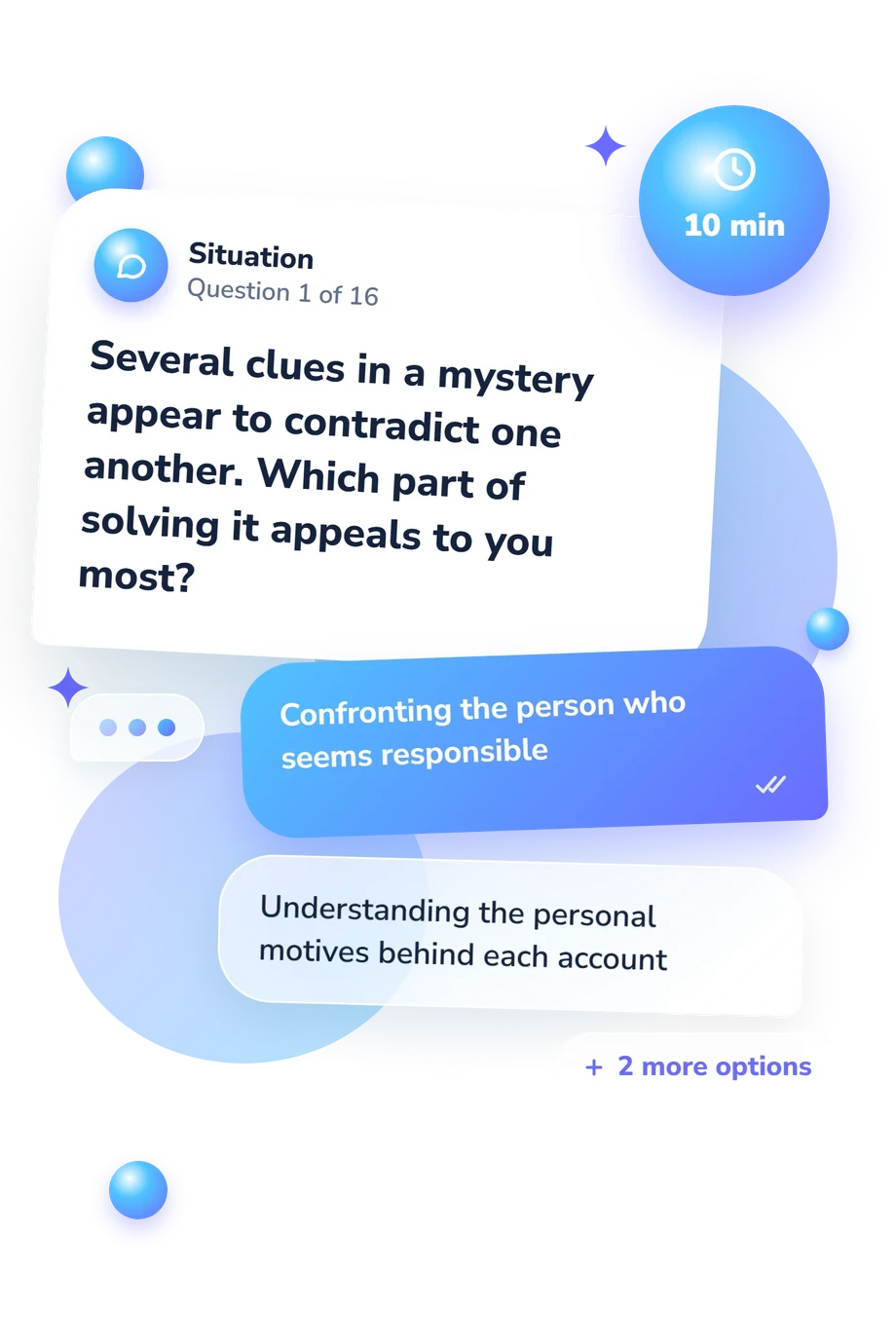
Example Questions From the Test
- Find an unexpected way around the conflict
- Collect the facts before deciding how to intervene
- Check on the teammate privately and help them feel supported
- Speak up directly, even if doing so puts attention on me
- Question whether the original goal is still worth following
- Review the causes and rebuild the plan carefully
- Keep everyone connected and restore their confidence
- Step forward, accept responsibility, and lead the next attempt
- Trust that I will rise to the occasion when it begins
- Talk with someone who understands what the challenge means to me
- Experiment with a fresh approach that feels more interesting
- Prioritize likely obstacles and prepare a response for each one
Main Character Quiz - Description and methodology of the test
Anyone curious about the kind of protagonist they might become in a difficult story can use this main character quiz to reflect on recurring preferences, loyalties, and ways of responding under pressure. It suits readers who want a playful but structured profile rather than a single personality label. If you have wondered, are you the main character, the result offers a more nuanced answer through several narrative qualities.
What This Assessment Explores
Fictional situations test preferences around uncertainty, conflict, responsibility, relationships, authority, and scarce resources. The result reflects tendencies that feel natural in a story and can prompt reflection on planning, empathy, independence, and action under pressure.
Rather than answering am I the main character with yes or no, it presents four complementary tendencies. The displayed results use these bands:
- Clever Strategist (0-12) moves from Instinctive Storyline (0-4), through Tactical Thinker (5-8), to Clever Strategist Affinity (9-12), showing planning versus improvisation.
- Compassionate Heart (0-12) spans Reserved Heart Thread (0-4), Steady Connector (5-8), and Compassionate Heart Affinity (9-12), showing the place of empathy.
- Courageous Hero (0-12) spans Quiet Hero Thread (0-4), Rising Hero Energy (5-8), and Courageous Hero Affinity (9-12), showing readiness to act.
- Defiant Rebel (0-12) spans Independent Spark (0-4), Selective Challenger (5-8), and Defiant Rebel Affinity (9-12), showing resistance to restrictive scripts.
Methodology and Evidence Base
As a main character personality quiz, the questionnaire uses self-report, forced-choice scenarios. Each item presents a fictional problem with four possible reactions, covering choices such as investigating, supporting, challenging, improvising, or leading. The format examines narrative preferences rather than clinical symptoms.
Selections feed four parallel scores, and the result is placed into the displayed bands. The questionnaire does not specify how individual answers are weighted, so the profile is best read as a pattern of relative tendencies within this assessment, not as a probability or diagnostic cutoff.
Its conceptual framework is Narrative character identification (Huang & Fung, 2024), which treats involvement with narrative characters as measurable. Cohen (2001) links identification with a character’s perspective, goals, and experiences, while van Krieken, Hoeken, and Sanders (2017) connect narrative cues with identification. This questionnaire is conceptually consistent with that work, not an adaptation of those published scales.
The bands are interpretive rather than norm-based: no population norms, reliability estimates, diagnostic cutoffs, or clinical validation are established for this questionnaire. Mood, recent experiences, self-awareness, and preferred self-presentation may influence self-report, so the result is a reflective snapshot rather than a fixed identity.
- Huang, Kate Y., and Helene H. Fung. (2024). Measuring identification with narrative characters: the development and validation of a new scale. Current Psychology, 43, 24835-24849. 10.1007/s12144-024-06191-2
- Cohen, Jonathan. (2001). Defining Identification: A Theoretical Look at the Identification of Audiences With Media Characters. Mass Communication and Society, 4(3), 245-264. 10.1207/S15327825MCS0403_01
- van Krieken, Kobie, Hans Hoeken, and José Sanders. (2017). Evoking and Measuring Identification with Narrative Characters - A Linguistic Cues Framework. Frontiers in Psychology, 8, 1190. 10.3389/fpsyg.2017.01190
Updated: