
Literature Quiz
How the Scales are Structured
Who Usually Takes This Test?
See How You Compare
Below is a preview of how scores are typically distributed across each scale.
Example Questions From the Test
- She chooses to preserve her moral and personal independence
- She plans to expose him publicly and seize his estate
- She has secretly promised to marry St. John Rivers
- She believes Thornfield belongs legally to her
- The boys’ growing ability to survive without tools
- The collapse of shared rules and social order
- Ralph’s acceptance of Jack’s leadership methods
- The island’s increasing control over the weather
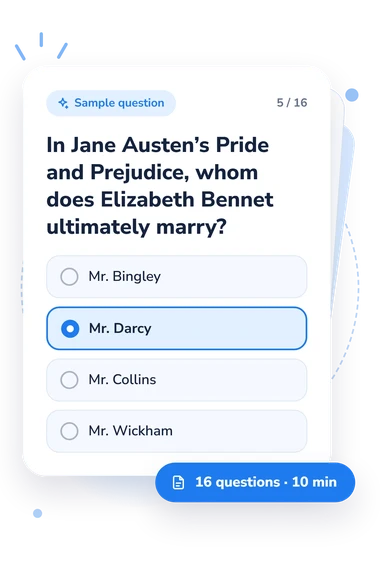
- Mr. Bingley
- Mr. Darcy
- Mr. Collins
- Mr. Wickham
Literature Quiz - Description and methodology of the test
Readers who want to check how confidently they recognize important works and interpret literary ideas can use this assessment as a focused self-check. The literature quiz suits regular readers and anyone revisiting the canon through characters, events, themes, symbols, and literary devices. The prompts combine recall with interpretation, so title recognition is only part of the task. As an online quiz about literature, it highlights current strengths and useful directions for further reading.
What This Assessment Explores
The questions measure literary knowledge through two connected activities: recognizing details from known works and interpreting why those details matter. They cover characters, plots, works, themes, symbols, literary devices, and choices that reveal a work’s broader ideas.
The result is reported on the Literature Knowledge scale, ranging from 0-16, with these bands:
- Foundations to Build (0-6) shows partial recognition of major characters, plots, and themes and points to useful areas for review.
- Developing Literary Range (7-12) shows a solid base with several interpretive connections and room to broaden or deepen reading.
- Strong Literary Command (13-16) shows accurate recognition plus interpretation of themes and symbols across varied works.
This literary quiz suits readers seeking a snapshot of their current command of widely taught literature.
Methodology and Evidence Base
Each item presents four alternatives and asks you to choose the answer that best fits a literary fact or interpretation. The set combines recognition of characters, narrators, events, and works with reasoning about themes, symbolism, irony, moral conflict, and consequential choices. Together, these items form a literature knowledge test focused on the selected prompts, not on reading speed or total reading volume.
Scoring is shown as a total on the overall scale, with the displayed band supplying its interpretation. The questionnaire does not report separate subscale scores, so the result describes performance across these tasks.
The assessment is conceptually consistent with work by McCarthy and Goldman on domain-specific literary knowledge and interpretive inference, but it is not an adaptation of that work. Print exposure and reading volume are separate constructs from the knowledge tested here, so the score should not be treated as a measure of either.
As an online multiple-choice knowledge assessment, it draws on memory and may be affected by guessing, familiarity with the selected canon, and current attention. Its result is useful for self-reflection, but conclusions should remain limited to this set of tasks.
- McCarthy, Kathryn S., and Susan R. Goldman. (2019). Constructing interpretive inferences about literary text: The role of domain-specific knowledge. Learning and Instruction, 60, 245-251. 10.1016/j.learninstruc.2017.12.004
- Acheson, Daniel J., Justine B. Wells, and Maryellen C. MacDonald. (2008). New and updated tests of print exposure and reading abilities in college students. Behavior Research Methods, 40(1), 278-289. 10.3758/BRM.40.1.278