
Leviticus Bible Quiz
How the Scales are Structured
Who Usually Takes This Test?
See How You Compare
Below is a preview of how scores are typically distributed across each scale.
Example Questions From the Test
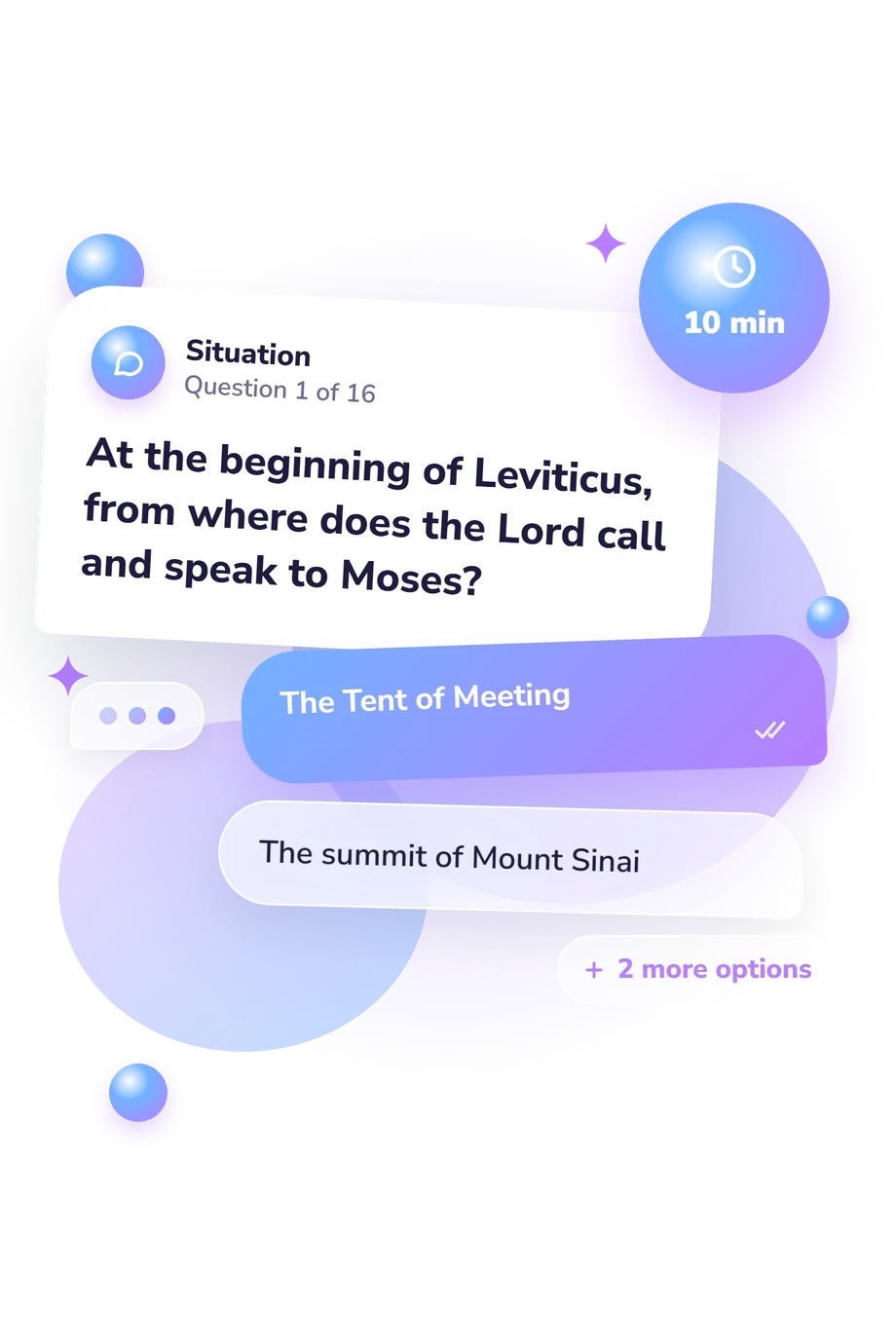
- The Tent of Meeting
- The summit of Mount Sinai
- The entrance to the Promised Land
- The bank of the Jordan River
- Do not mix two kinds of seed in one field
- Bring the first sheaf to the priest
- Observe the Day of Atonement
- Love your neighbor as yourself
- Leaven and honey
- Flour and incense
- Oil and salt
- Barley and water
Leviticus Bible Quiz - Description and methodology of the test
Readers who want to check how well they understand the book of Leviticus can work through the online leviticus bible quiz questions and answers pdf as a focused knowledge check. For Bible-study participants, students, and curious readers, this Leviticus quiz offers a way to connect individual commands with the book’s larger religious and social framework. The result highlights strengths and topics worth revisiting rather than merely marking isolated facts.
What This Assessment Explores
This assessment asks whether a reader can recognize Leviticus’s major instructions and connect each rule with its ritual, social, or theological setting. It suits Bible-study participants, students, teachers, and curious readers seeking biblical literacy. A Leviticus Bible Quiz result reflects familiarity with the book’s content and internal connections, not faith, devotion, or religious commitment.
The items cover these areas:
- Offerings and atonement show how sacrifices serve distinct ritual purposes.
- Purity practices examine priestly decisions about bodies, houses, food, and sacred boundaries.
- Holiness and community laws address conduct, neighbors, harvests, property, and restitution.
- Festivals and sacred time link the Day of Atonement, Sabbath patterns, and Jubilee.
Together, these topics produce Leviticus Knowledge, scored from 0-16: Foundations to Build (0-6), Developing Knowledge (7-12), or Strong Knowledge (13-16). The result indicates how securely the respondent recognizes the book’s practices, values, and structure.
Methodology and Evidence Base
Each prompt presents a short question with four answer choices. The respondent selects the option that best matches Leviticus; several items require applying a rule to a brief situation rather than recognizing a phrase. In practice, the Leviticus quiz questions and answers therefore move among ritual procedure, legal instruction, purity classification, sacred time, and ethical responsibility.
The displayed result reports performance on a single knowledge scale. Its bands are descriptive labels for this quiz, and the score should be interpreted within the displayed scale rather than as a measure of religious commitment.
The questions concern the biblical book of Leviticus. Jacob Milgrom’s commentary and the notes by Arthur Thomas Chapman and Annesley William Streane offer contextual scholarship on offerings, purity rules, holiness laws, and Jubilee provisions. David Janzen’s study adds context for reading priestly sacrifice. The questionnaire is conceptually consistent with these works; they provide context for the biblical themes, not authorship of this online quiz.
Interpretation should allow for translation familiarity, prior study, memory, and attention. The score is most useful for identifying passages to review and questions to discuss, not for ranking biblical knowledge universally.
- Leviticus. In The Holy Bible, New Revised Standard Version Updated Edition. National Council of the Churches of Christ in the United States of America, 2021.
- Milgrom, Jacob. Leviticus 1-16: A New Translation with Introduction and Commentary. Anchor Bible 3. New York: Doubleday, 1991.
- Chapman, Arthur Thomas, and Annesley William Streane. The Book of Leviticus, in the Revised Version, with Introduction and Notes. Cambridge: Cambridge University Press, 1914.
- Janzen, David. “Priestly Sacrifice in the Hebrew Bible: A Summary of Recent Scholarship and a Narrative Reading.” Religion Compass 2, no. 1 (2008): 38-52. 10.1111/j.1749-8171.2007.00054.x
Updated: