
Kidney Anatomy Quiz
How the Scales are Structured
Who Usually Takes This Test?
See How You Compare
Below is a preview of how scores are typically distributed across each scale.
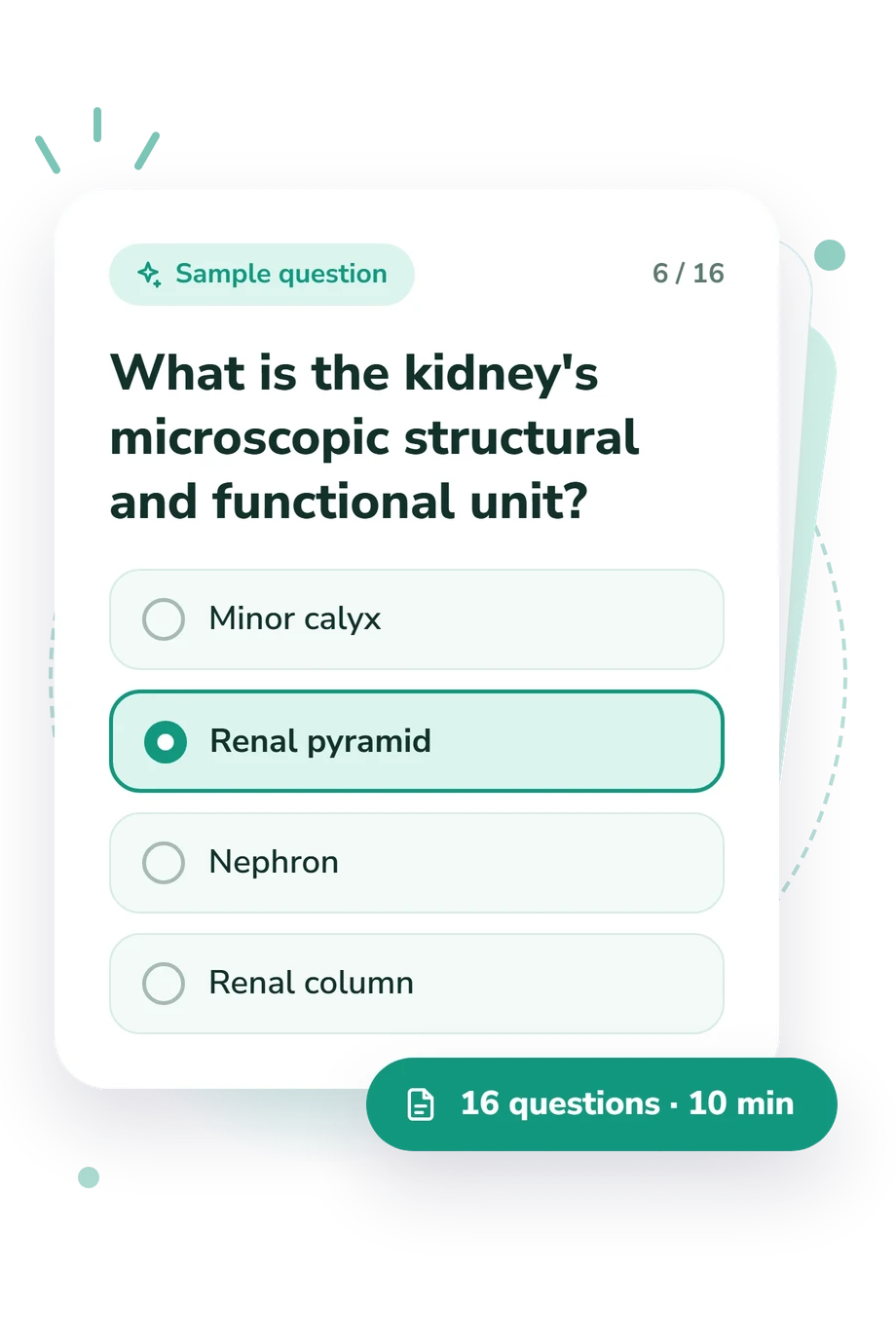
Example Questions From the Test
- Interlobar artery
- Afferent arteriole
- Efferent arteriole
- Peritubular capillary
- Major calyx → minor calyx → renal pelvis → ureter
- Renal pelvis → minor calyx → major calyx → ureter
- Minor calyx → renal pelvis → major calyx → ureter
- Minor calyx → major calyx → renal pelvis → ureter
- Renal fascia
- Fibrous renal capsule
- Pararenal fat
- Perirenal fat
Kidney Anatomy Quiz - Description and methodology of the test
Designed for learners who want to check their grasp of renal structure, the kidney anatomy quiz focuses on major regions, microscopic units, and connected blood and urine pathways. It suits anatomy study, revision, or a quick knowledge check before practical work. The visual relationships expected in a kidney diagram quiz are tested alongside tissue layers and nephron sequence.
What This Assessment Explores
These questions treat renal structure as a connected system, not a vocabulary list. They test location, shape, tissue level, and functional relationships, so the renal anatomy quiz result reflects how consistently you connect names with regions and pathways.
The main content areas are:
- Gross organization shows whether your result identifies the capsule, cortex, medulla, pyramids, columns, hilum, and kidney position.
- Nephron structure indicates how well you place the renal corpuscle, tubules, loop, and collecting pathway together.
- Flow pathways show whether you can trace filtrate and urine through calyces, pelvis, ureter, and bladder.
- Vascular relationships reveal whether you distinguish vessels entering and leaving the glomerulus and supplying capillary beds.
The displayed scale is Kidney Anatomy Knowledge (0-16). Foundations to Build (0-6) marks areas needing review; Developing Knowledge (7-12) reflects many correct relationships with details to revisit; Strong Knowledge (13-16) indicates a well-developed grasp of renal structure and pathways.
Methodology and Scientific Basis
Each item presents a short anatomical scenario or direct identification prompt with four answer choices. As an anatomy of the kidney quiz, it emphasizes recognition and relational reasoning: you select the structure, sequence, or vessel that best fits the location or function described. It is an objective selected-response knowledge assessment, not a self-report measure.
The questionnaire reports one total knowledge score rather than separate subscores. The result uses the displayed bands to suggest targeted review of regions, nephron segments, or flow pathways. A stronger band reflects performance on these relationships, not complete mastery of renal science.
Sampaio (2000) provides the closest subject-specific anatomical reference for the vascular, collecting-system, and regional relationships addressed here. The content is conceptually consistent with that work and with anatomy teaching by Betts and colleagues (2022), Drake and colleagues (2023), and Moore and colleagues (2023). These sources provide an anatomical framework, not population norms for this online questionnaire.
Interpret the result as a focused learning snapshot. Performance can vary with prior study, terminology familiarity, attention to spatial wording, and the limits of four-choice recognition. It cannot show practical dissection, microscopy, or clinical reasoning skill, so its clearest use is choosing what to review next.
- Sampaio, Francisco J. B. "Renal anatomy. Endourologic considerations." Urologic Clinics of North America, vol. 27, no. 4, 2000, pp. 585-607. 10.1016/S0094-0143(05)70109-9.
- Betts, J. Gordon, Kelly A. Young, James A. Wise, Eddie Johnson, Brandon Poe, Dean H. Kruse, Oksana Korol, Jody E. Johnson, Mark Womble, and Peter DeSaix. Anatomy and Physiology 2e. 2nd ed. Houston, TX: OpenStax, 2022.
- Drake, Richard L., A. Wayne Vogl, and Adam W. M. Mitchell. Gray's Anatomy for Students. 5th ed. Philadelphia, PA: Elsevier, 2023. ISBN 978-0-323-93423-7.
- Moore, Keith L., Arthur F. Dalley II, and Anne M. R. Agur. Moore's Clinically Oriented Anatomy. 9th ed. Philadelphia, PA: Wolters Kluwer, 2023. ISBN 978-1-9752-0954-4.
Updated: