
Invention Quiz
How the Scales are Structured
Who Usually Takes This Test?
See How You Compare
Below is a preview of how scores are typically distributed across each scale.
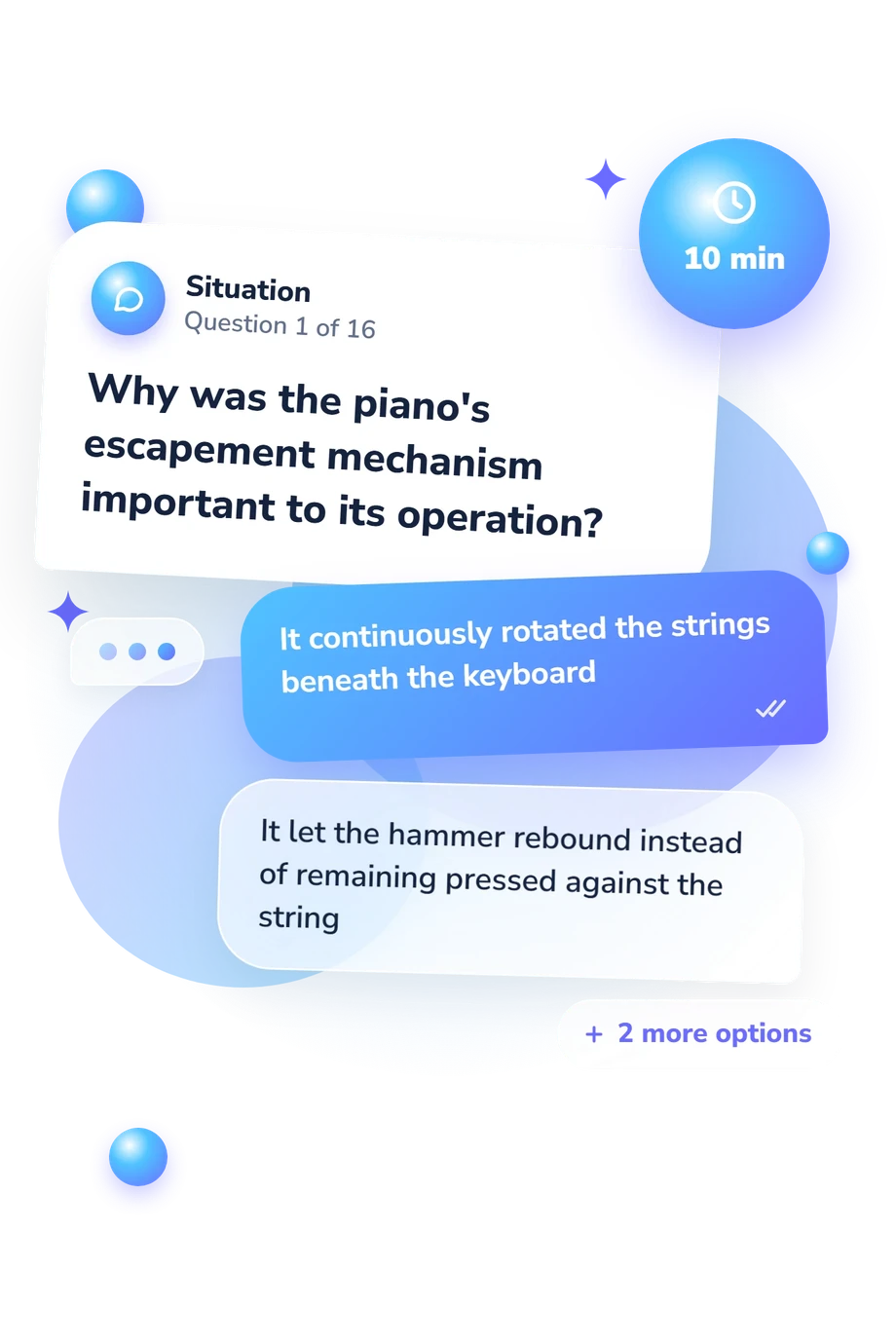
Example Questions From the Test
- Glass armonica
- Celesta
- Bandoneon
- Saxhorn
- Trinidad and Tobago
- Cuba
- Jamaica
- Barbados
- Ondes Martenot
- Fairlight CMI
- Moog synthesizer
- Synclavier
Invention Quiz - Description and methodology of the test
Readers who want to connect instruments with their creators, places, and engineering ideas can use this assessment as a focused starting point for a who invented what quiz. It suits learners, listeners, and curious musicians interested in how instruments came into being. The invention quiz questions test factual understanding across acoustic design, electronic technology, and musical history.
What This Assessment Explores
Questions connect historical attribution with practical understanding, so the result reflects recognition of inventions and the principles behind them. Questions and answers about musical inventions cover four connected dimensions:
- Creators and origins show whether you can connect an instrument with its inventor, period, or cultural setting.
- Mechanisms and materials show whether you recognize how parts produce or shape sound.
- Electronic development measures recognition of amplification, synthesis, tone generation, and modular design.
- Classification and communication show whether you can place instruments by sound production and understand MIDI data.
Musical Instrument Invention Knowledge is scored from 0-16. Foundations to Build (0-6) marks basic recognition; Developing Knowledge (7-12) reflects many correct connections; Strong Knowledge (13-16) indicates broad command of notable inventions and how they work.
Methodology and Scientific Basis
Each item offers four answer choices, requiring selection of the best response rather than an explanation. The total counts correct answers, so this musical instrument invention quiz measures factual knowledge, not playing skill, creativity, or confidence.
As an online questionnaire, it is not an adaptation of a published psychometric scale. Campbell, Greated, and Myers (2004) provides the closest broad reference for instrument history, construction, and performance; the questions are conceptually consistent with that work without reproducing its method. Dudley (2007) supplies context for steelband development in Trinidad and Tobago. Hornbostel and Sachs support the classification of instruments by sound-producing principles, while the MIDI Manufacturers Association (1996) supplies the technical context for the communication-standard item.
These sources support the content domain, not the questionnaire’s standardization. No normative sample, reliability estimate, or validation study is stated for this online test, so the bands describe performance on this question set rather than population cutoffs. Results may vary with prior exposure, memory, and interpretation of technical wording; they should be read as a focused knowledge profile, not a complete measure of musical expertise.
- Campbell, Murray, Clive Greated, and Arnold Myers. Musical Instruments: History, Technology and Performance of Instruments of Western Music. Oxford University Press, 2004. 10.1093/acprof:oso/9780198165040.001.0001
- Dudley, Shannon. Music from behind the Bridge: Steelband Aesthetics and Politics in Trinidad and Tobago. Oxford University Press, 2007. 10.1093/acprof:oso/9780195175479.001.0001
- von Hornbostel, Erich M., and Curt Sachs. Classification of Musical Instruments: Translated from the Original German by Anthony Baines and Klaus P. Wachsmann. The Galpin Society Journal, vol. 14, 1961, pp. 3-29. 10.2307/842168
- MIDI Manufacturers Association. MIDI 1.0 Detailed Specification, Version 96.1, 3rd ed., 1996.
Updated: