
Indeed Quiz
How the Scales are Structured
Who Usually Takes This Test?
See How You Compare
Below is a preview of how scores are typically distributed across each scale.
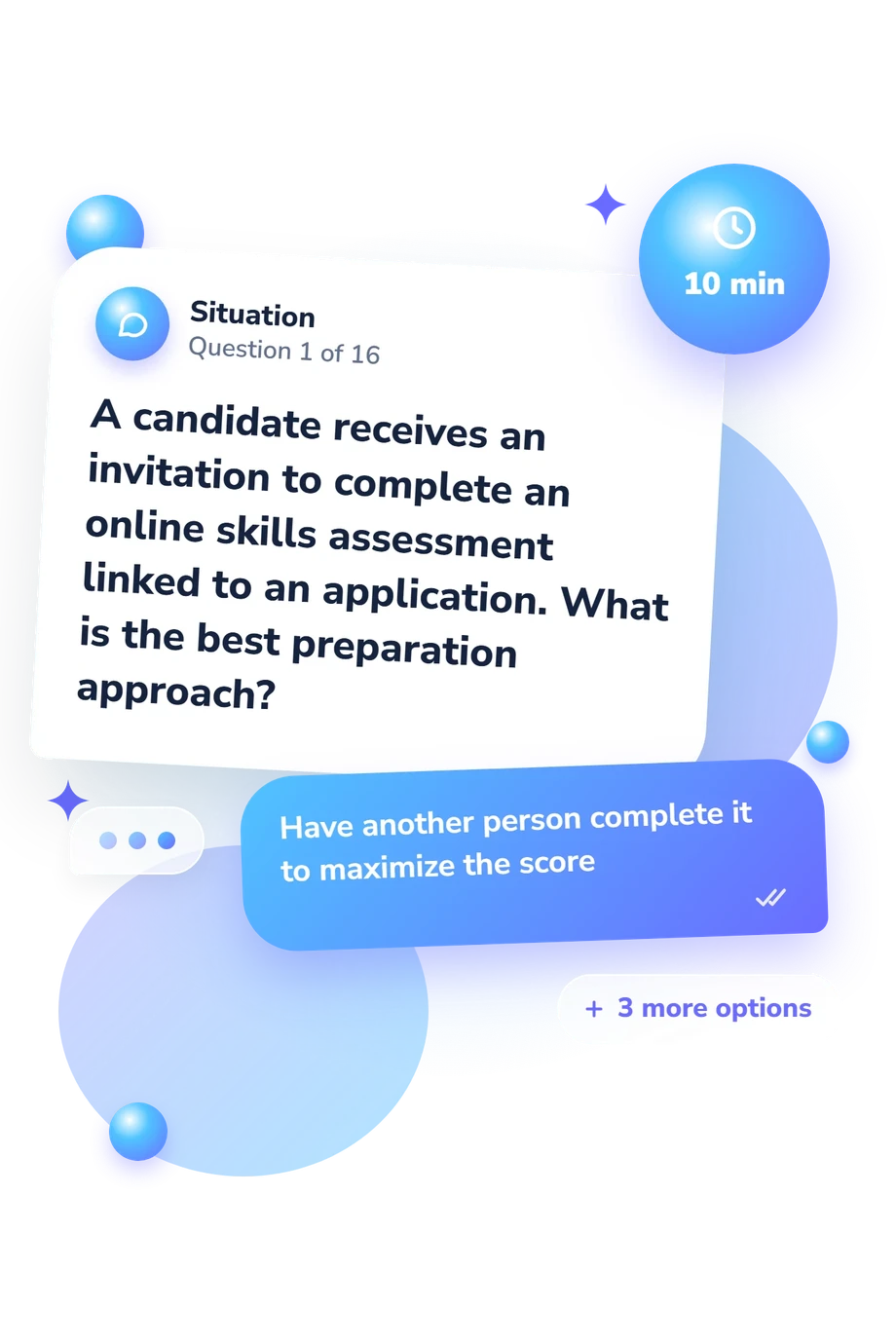
Example Questions From the Test
- Search for job opportunities and connect with employers
- Issue professional licenses for regulated occupations
- Provide government unemployment benefits
- Guarantee placement with a participating employer
- A complete list of personal social media accounts
- The candidate’s full street address and household details
- The contact information of every previous supervisor
- A current professional email address and reliable phone number
- Placing all important experience inside decorative graphics
- Using standard section headings and clear text-based formatting
- Writing the entire resume as one continuous paragraph
- Hiding keywords in white text around the page margins
Indeed Quiz - Description and methodology of the test
People who want to improve applications or judge candidate information can use the indeed quiz to examine practical decisions around job searching, resumes, and fair screening. It suits job seekers, recruiters, educators, and learners who want a clear snapshot of responsible practice. As a job search quiz, it links everyday platform-related tasks with evidence-based choices rather than memorized trivia.
What This Assessment Explores
The assessment measures practical knowledge, not personality or hiring probability. Its situations ask how to refine a search, prepare for an online assessment, present experience, recognize transferable skills, and evaluate applicants using job-related evidence. It helps job seekers inspect habits and helps recruiters or learners consider fairer screening choices.
The result uses three thematic dimensions:
- Focused searching shows whether role, skill, and location details are used to narrow opportunities.
- Resume communication shows whether experience is expressed with clear, relevant, and measurable evidence.
- Fair screening judgment shows whether decisions rely on qualifications and requirements rather than assumptions.
The displayed Indeed & Resume Screening Knowledge scale runs from 0-16, and Indeed's quiz levels are Foundations to build (0-6), Developing knowledge (7-12), and Strong knowledge (13-16). The bands identify topics to review or practices understood; they are educational, not official Indeed certification or employment forecasts.
Methodology and Evidence Base
Each item presents a practical situation with four answer choices and asks for the best action or strongest evidence. Themes include search refinement, honest assessments, resume clarity, transferable skills, credentials, scam awareness, and fair evaluation. One answer is selected per scenario, and the result summarizes performance across the questionnaire; point-by-point weighting is not documented.
As an online resume screening quiz, it tests recognition of sound decisions rather than simulating recruitment work. It is an educational self-report questionnaire without published norms, reliability estimates, or clinical cutoffs, so the score is a learning snapshot rather than a population comparison.
Its evidence base is conceptual. Ock (2022) connects minority-applicant bias in resume screening with selection outcomes, while Derous and Ryan (2019) model ethnic bias in resume screening. The questionnaire is not an adaptation or validation of either study.
Interpretation depends on honest responses, self-awareness, wording, and current experience. A higher result suggests familiarity with the represented practices; a lower result identifies topics to review, not screening accuracy or employment prospects.
- Ock, Jisoo. (2022). The Practical Impact of Bias against Minority Group Applicants in Resume Screening on Personnel Selection Outcomes. Sustainability, 14(15), 9438. 10.3390/su14159438
- Derous, Eva, and Ann Marie Ryan. (2019). When your resume is (not) turning you down: Modelling ethnic bias in resume screening. Human Resource Management Journal, 29(2), 113-130. 10.1111/1748-8583.12217
Updated: