
Identity Crisis Quiz
How the Scales are Structured
Who Usually Takes This Test?
See How You Compare
Below is a preview of how scores are typically distributed across each scale.
Example Questions From the Test
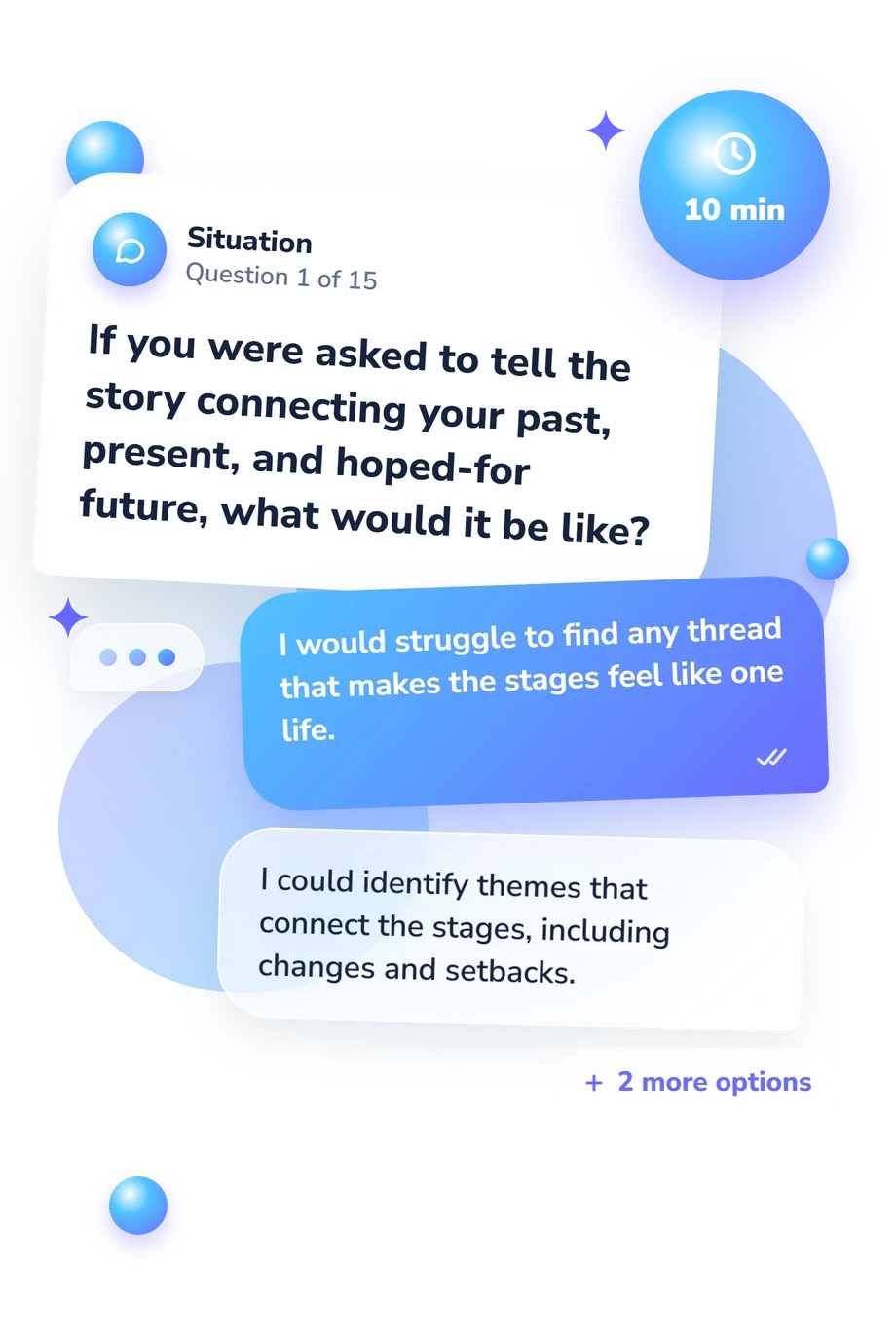
- I would struggle to find any thread that makes the stages feel like one life.
- I could identify themes that connect the stages, including changes and setbacks.
- I could describe the stages, but they would feel fragmented or incompatible.
- Some connections would be clear, while other chapters would remain unresolved.
- I often cannot tell whether any of my preferences are genuinely mine.
- I naturally adapt how I present myself, but my underlying preferences remain recognizable.
- Trying new influences feels compatible with a stable sense of who I am.
- I later wonder which version of me—the old or new one—is real.
- I feel unable to tell what I would want instead or why I pursued it.
- I reassess what the experience taught me and adjust future goals.
- I can distinguish the achievement's value from my own next direction.
- I question several other goals because they may also come from outside expectations.
Identity Crisis Quiz - Description and methodology of the test
People who feel divided between past and present, uncertain in unfamiliar roles, or unsure which goals are truly theirs may find the Identity Crisis Quiz useful. The result offers an identity self-assessment that organizes these experiences without reducing identity to one fixed label. It can support reflection during transitions, cultural tensions, relationship changes, migration, or role loss.
What This Assessment Explores
Items address continuity across change, self-description, belonging, roles, expectations, values, and choices. Across the identity crisis questions, the result reports separate patterns, with higher totals indicating greater disruption or uncertainty in that dimension.
The three displayed dimensions are:
- Continuity and Belonging (0-15) measures connection across roles and relationships: Connected identity (0-5), Context-sensitive continuity (6-10), and Continuity frequently disrupted (11-15) mark increasing difficulty forming one life story.
- Self-Concept Clarity (0-15) measures recognition of personal qualities: Mostly defined (0-5), Active questioning (6-10), and Frequently unsettled (11-15) mark increasing uncertainty across settings.
- Values and Direction (0-15) measures clarity of personal priorities: Internally guided (0-5), Direction under review (6-10), and Direction frequently unclear (11-15) mark increasing difficulty choosing from an internal basis.
Methodology and Scientific Basis
Each item presents a situation with four response options. The choices contrast integration, adaptation, uncertainty, fragmentation, and reliance on outside expectations. This self-report, dimensional questionnaire produces separate domain totals, then shows them through reflective bands. Its online scoring has no documented rule for how many points each option contributes, so no further point system should be inferred.
Its evidence base is conceptual rather than a claim that this version reproduces a published scale. AIDA (Goth et al., 2012) offers the closest framework for identity continuity, integration, and diffusion. Berman, Montgomery, and Kurtines (2004) provide a comparison for identity distress, while Campbell et al. (1996) support self-concept clarity. The questionnaire is conceptually consistent with these works, not an adaptation or validation of them.
Reading the identity quiz results alongside current circumstances can clarify which areas merit reflection during stress, relationship change, cultural pressure, discrimination, migration, or role loss. Scores may shift with context, self-awareness, and response bias. This online questionnaire has no documented standardization, norms, or clinical cutoffs, so persistent disruption or distress is best understood within a broader assessment.
- Goth, K., Foelsch, P., Schlüter-Müller, S., Birkhölzer, M., Jung, E., Pick, O., & Schmeck, K. (2012). Assessment of identity development and identity diffusion in adolescence - Theoretical basis and psychometric properties of the self-report questionnaire AIDA. Child and Adolescent Psychiatry and Mental Health, 6, Article 27. 10.1186/1753-2000-6-27
- Berman, S. L., Montgomery, M. J., & Kurtines, W. M. (2004). The development and validation of a measure of identity distress. Identity: An International Journal of Theory and Research, 4(1), 1-8. 10.1207/S1532706XID0401_1
- Campbell, J. D., Trapnell, P. D., Heine, S. J., Katz, I. M., Lavallee, L. F., & Lehman, D. R. (1996). Self-concept clarity: Measurement, personality correlates, and cultural boundaries. Journal of Personality and Social Psychology, 70(1), 141-156. 10.1037/0022-3514.70.1.141
Updated: