
Hypersomnia Quiz
How the Scales are Structured
Who Usually Takes This Test?
See How You Compare
Below is a preview of how scores are typically distributed across each scale.
Example Questions From the Test
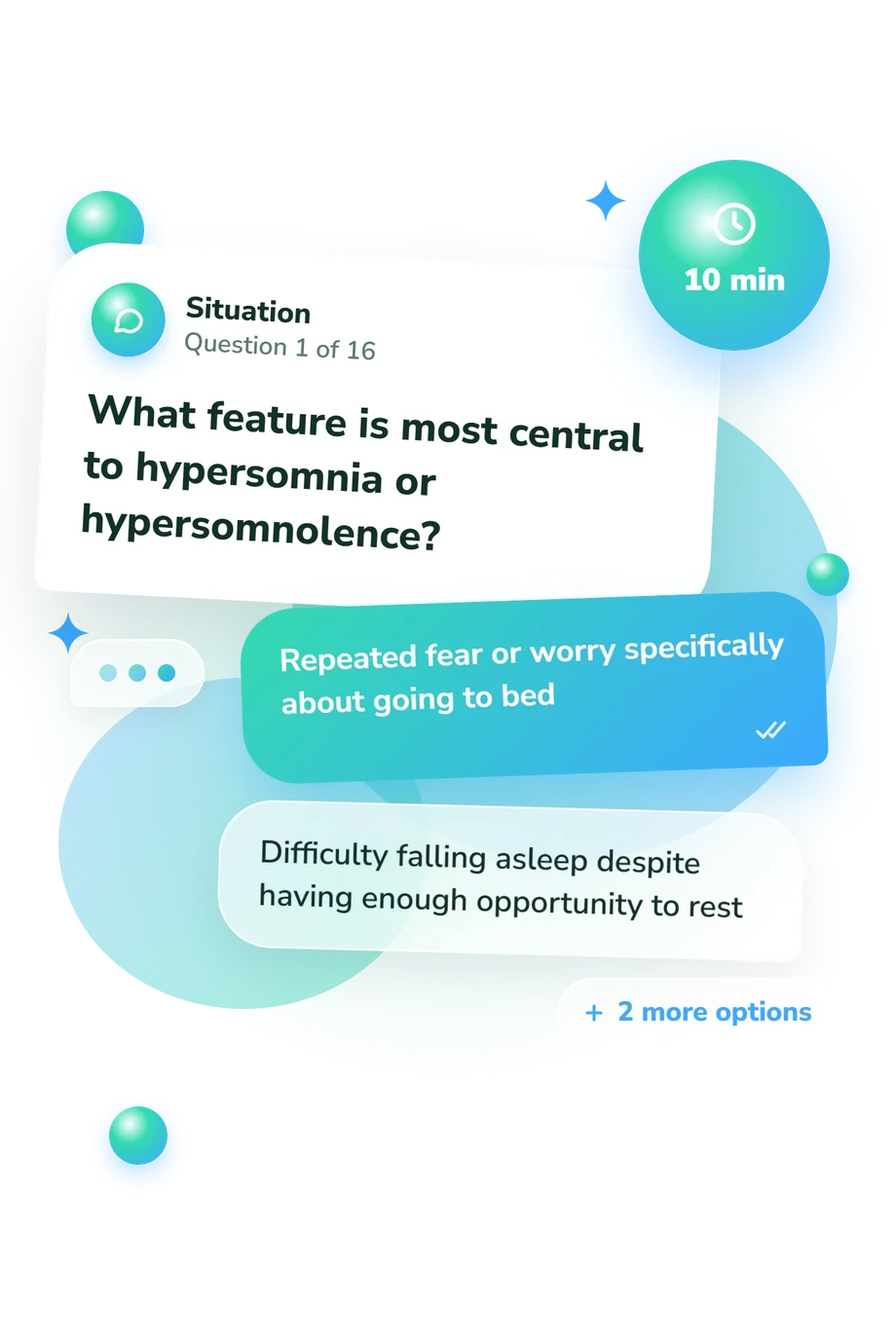
- Repeated fear or worry specifically about going to bed
- Difficulty falling asleep despite having enough opportunity to rest
- Excessive sleepiness, such as an ongoing urge to sleep or difficulty staying awake
- Uncomfortable leg sensations that occur only during exercise
- Sleep–wake timing and activity patterns across multiple days
- The exact content of dreams during each sleep cycle
- The oxygen level inside the lungs without any other sensor
- The specific emotional cause of daytime tiredness
- Open a window and continue until the next planned stop
- Turn up the music and reduce her speed slightly
- Pull over safely as soon as possible and stop driving
- Rely on caffeine to remain alert for the rest of the trip
Hypersomnia Quiz - Description and methodology of the test
For readers who want to understand persistent daytime sleepiness without jumping to conclusions, this hypersomnia quiz offers a focused knowledge check. It is suited to people learning sleep terminology, reviewing a concern in their routine, or preparing for a conversation with a clinician. This sleep disorder knowledge quiz can clarify symptoms, assessment tools, medicines, and safety decisions, helping readers organize unfamiliar sleep concepts for a conversation with a clinician.
What This Assessment Explores
This assessment treats hypersomnia as a knowledge topic involving excessive sleepiness, sleep opportunity, contributing conditions, clinical clues, and safety. It distinguishes sleepiness from fatigue, insufficient sleep from central disorders, and ordinary grogginess from concerning patterns. Questions address narcolepsy clues, sleep apnea, medicines, sleep diaries, actigraphy, and the Multiple Sleep Latency Test.
The result is educational, not a symptom profile. Hypersomnia Knowledge runs from 0-16 correct answers: Foundation Building (0-6), Developing Knowledge (7-12), and Strong Knowledge (13-16). These bands describe understanding, not whether someone has hypersomnia.
The main knowledge areas are:
- Core concepts explain sleepiness, fatigue, sleep inertia, and restricted sleep.
- Assessment tools show what diaries, actigraphy, and nap testing reveal.
- Contributors connect sleepiness with medicines, breathing problems, schedules, and other conditions.
- Safety decisions identify when to stop driving or seek care.
This hypersomnia knowledge assessment explains when excessive sleepiness calls for caution and safer action.
Methodology and Scientific Basis
Each item uses a four-option multiple-choice format and asks for the best answer to a practical sleep question. The score counts correct responses, so a higher result indicates stronger command of the educational material; it does not estimate symptom severity. The test covers definitions, differential clues, assessment procedures, contributing factors, and safety actions.
Its content is conceptually consistent with Khan and Trotti (2015), which discusses central disorders of hypersomnolence, including narcolepsy and idiopathic hypersomnia. The diagnostic framing also aligns with the International Classification of Sleep Disorders, Third Edition, while actigraphy content reflects the evidence summarized by Smith and colleagues (2018). This questionnaire is not presented as an adaptation of any of those publications; it is an online educational knowledge test organized around related concepts.
Its role is closer to a hypersomnia knowledge test than a symptom screener. The score has no stated clinical norms or diagnostic cutoff, so it cannot establish a sleep disorder. Persistent sleepiness warrants healthcare assessment, sudden severe symptoms require urgent help, and anyone becoming drowsy while driving should pull over safely and stop.
- Zeeshan Khan, Lynn Marie Trotti. Central Disorders of Hypersomnolence: Focus on the Narcolepsies and Idiopathic Hypersomnia. Chest. 2015;148(1):262-273. 10.1378/chest.14-1304
- American Academy of Sleep Medicine. International Classification of Sleep Disorders, 3rd ed. Darien, IL: American Academy of Sleep Medicine; 2014.
- Michael T. Smith, Christina S. McCrae, Joseph Cheung, Jennifer L. Martin, Christopher G. Harrod, Jonathan L. Heald, Kelly A. Carden. Use of Actigraphy for the Evaluation of Sleep Disorders and Circadian Rhythm Sleep-Wake Disorders: An American Academy of Sleep Medicine Systematic Review, Meta-Analysis, and GRADE Assessment. Journal of Clinical Sleep Medicine. 2018;14(7):1209-1230. 10.5664/jcsm.7228
Updated: