
Hygiene Quiz
How the Scales are Structured
Who Usually Takes This Test?
See How You Compare
Below is a preview of how scores are typically distributed across each scale.
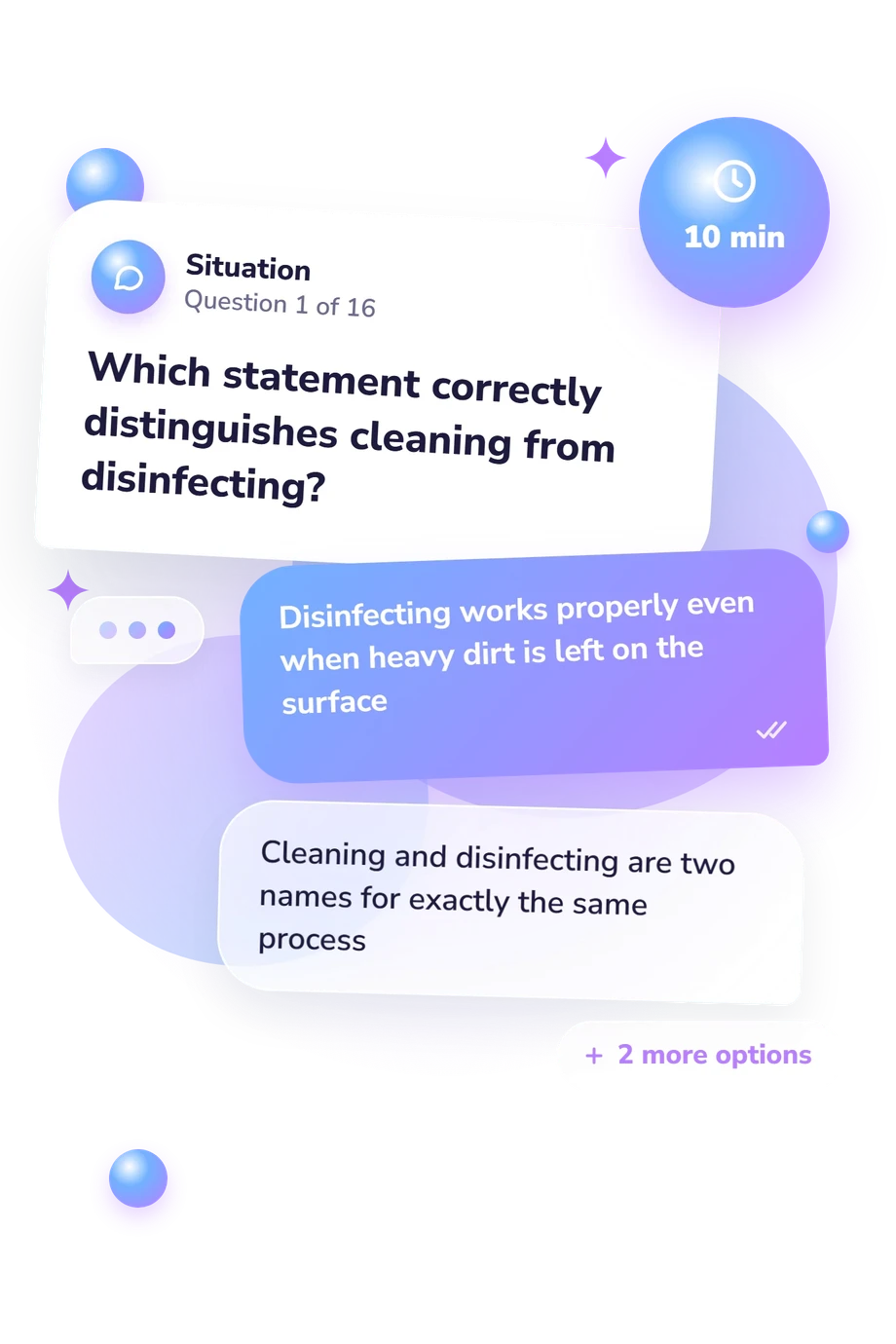
Example Questions From the Test
- Within two hours
- Within about four hours
- The next morning, provided they are covered
- Only after they have completely cooled, however long that takes
- Cough into your bent elbow, away from other people
- Turn away from others and cough into the air
- Hold the cough in until you reach a restroom
- Cough into your hands and wipe them on your clothing
- Rub them with a dry towel until the dirt is less visible
- Wash them thoroughly with soap and running water
- Use hand sanitizer repeatedly until the mud loosens
- Rinse briefly with water but do not use soap
Hygiene Quiz - Description and methodology of the test
People who want a practical check of everyday health routines can use this assessment to see which decisions are well understood and which deserve attention. This hygiene quiz focuses on applying basic guidance rather than judging appearance, habits, or personal worth. It is suitable for learners, households, and adults refreshing knowledge for safer daily choices. As a quiz about personal hygiene, it turns familiar situations into concrete opportunities for self-reflection.
What This Assessment Explores
The questionnaire checks knowledge of safer actions involving handwashing, cough etiquette, food, dental care, surfaces, and contamination. It suits anyone reviewing routines; it does not classify personality or prove behavior. The hygiene knowledge questions use situations with four choices, so results show recognition of good practice.
The main areas are:
- Hand and respiratory hygiene identifies safer washing, coughing, and glove-use choices.
- Food, dental, and body care covers leftovers, thawing, interdental cleaning, and personal-item safety.
- Household exposure control covers blood, laundry, contact lenses, and communal wet areas.
The displayed scale is Hygiene Knowledge (0-16): Foundations to build (0-6) signals unfamiliar principles; Developing knowledge (7-12) shows many effective practices with some gaps; Strong knowledge (13-16) indicates solid understanding of recommended principles. This unvalidated educational result indicates knowledge rather than health status; persistent symptoms require qualified professional advice.
Methodology and Evidence Base
Each item asks for the best response to a situation, using four alternatives rather than a frequency scale. Topics include cleaning, food storage, body-fluid exposure, oral and menstrual care, cough etiquette, contact lenses, and skin or foot care. The scoring presentation produces a total, but individual response weights are not documented, so the result should be interpreted through its displayed bands rather than treated as a validated norm.
Conceptually, the questionnaire is closest to HICORIN (Moreno-Martínez et al., 2015), which links hygiene knowledge with personal hygiene habits. Food-safety content is also consistent with the knowledge-assessment approach of Byrd-Bredbenner et al. (2007). Stevenson et al. (2009) addresses hygiene behavior, while Westaway and Viljoen (2000) distinguish knowledge, attitudes, and behavior. These sources provide comparison, not proof that this questionnaire adapts any one instrument.
Viewed as a cleanliness quiz, it tests knowledge of safer routines rather than personal worth. A correct choice shows recognition of guidance, not reliable behavior in conditions. Wording familiarity, current guidance, illness, resources, and situational pressure can affect performance. Use the result to choose topics for review.
- Moreno-Martínez FJ, Ruzafa-Martínez M, Ramos-Morcillo AJ, Gómez García CI, Hernández-Susarte AM. Development and validation of a questionnaire on knowledge and personal hygiene habits in childhood (HICORIN®). Atención Primaria. 2015;47(7):419-427. 10.1016/j.aprim.2014.10.004
- Stevenson RJ, Case TI, Hodgson D, Porzig-Drummond R, Barouei J, Oaten MJ. A scale for measuring hygiene behavior: Development, reliability and validity. American Journal of Infection Control. 2009;37(7):557-564. 10.1016/j.ajic.2009.01.003
- Byrd-Bredbenner C, Wheatley V, Schaffner D, Bruhn C, Blalock L, Maurer J. Development and Implementation of a Food Safety Knowledge Instrument. Journal of Food Science Education. 2007;6(3):46-55. 10.1111/j.1541-4329.2007.00029.x
- Westaway MS, Viljoen E. Health and hygiene knowledge, attitudes and behaviour. Health & Place. 2000;6(1):25-32. 10.1016/S1353-8292(99)00027-1
Updated: