
Heart Block Quiz
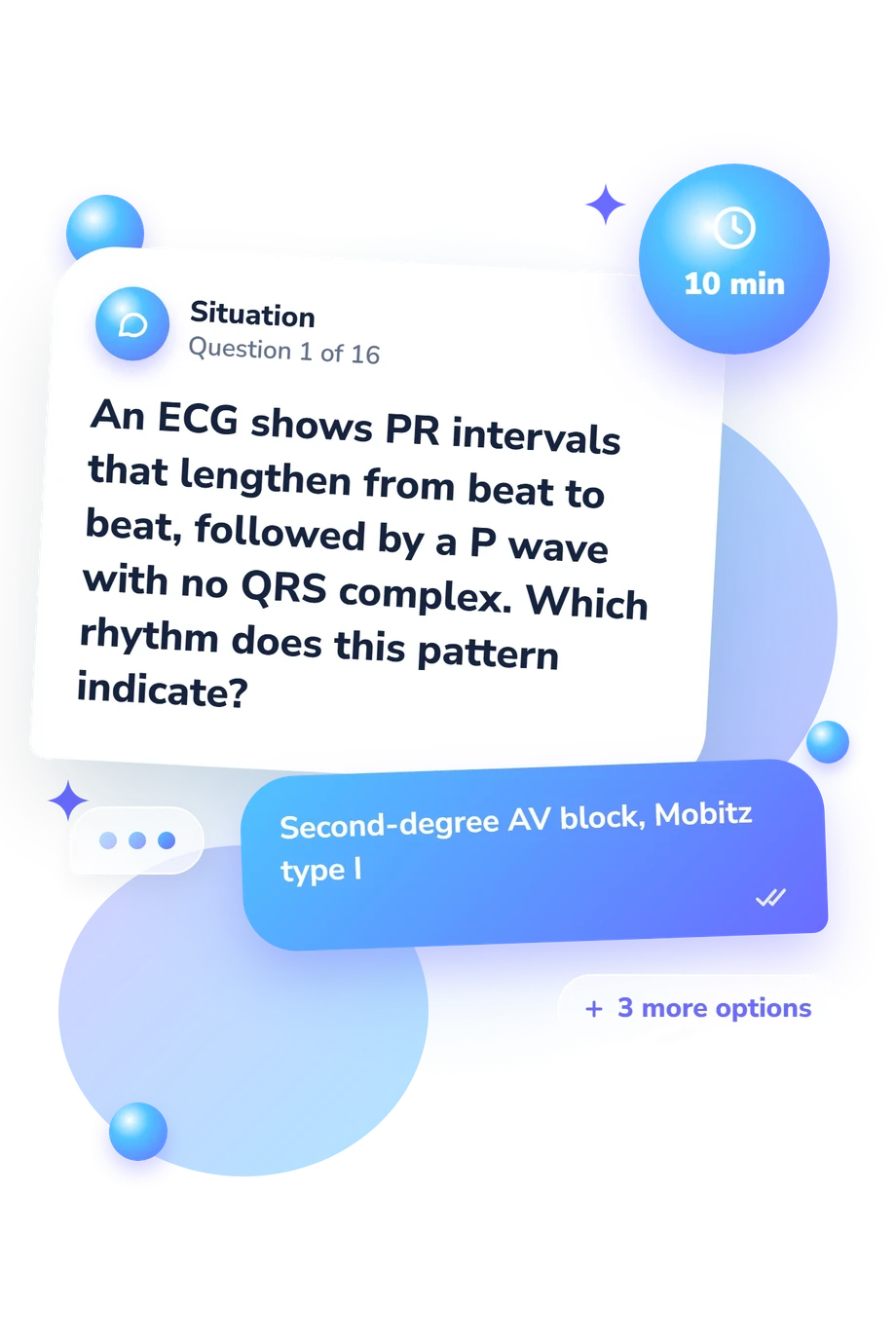
How the Scales are Structured
Who Usually Takes This Test?
See How You Compare
Below is a preview of how scores are typically distributed across each scale.
Example Questions From the Test
- Generation of every impulse within the ventricular muscle
- Transmission of impulses from the atria toward the ventricles
- Recovery of the heart muscle after ventricular contraction
- Blood flow from the ventricles into the major arteries
- A QRS complex appears without any atrial activity nearby
- A T wave is followed immediately by another T wave
- The PR interval becomes shorter than the QRS duration
- A P wave appears without a subsequent QRS complex
- The end of the P wave to the end of the QRS complex
- The peak of one R wave to the peak of the next R wave
- The beginning of the QRS complex to the end of the T wave
- The beginning of the P wave to the beginning of the QRS complex
Heart Block Quiz - Description and methodology of the test
Designed for learners, students, and readers reviewing ECG interpretation, this assessment checks whether core atrioventricular conduction concepts can be applied to described rhythms. The Heart Block Quiz connects terminology with PR intervals, dropped QRS complexes, complete dissociation, symptoms, and management choices. This heart block assessment offers a focused educational snapshot and points to areas that may deserve further study.
What This Assessment Measures
AV block can delay or interrupt transmission from the atria to the ventricles. The questions link it to PR intervals, nonconducted P waves, dropped QRS complexes, atrial-ventricular dissociation, medication effects, and urgent response choices. In this ECG-focused quiz about heart block, the questionnaire also tests recognition of ECG patterns described in words.
The question themes contributing to that single educational result are:
- AV conduction basics show how impulses reach the ventricles.
- PR intervals reveal delayed or failed conduction.
- Mobitz pattern recognition separates progressive lengthening from sudden dropped beats.
- Knowledge of appropriate responses to concerning findings links symptoms, medication effects, and urgent-care choices with action.
The Heart Block Knowledge score is 0-16: Foundation to build (0-6) marks topics to review; Developing knowledge (7-12) reflects core understanding; Strong knowledge (13-16) indicates solid educational understanding of AV heart block and its ECG patterns.
Methodology and Evidence Base
This AV-block quiz presents short ECG descriptions, conduction definitions, interval measurement, medication context, symptoms, and management scenarios with four answer choices. Each item asks for the interpretation or action that best matches the finding. The questionnaire reports one educational result on that scale; it is not a symptom or severity scale.
The terminology and distinctions used in the questions are consistent with Barold and Herweg's (2012) treatment of second-degree block, while the 2018 ACC/AHA/HRS guideline supports the management content on symptomatic bradycardia, high-grade block, reversible causes, and pacing. The questionnaire is conceptually consistent with these sources, not an adaptation or validated administration of them.
The score is unvalidated and has no diagnostic or clinical-cutoff meaning. Guessing, prior ECG training, attention, and interpretation of written rhythms can affect performance, so the result is best read as a learning snapshot rather than a measure of clinical competence; it cannot assess symptoms, and fainting, chest pain, severe breathlessness, confusion, or a markedly slow pulse with symptoms require urgent medical help.
- Barold SS, Herweg B. Second-degree atrioventricular block revisited. Herzschrittmachertherapie + Elektrophysiologie. 2012;23(4):296-304. 10.1007/s00399-012-0240-8
- Kusumoto FM, Schoenfeld MH, Barrett C, Edgerton JR, Ellenbogen KA, Gold MR, Goldschlager NF, Hamilton RM, Joglar JA, Kim RJ, Lee R, Marine JE, McLeod CJ, Oken KR, Patton KK, Pellegrini C, Selzman KA, Thompson A, Varosy PD. 2018 ACC/AHA/HRS Guideline on the Evaluation and Management of Patients With Bradycardia and Cardiac Conduction Delay: A Report of the American College of Cardiology/American Heart Association Task Force on Clinical Practice Guidelines and the Heart Rhythm Society. Circulation. 2019;140:e382-e482. 10.1161/CIR.0000000000000628
- Silverman ME, Upshaw CB Jr, Lange HW. Woldemar Mobitz and His 1924 Classification of Second-Degree Atrioventricular Block. Circulation. 2004;110(9):1162-1167. 10.1161/01.CIR.0000140669.35049.34
Updated: