
Hamlet Act 4 Quiz
How the Scales are Structured
Who Usually Takes This Test?
See How You Compare
Below is a preview of how scores are typically distributed across each scale.
Example Questions From the Test
- Death, lost love, and sexual betrayal
- Military honor, national borders, and royal succession
- Religious forgiveness, political reform, and lawful judgment
- Childhood education, family wealth, and courtly entertainment
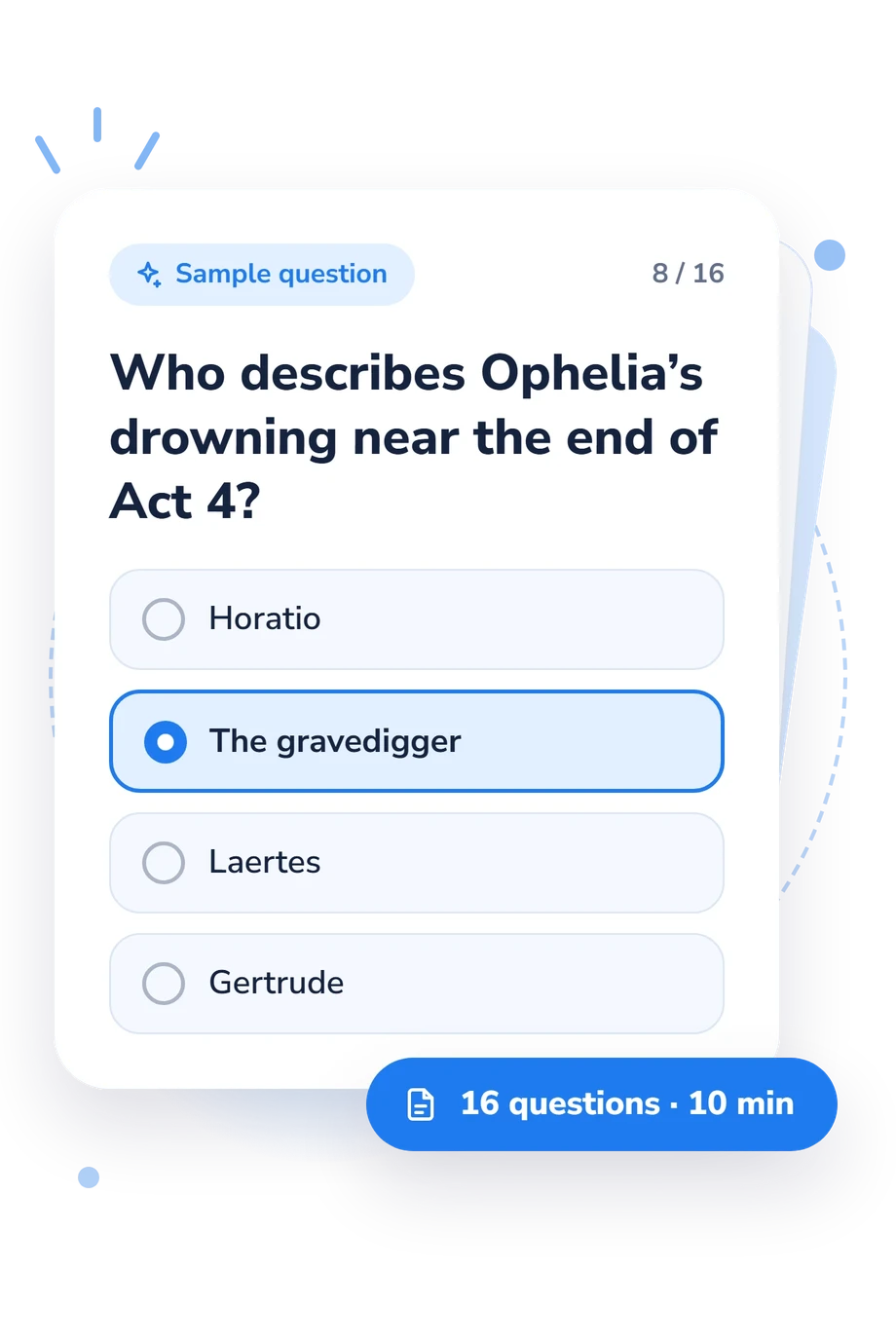
- Horatio
- The gravedigger
- Laertes
- Gertrude
- Fennel
- Rue
- Rosemary
- Violets
Hamlet Act 4 Quiz - Description and methodology of the test
For students, teachers, and independent readers, the Hamlet Act 4 Quiz provides a focused way to check how securely the act’s events, motives, images, and dramatic contrasts are understood. It is useful for Act 4 Hamlet revision when a close reading feels familiar but specific details remain uncertain. The result indicates overall command of Act 4 content and helps readers decide what to revisit.
What This Assessment Explores
Act 4 turns private revenge into political danger, grief, and public disorder. The assessment follows Hamlet’s return, Claudius’s manipulation, Laertes’s anger, Fortinbras’s example, Ophelia’s songs and drowning, and recurring concerns with death, memory, honor, and bodily decay.
The Act 4 Hamlet questions ask readers to place events, infer motives, and interpret images such as the “supper” metaphor, the flowers, and the “sponge.” The result reflects these dimensions:
- Plot and sequence show whether major developments are placed accurately.
- Character motives show how central figures respond to pressure and loss.
- Imagery and themes show whether symbolic details connect with death, memory, and status.
- Dramatic contrasts show how hesitation, personal revenge, and warfare shape injured honor.
The result reports one scale, Hamlet Act 4 Knowledge (0-16), with Foundation to Review (0-6), Developing Command (7-12), and Strong Command (13-16).
Methodology and Evidence Base
Each item presents a prompt with four answer choices. Some ask for a precise textual detail; others ask for the best interpretation of a motive, image, sequence, or relationship. The questionnaire reports an overall score, but its answer-to-score calculation is not specified, so no points-per-answer rule should be inferred.
Reviewing quiz answers for Act 4 of Hamlet against the relevant speech or stage action can clarify a missed detail, especially where the act permits more than one plausible emphasis.
The textual anchor is Hamlet, Act 4 (Shakespeare). Its emphasis on Hamlet and Fortinbras is conceptually consistent with Lawrence (1946), which reads them as contrasting responses to honor, action, and political purpose. Hamamra and Abusamra (2020) provide literary context for Horatio’s role as catastrophe approaches; their study does not establish the questionnaire’s methodology or validity.
For this online quiz, no standardization, norms, reliability coefficients, or validity estimates are documented. Results can vary with memory, prior teaching, wording sensitivity, and interpretation of ambiguous passages, so a lower score is best used as a prompt to reread relevant passages more closely.
- Shakespeare, William. The Tragedy of Hamlet, Prince of Denmark. Edited by Barbara A. Mowat and Paul Werstine. New York: Simon & Schuster Paperbacks, 2012.
- Lawrence, William Witherle. “Hamlet and Fortinbras.” PMLA, vol. 61, no. 3, 1946, pp. 673-698. 10.1632/459241.
- Hamamra, Bilal Tawfiq, and Sanaa Abusamra. “O, I Die, Horatio”: Witness and Martyrdom in Shakespeare’s Hamlet. The Explicator, vol. 78, nos. 3-4, 2020, pp. 124-127. 10.1080/00144940.2020.1794770.
Updated: