
Guess the Ethnicity Quiz
How the Scales are Structured
Who Usually Takes This Test?
See How You Compare
Below is a preview of how scores are typically distributed across each scale.
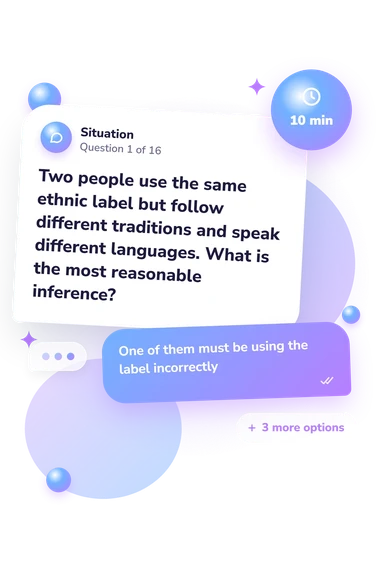
Example Questions From the Test
- Sardinian
- Breton
- Basque
- Catalan
- Chamorro
- Aboriginal Australians
- Samoan
- Māori
- Tajiks
- Baloch
- Punjabis
- Pashtuns
Guess the Ethnicity Quiz - Description and methodology of the test
Readers who want to examine how they reason about cultural identity can use the Guess the Ethnicity Quiz as a focused knowledge check. This online ethnicity knowledge test suits people who want to distinguish ethnic identity from nationality, ancestry, language, and appearance without assigning an identity to anyone. The result offers a structured snapshot of conceptual understanding and highlights areas where more careful interpretation may help.
What This Assessment Explores
The questionnaire tests whether a respondent can separate ethnicity from nationality, ancestry, language, and appearance. Situations address internal diversity, multiple affiliations, self-identification, changing DNA estimates, and communities linked to regions or languages. The aim is careful interpretation, not judging identity from one clue.
The ethnicity quiz measures three related abilities:
- Separating ethnicity from nationality keeps cultural affiliation distinct from citizenship.
- Recognizing layered identity allows for several communities or affiliations.
- Weighing clues cautiously avoids treating language, birthplace, appearance, surnames, or DNA estimates as proof.
Ethnicity Knowledge ranges from 0-16. Foundational (0-6) means core distinctions may need review; Developing (7-12) reflects useful understanding with room to strengthen unfamiliar concepts; Strong (13-16) indicates consistent awareness of ethnic inference limits. The score measures quiz knowledge, not anyone’s ethnicity.
Methodology and Evidence Base
Each item presents a short scenario or recognition question with four answer choices. The response format asks the reader to select the best-supported interpretation, so the assessment emphasizes conceptual accuracy and restraint around uncertain evidence. Responses are summarized as one Ethnicity Knowledge result rather than separate personality or identity profiles.
The questionnaire is conceptually consistent with Ford and Harawa (2010), who describe ethnicity as multidimensional and socially situated. Lu et al. (2022) and Hollenbach et al. (2015) support keeping race, ethnicity, and ancestry distinct in research and interpreting self-identification with care. Hollenbach et al. (2015) compares self-identification with genetic information, showing why these works are not interchangeable. This ethnicity test is a structured online knowledge questionnaire whose themes are conceptually consistent with these studies.
The bands describe performance on these questions, not anyone’s ethnicity or ability to identify people by appearance. Results can reflect education, cultural exposure, familiarity with examples, and how the respondent reads each scenario. The outcome helps the respondent examine distinctions among identity categories where a single clue cannot establish belonging.
- Ford, Chandra L., and Nina T. Harawa. "A new conceptualization of ethnicity for social epidemiologic and health equity research." Social Science & Medicine 71, no. 2 (2010): 251-258. 10.1016/j.socscimed.2010.04.008
- Lu, Clara, Rabeeyah Ahmed, Amel Lamri, and Sonia S. Anand. "Use of race, ethnicity, and ancestry data in health research." PLOS Global Public Health 2, no. 9 (2022): e0001060. 10.1371/journal.pgph.0001060
- Hollenbach, Jill A., Ann Saperstein, Michael Albrecht, Christine Vierra-Green, Peter Parham, Peter J. Norman, et al. "Race, Ethnicity and Ancestry in Unrelated Transplant Matching for the National Marrow Donor Program: A Comparison of Multiple Forms of Self-Identification with Genetics." PLOS ONE 10, no. 8 (2015): e0135960. 10.1371/journal.pone.0135960