
Good vs Well Quiz
How the Scales are Structured
Who Usually Takes This Test?
See How You Compare
Below is a preview of how scores are typically distributed across each scale.
Example Questions From the Test
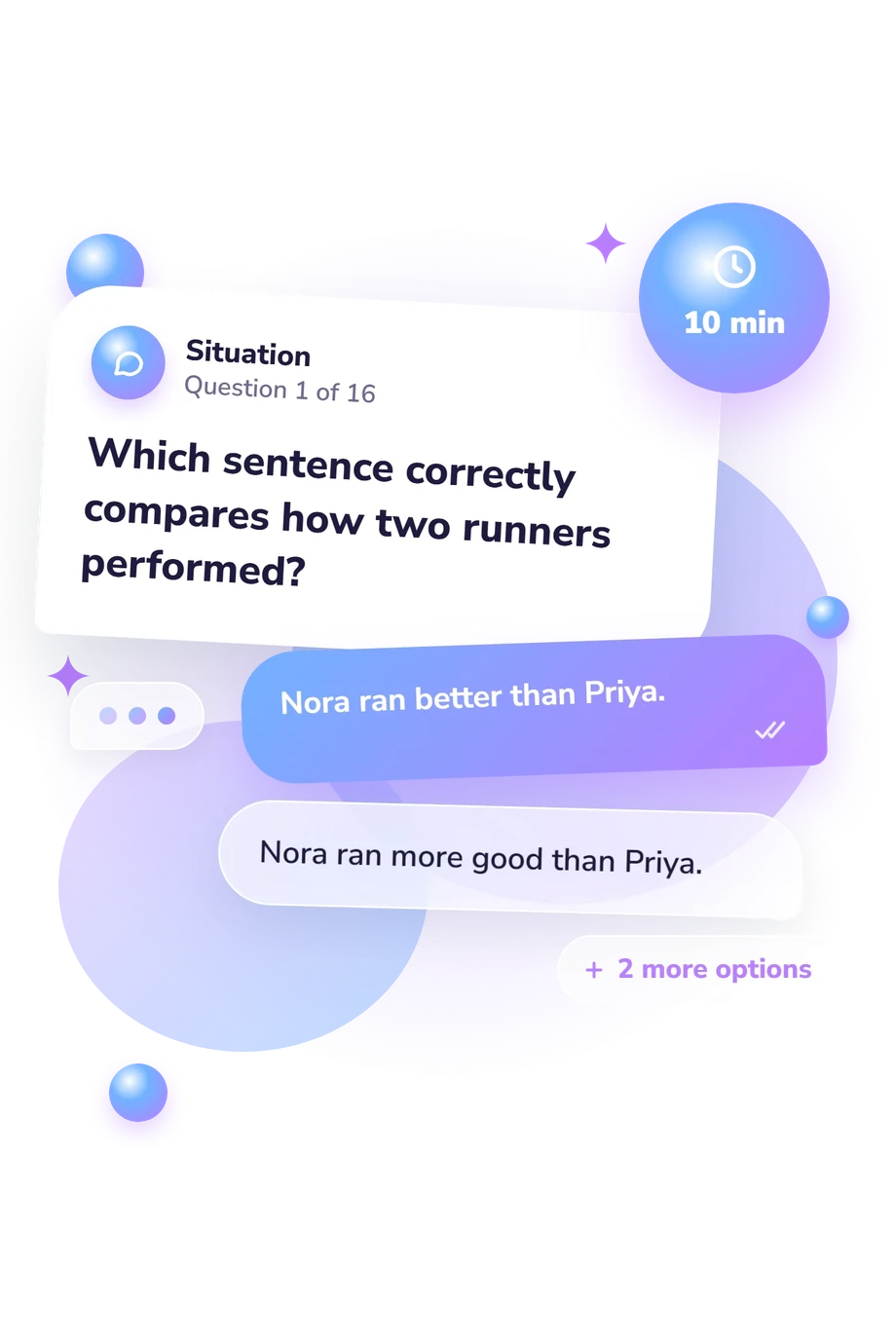
- Nora ran better than Priya.
- Nora ran more good than Priya.
- Nora ran gooder than Priya.
- Nora ran more weller than Priya.
- After a week of rest, Maya recovered good.
- After a week of rest, Maya is well again.
- After a week of rest, Maya well recovered.
- After a week of rest, Maya is goodly again.
- That plan sounds wellly.
- That plan well sounds.
- That plan sounds good.
- That plan sounds a well.
Good vs Well Quiz - Description and methodology of the test
Readers who hesitate over sentences such as “She explained the process well” or “The report sounds good” can use this assessment to clarify good and well usage. Designed for English learners, writers, editors, and speakers, the good vs well quiz offers a focused check of standard usage. Its result summarizes performance across the grammatical situations represented by the questions, rather than promising feedback on each context.
What This Assessment Explores
The assessment examines how accurately a reader distinguishes two forms with different standard-grammar roles. Questions cover adjective and adverb use, linking verbs, health, comparison, compounds, and the difference between quality and performance. It suits readers seeking practice with the grammar of good and well rather than a measure of English proficiency.
These groups show what the result covers:
- Adjective use shows how good describes nouns, linking verbs, and quality.
- Adverb use shows how well describes actions.
- Health and mood contexts show when well means healthy or emotionally positive.
- Comparatives and compounds check forms such as better and well-prepared.
The Good vs Well Knowledge scale runs from 0-16: Building Foundations (0-6), Developing Knowledge (7-12), and Strong Knowledge (13-16). The result summarizes performance across the represented grammatical situations.
Methodology and Scientific Basis
Each item presents a sentence or usage situation with four choices. The respondent selects the standard-English option, identifies a word’s role, or corrects an unsuitable form. This combines recognition with application while keeping the task focused on observable language choices.
The questionnaire presents one knowledge result rather than separate scores for grammatical contexts. Interpretation uses three knowledge bands, so the labels describe demonstrated understanding rather than a fixed ability. The questionnaire is a quiz about good and well that can support practice by revisiting grammatical situations represented in the items.
Its framework is consistent with English Grammar Today, which distinguishes usual adjective and adverb functions of good and well while noting exceptions, and with Huddleston and Pullum’s grammatical analysis. The questionnaire is conceptually consistent with those sources, not an adaptation or validation of either work.
This version has no stated norm group, reliability estimate, or independent validation. Attention, prior instruction, and familiarity with formal usage can affect a result, so the result is best read as feedback on these language choices rather than a measure of English competence.
- Cambridge University Press & Assessment. “Part of speech: good or well?” English Grammar Today, Cambridge Dictionary, n.d. Accessed September 21, 2026.
- Huddleston, Rodney D., and Geoffrey K. Pullum. The Cambridge Grammar of the English Language. Cambridge University Press, 2002. 10.1017/9781316423530.
Updated: