
Gaydar Test
How the Scales are Structured
Who Usually Takes This Test?
See How You Compare
Below is a preview of how scores are typically distributed across each scale.
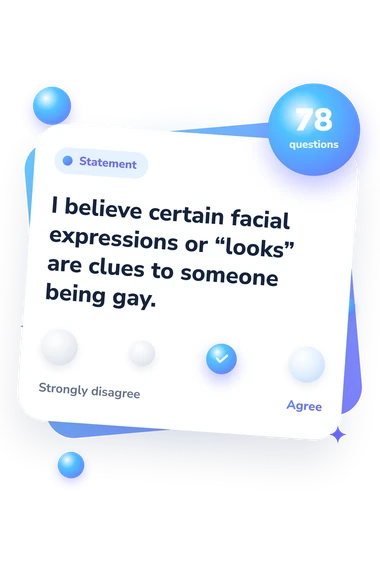
Example Questions From the Test
- Strongly disagree
- Disagree
- Not sure
- Agree
- Strongly disagree
- Disagree
- Not sure
- Agree
- Strongly disagree
- Disagree
- Not sure
- Agree
Gaydar Test - Description and methodology of the test
People who want to examine how they read social cues may use the gaydar test as a structured prompt for self-reflection, rather than as a verdict about anyone’s identity. It is suited to people curious about first impressions, confidence, and assumptions when interpreting another person’s sexuality. This gaydar quiz helps reveal whether certainty comes from context, communication, or familiar visual and behavioral stereotypes.
What This Assessment Explores
This questionnaire examines how people make quick judgments about perceived sexual orientation; some items use LGBTQ+ wording for that subject. Its agreement statements mention facial expressions, emotional expressiveness, dating talk, grooming, clothing, hairstyles, mannerisms, gender presentation, and visible friend groups. The emphasis is on interpreting limited cues and deciding how much confidence to place in an impression, not on establishing another person’s identity.
Together, the statements make this a gaydar questionnaire with three profile dimensions:
- Confidence in Snap Judgments (0-30) shows certainty when interpreting cues; Cautious 0-10, Moderate 11-20, and Very Confident 21-30 are the displayed bands.
- Perceived Gaydar Accuracy (0-40) captures self-rated accuracy, not objective accuracy; Low confidence 0-13, Moderate confidence 14-27, and High confidence 28-40 are shown.
- Stereotype Reliance (0-30) reflects reliance on stereotyped cues over context or communication; Low reliance 0-10, Moderate reliance 11-20, and High reliance 21-30 are shown.
Methodology and Scientific Basis
Each statement uses a four-option agreement format: Strongly disagree, Disagree, Not sure, or Agree. The items ask about confidence, willingness to commit quickly, perceived reliability, and reliance on appearance or mannerisms. Responses are combined into the three profile dimensions; the displayed ranges and bands describe result categories, but the questionnaire does not state that every answer contributes an identical number of points.
The framework is conceptually consistent with Cox et al. (2016), who examined how stereotypes and facial cues shape inferences about sexual orientation. It is not presented as an adaptation of their measure. Rule and Alaei (2016) describe how subtle cues can influence perception, while Miller (2018) highlights the importance of context, bias, and the difference between perceived and demonstrated accuracy.
Conceptually, the gaydar assessment is consistent with these sources; they provide context rather than validation for this online questionnaire, its scales, displayed categories, or accuracy measure. The online profile reports self-rated confidence and perceived accuracy rather than objective performance. Because answers are self-reported, scores may vary with context, self-awareness, and social desirability; a high perceived-accuracy result cannot verify an individual judgment.
- Cox, William T. L., Patricia G. Devine, Alyssa A. Bischmann, and Janet S. Hyde. Inferences About Sexual Orientation: The Roles of Stereotypes, Faces, and The Gaydar Myth. Journal of Sex Research, 53(2), 157-171 (2016). 10.1080/00224499.2015.1015714
- Rule, Nicholas O., and Ravin Alaei. “Gaydar”: The Perception of Sexual Orientation From Subtle Cues. Current Directions in Psychological Science, 25(6), 444-448 (2016). 10.1177/0963721416664403
- Miller, Arianne E. Searching for gaydar: Blind spots in the study of sexual orientation perception. Psychology & Sexuality, 9(3), 188-203 (2018). 10.1080/19419899.2018.1468353