
Gas Laws Quiz
How the Scales are Structured
Who Usually Takes This Test?
See How You Compare
Below is a preview of how scores are typically distributed across each scale.
Example Questions From the Test
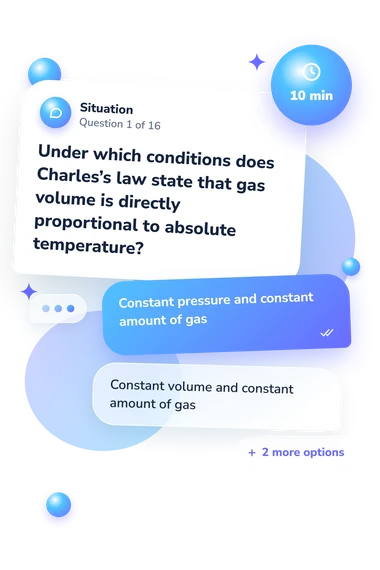
- Constant pressure and constant amount of gas
- Constant volume and constant amount of gas
- Constant temperature and constant amount of gas
- Constant pressure and constant volume
- Boyle’s law
- Gay-Lussac’s law
- Avogadro’s law
- Graham’s law
- 050 mol
- 120 mol
- 500 mol
- 200 mol
Gas Laws Quiz - Description and methodology of the test
Students reviewing introductory chemistry can use this gas laws quiz to check how confidently they connect pressure, volume, temperature, amount of gas, and particle behavior. It suits learners preparing for classwork, revision, or a self-directed knowledge check. A chemistry gas-law quiz can highlight whether further study should focus on conceptual relationships, equation selection, units, or multi-step calculations.
What This Assessment Explores
The questionnaire checks whether learners can connect gas variables and apply their relationships in familiar chemical situations. It covers proportional laws, the ideal gas equation, partial pressure, gas collection over water, effusion, density, and departures from ideal behavior. Results from this gas law practice quiz combine conceptual and numerical performance.
The question themes show what the result samples:
- Gas-law relationships show whether changing one variable is linked correctly to pressure, volume, temperature, or amount when conditions are fixed.
- Calculation items test equation choice, Kelvin conversion, units, and handling pressure, volume, and moles.
- Mixture and molecular questions cover partial pressure, water vapor, effusion, density, molar mass, and ideal-gas limits.
- Gas Laws Knowledge (0-16) awards one point per correct answer: Foundation to Build covers 0-6, Developing Knowledge covers 7-12, and Strong Knowledge covers 13-16. Higher bands indicate more consistent links among principles, calculations, and practical scenarios.
Methodology and Scientific Basis
Each item is multiple choice with four answer options and asks for a law, a qualitative prediction, or a calculation involving proportional reasoning, PV = nRT, partial pressures, or Graham’s law. One point is awarded for each correct response, producing a total that is interpreted through the displayed performance bands rather than population percentiles.
The structure is conceptually consistent with Lin, Cheng, and Lawrenz (2000), who examined common understanding of gas-law relationships, and with Kautz, Heron, Loverude, and McDermott (2005), who analyzed ideal-gas reasoning from a macroscopic perspective. The quiz is not presented as an adaptation of either study; the sources support its themes, not its scores.
Reviewing the gas law quiz answers is most useful when you explain why a relationship works, since errors can arise from fixed-condition assumptions, Kelvin conversion, units, or arithmetic. No population norms, reliability estimates, or formal standardization are stated for this online version. Guessing, preparation, and concentration can affect performance, so the result is a focused snapshot that guides practice rather than a complete measure of chemistry achievement.
- Lin, Huann-shyang, Hsiu-ju Cheng, and Frances Lawrenz. "The Assessment of Students and Teachers' Understanding of Gas Laws." Journal of Chemical Education 77, no. 2 (2000): 235-238. 10.1021/ed077p235
- Kautz, Christian H., Paula R. L. Heron, Michael E. Loverude, and Lillian C. McDermott. "Student understanding of the ideal gas law, Part I: A macroscopic perspective." American Journal of Physics 73, no. 11 (2005): 1055-1063. 10.1119/1.2049286