
Free WHMIS Quiz
How the Scales are Structured
Who Usually Takes This Test?
See How You Compare
Below is a preview of how scores are typically distributed across each scale.
Example Questions From the Test
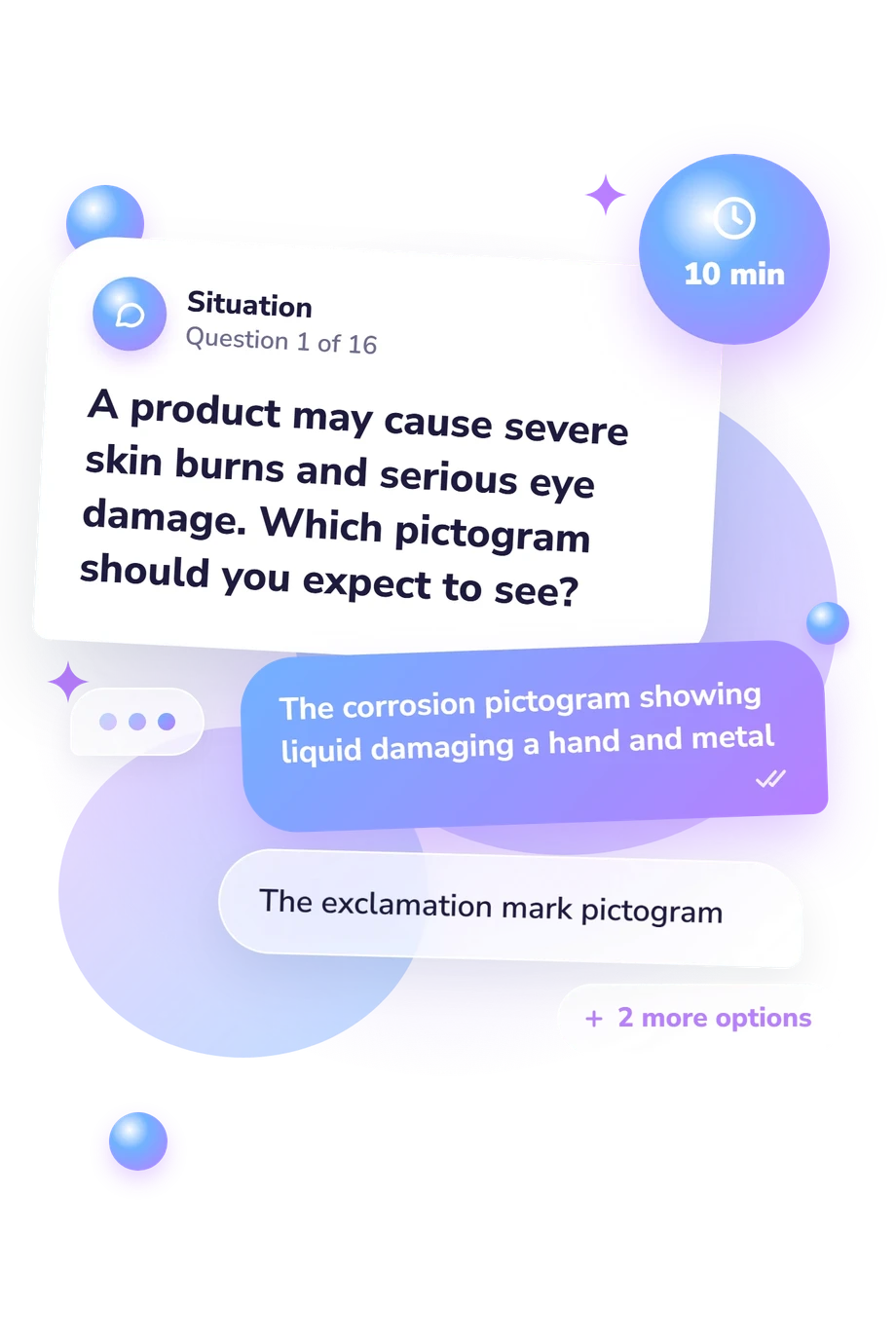
- The corrosion pictogram showing liquid damaging a hand and metal
- The exclamation mark pictogram
- The gas cylinder pictogram
- The flame-over-circle pictogram
- Inspections, exposure testing, and incident reports
- Medical screening, warning alarms, and evacuation maps
- Shipping documents, insurance records, and equipment manuals
- Labels, safety data sheets, and worker education and training
- The exclamation mark
- The health hazard silhouette with a starburst in the chest
- The flame over circle
- The gas cylinder
Free WHMIS Quiz - Description and methodology of the test
Anyone preparing to handle hazardous products, refresh workplace knowledge, or check whether key WHMIS concepts are familiar can use this assessment as a focused learning checkpoint. The Free WHMIS Quiz turns common workplace situations into a practical knowledge check rather than asking for personal opinions. Used as a WHMIS refresher quiz, this assessment identifies broad topics worth reviewing before formal training or site-specific instruction.
What This Assessment Measures
The questionnaire checks whether a reader can apply WHMIS communication rules to familiar workplace situations. It addresses pictograms, supplier and workplace labels, safety data sheets, signal words, hazard classes, and the link between knowledge and site-specific training.
Items require practical choices: stopping when a label is unreadable, selecting precautions for flammable materials, locating first-aid instructions in an SDS, or recognizing when a transferred product needs a workplace label. As a WHMIS safety quiz, this assessment covers hazard-communication knowledge rather than evaluating an employer’s complete safety program.
The unvalidated educational score appears on the WHMIS Knowledge scale (0-16), with these bands:
- Foundation (0-6) indicates recognition of some WHMIS ideas, with pictograms, labels, and SDS basics worth reviewing.
- Developing (7-12) indicates understanding of many core concepts, while some topics remain worth revisiting.
- Strong (13-16) indicates broad knowledge of WHMIS communication and common workplace applications.
Methodology and Evidence Base
Each item presents a workplace question with four answer choices, and the respondent selects the option that best matches WHMIS requirements. This WHMIS knowledge quiz presents one educational score, not separate ratings for each hazard class. This assessment can indicate whether broad WHMIS communication concepts merit further review; its unvalidated score does not establish certification, and site-specific procedures remain matters for workplace instruction.
The content is conceptually consistent with the WHMIS 2015 Instructor's Toolkit, which organizes communication around labels, SDSs, and worker training. Health Canada's supplier requirements give regulatory context for label content, pictograms, signal words, and bilingual presentation. The questionnaire is not a direct adaptation of either publication.
Interpretation should remain broad: use the result to decide whether pictograms, labels, SDSs, or worker training merit further review; storage, ventilation, spill response, and emergency procedures belong to workplace instruction rather than being identified by this score.
Answers can be affected by guessing, prior experience, self-awareness, and immediate context. Check the applicable label and SDS and follow workplace procedures when making decisions about an actual hazardous product or exposure.
- Canadian Centre for Occupational Health and Safety. WHMIS 2015: Instructor's Toolkit. Hamilton, Ontario: Canadian Centre for Occupational Health and Safety; 2015.
- Tenkate T, Kramer DM, Strahlendorf P, Szymanski T. Setting priorities: Testing a tool to assess and prioritize workplace chemical hazards. Work. 2021;70(1):85-98. 10.3233/WOR-205270
- Health Canada. Technical Guidance on the Requirements of the Hazardous Products Act and the Hazardous Products Regulations: WHMIS 2015 Supplier Requirements. Ottawa: Health Canada; 2016. ISBN 978-0-660-06575-5.
Updated: