
Food Label Quiz
How the Scales are Structured
Who Usually Takes This Test?
See How You Compare
Below is a preview of how scores are typically distributed across each scale.
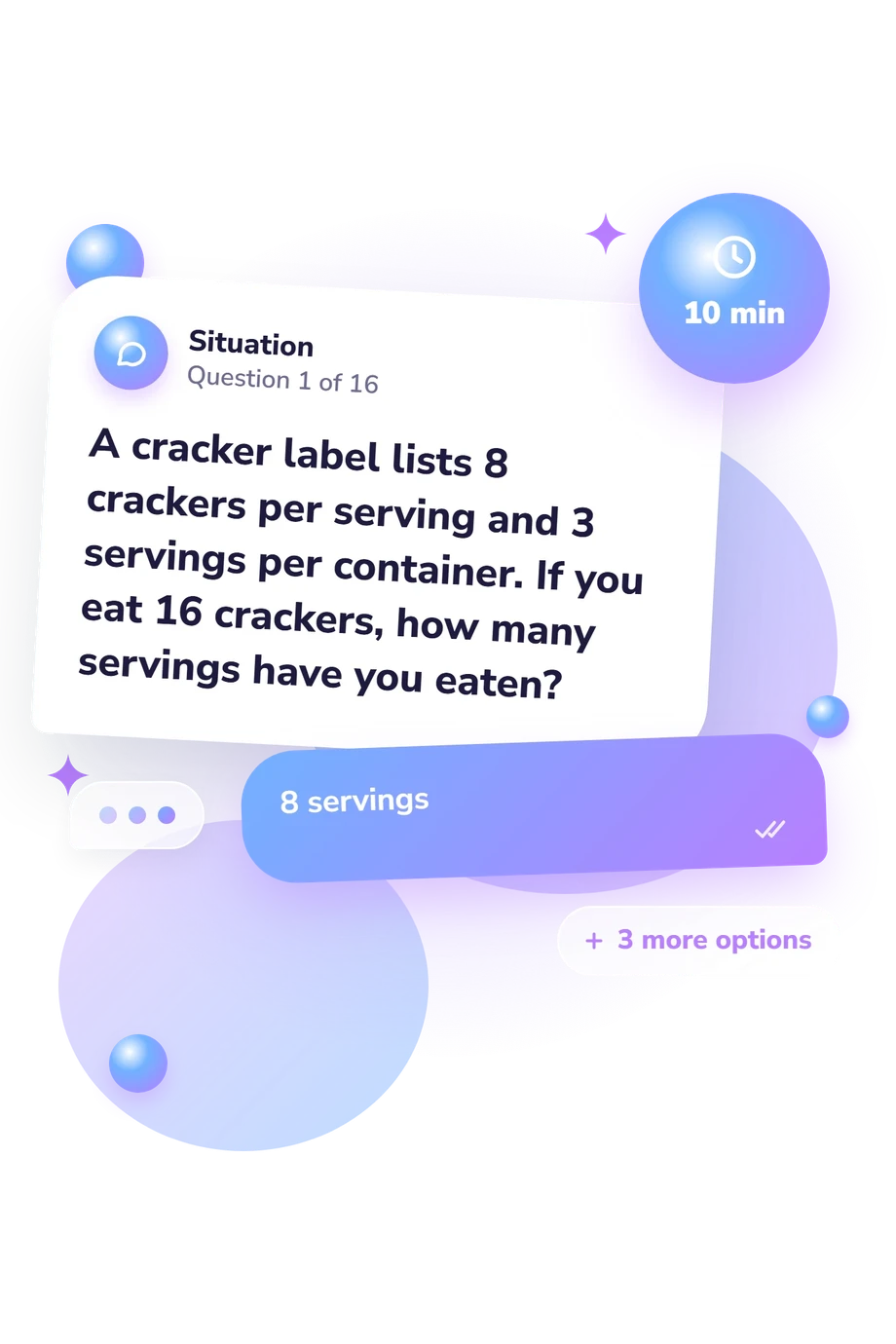
Example Questions From the Test
- Alphabetically by ingredient name
- By weight, from the greatest amount to the least
- From the largest ingredient by volume to the smallest
- From the most nutritious ingredient to the least nutritious
- 2,500 calories per day for every adult
- 1,200 calories per day for every adult
- 2,000 calories per day, although individual calorie needs vary
- The exact calorie requirement of the person reading the label
- 5% DV or less is low, while 20% DV or more is high
- 10% DV or less is low, while 50% DV or more is high
- 5% DV or less is high, while 20% DV or more is low
- Any value below 100% DV is considered low
Food Label Quiz - Description and methodology of the test
People comparing packaged foods can use this food label quiz to check practical understanding of U.S. Nutrition Facts panels and ingredient statements. The questionnaire uses a nutrition label quiz format built around serving sizes, Daily Values, and ingredient ordering, which suits curious shoppers, students, and anyone refreshing everyday nutrition information. It produces a knowledge profile pointing to strengths and topics for review.
What This Assessment Explores
The questionnaire tests practical label understanding: locating facts, interpreting regulated wording, and calculating amounts when packages contain multiple servings. Items cover portion conversions, calorie and sodium comparisons, Daily Values, ingredient order, allergen declarations, added sugars, and claims such as low or reduced.
The questions make this a reading food labels quiz, showing how accurately readers handle U.S. conventions. It suits shoppers, students, and anyone refreshing nutrition knowledge. The single displayed score is Food Label Knowledge (0-16), with Foundational (0-6), Developing (7-12), and Strong (13-16) bands.
The questions cover these practical areas:
- Serving-size reasoning shows whether you adjust calories and nutrients when portions change.
- Nutrient and Daily Value reading shows how you interpret amounts, percentages, and reference values.
- Ingredients and claims comprehension shows whether you understand ordering, allergen statements, and regulated wording.
Methodology and Scientific Basis
Each item presents a label scenario with four choices. Some questions test meaning; others require proportional reasoning, such as converting portions or scaling sodium to a common amount. Correct responses are totaled on one educational scale, and the displayed band follows that total.
The approach is conceptually consistent with Levy and Fein's 1998 study of consumers' ability to use nutrition labels. This questionnaire is a separate educational questionnaire, not that published study. Its conventions align with FDA guidance on serving sizes, the 2,000-calorie reference for % Daily Value, ingredient ordering, nutrient claims, and allergen declarations.
In this food label knowledge test, the result is a snapshot of performance under the question format. Higher scores indicate stronger handling of the tested conventions. The displayed bands can guide review: lower results point to label basics, middle results to sharper calculations and claim interpretation, and higher results to applying knowledge consistently. The bands are educational indicators, not clinical thresholds or measures of dietary quality or individualized nutrition needs. Interpretation depends on attention, arithmetic, familiarity with U.S. rules, honest self-report, and current context.
- Levy, Alan S., and Sara B. Fein. “Consumers’ Ability to Perform Tasks Using Nutrition Labels.” Journal of Nutrition Education, vol. 30, no. 4, 1998, pp. 210-217. 10.1016/S0022-3182(98)70321-8.
- U.S. Food and Drug Administration. “How to Understand and Use the Nutrition Facts Label.” Nutrition Education Resources & Materials, March 5, 2024.
- U.S. Food and Drug Administration. “Guidance for Industry: Food Labeling Guide.” January 2013.
- U.S. Food and Drug Administration. “Final Guidance for Industry: Questions and Answers Regarding Food Allergens, Including the Food Allergen Labeling Requirements of the Federal Food, Drug, and Cosmetic Act (Edition 5).” January 2025.
Updated: