
Fictional Character Quiz
How the Scales are Structured
Who Usually Takes This Test?
See How You Compare
Below is a preview of how scores are typically distributed across each scale.
Example Questions From the Test
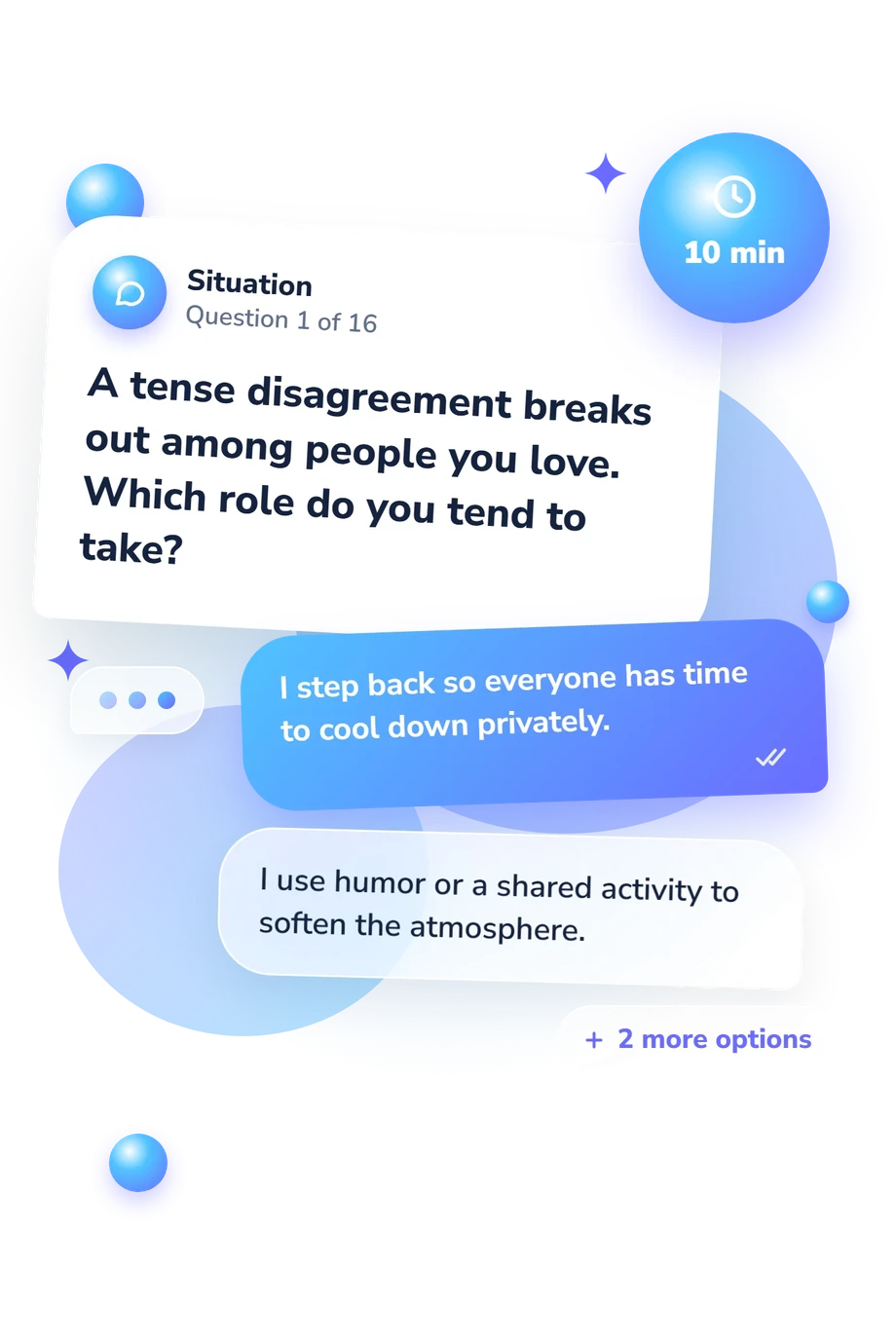
- I step back so everyone has time to cool down privately.
- I use humor or a shared activity to soften the atmosphere.
- I quietly help each person understand the others’ concerns.
- I speak candidly, defend what matters, and then work toward repair.
- Taking an unplanned trip somewhere with unfamiliar scenery.
- Preparing a relaxed gathering where friends can reconnect.
- Learning a structured skill that has clear steps and measurable progress.
- Turning an idea I care about into a story, project, or expressive piece.
- Follow the people who seem familiar with the place.
- Choose the clearest sign and treat it as the working rule.
- Imagine a few explanations that could make all the signs fit together.
- Test the apparent pattern and ask questions until the contradiction becomes interesting.
Fictional Character Quiz - Description and methodology of the test
Readers who enjoy stories, self-reflection, and personality-based discussion can use this fictional character quiz to connect everyday choices with qualities associated with four literary protagonists. It suits anyone using a which character personality quiz to reflect on habits, values, and problem-solving style. The outcome offers a playful profile for conversation, reflection, and noticing patterns without reducing personality to one label.
What This Assessment Explores
The questions examine conflict, uncertainty, creativity, responsibility, rules, loyalty, and difficult problems. Situational choices reveal affinity with character qualities rather than a complete personality portrait, giving the result a specific take on the what fictional character am i quiz idea.
The four scales capture literary affinity:
- Alice (0-12) measures curiosity, imagination, adaptability, and willingness to question absurd rules; Different Wonderland (0-4), Curious Visitor (5-8), and Strong Affinity (9-12) are bands.
- Jo March (0-12) measures expressive ambition, candor, devotion, and self-direction; Different Path (0-4), Kindred Streak (5-8), and Strong Affinity (9-12) are bands.
- Samwise Gamgee (0-12) measures loyalty, practical care, and quiet courage; Different Calling (0-4), Reliable Companion (5-8), and Strong Affinity (9-12) are bands.
- Sherlock Holmes (0-12) measures observation, independent reasoning, and puzzle-solving; Different Lens (0-4), Shared Traits (5-8), and Strong Affinity (9-12) are bands.
Methodology and Evidence Base
Each item presents a social, practical, or imaginative situation with four response options. Choices contrast emotion, connection, duty, independence, curiosity, evidence, and uncertainty, letting respondents select what feels characteristic.
The format works as a fictional character personality quiz, comparing four character totals. The highest score marks strongest affinity; any outcome within one point joins a blended result, with no forced winner or hidden tie-breaker. Displayed bands are interpretive levels, and the method does not state how many points each answer contributes.
Park and Henley (2007) offer the closest comparison, linking personality with fantasy-character preferences. Cohen (2001) frames identification as an audience’s relationship with a media character, while Huang and Fung (2024) offer a newer framework for narrative-character identification. These sources support comparison, but this questionnaire is not a standardized adaptation of their instruments.
For many readers, the format resembles a which fictional character are you quiz: it prompts reflection rather than offering a complete account of personality.
- Park, A. E., & Henley, T. B. (2007). Personality and Fantasy Game Character Preferences. Imagination, Cognition and Personality, 27(1), 37-46. 10.2190/IC.27.1.d
- Huang, K. Y., & Fung, H. H. (2024). Measuring identification with narrative characters: The development and validation of a new scale. Current Psychology, 43, 24835-24849. 10.1007/s12144-024-06191-2
- Cohen, J. (2001). Defining identification: A theoretical look at the identification of audiences with media characters. Mass Communication and Society, 4(3), 245-264. 10.1207/S15327825MCS0403_01
Updated: