
Ethnicity Quiz
How the Scales are Structured
Who Usually Takes This Test?
See How You Compare
Below is a preview of how scores are typically distributed across each scale.
Example Questions From the Test
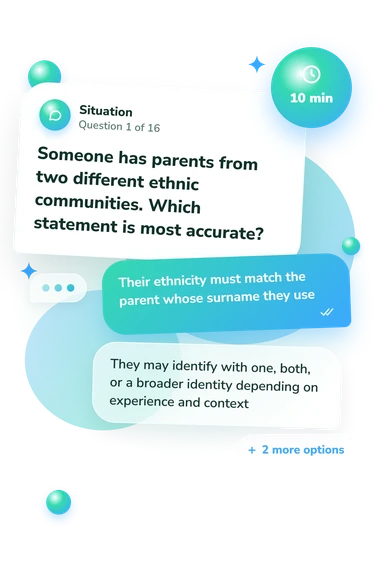
- Their ethnicity must match the parent whose surname they use
- They may identify with one, both, or a broader identity depending on experience and context
- They cannot meaningfully belong to either community
- Their ethnicity is determined by dividing each parent’s identity into exact percentages
- Assign ethnicity from each participant’s surname
- Infer ethnicity from birthplace alone
- Permit self-identification, multiple selections, and a self-description option
- Ask observers to classify participants by appearance
- The historical formation of a new or distinct ethnic identity
- Marrying primarily within a particular community
- Adopting selected customs after moving to another society
- Receiving citizenship through a legal process
Ethnicity Quiz - Description and methodology of the test
People who want to understand how cultural identity is discussed can use this assessment as a focused learning exercise. The ethnicity quiz is intended for readers who want to distinguish ethnicity from ancestry, race, nationality, and religion. Someone approaching it as a quiz asking what ethnicity I am may expect a personal label, but the result instead reports an educational profile of conceptual understanding.
What This Assessment Explores
The questions distinguish ethnicity, ancestry, nationality, race, and religion while recognizing that identities can overlap. They use situations involving self-identification, mixed backgrounds, diaspora, ethnogenesis, discrimination, minority status, language change, and acculturation. The result describes conceptual understanding rather than a respondent’s biological percentages or personal ethnicity.
The displayed scale, Ethnicity Knowledge (0-16), uses three result bands:
- Foundation (0-6) indicates recognition of basic distinctions, with possible confusion among ethnicity, ancestry, race, nationality, and religion.
- Developing (7-12) shows that central distinctions can be applied in familiar situations while more contextual understanding remains to be refined.
- Strong (13-16) reflects consistent interpretation of ethnicity as a cultural and social identity shaped by history, community, and context.
Readers expecting a quiz that helps them guess their ethnicity may assume that the result names their background, but this assessment instead evaluates whether concepts are understood in context.
Methodology and Scientific Basis
Each item presents a scenario with four answer choices. Respondents select the option that fits the distinction being tested, so the format examines understanding rather than genetic estimation. For readers expecting a quiz designed to guess their race, the items redirect attention from appearance to social context.
The displayed result reports performance on the knowledge scale and assigns a band, but the point value attached to each response is not specified. It is a non-standardized self-reflection exercise, with no population norms, reliability coefficients, or clinical cutoffs.
Its themes are conceptually consistent with Yao et al. (2021), not an adaptation of it; that work shows how multiple identifications, self-description, and response options affect ethnicity measurement. Nagel (1994) treats ethnicity as formed and re-formed through culture, history, boundaries, and interaction. Burton, Nandi, and Platt (2010) explain why flexible social categories challenge survey measurement.
Readers treating the result as a quiz asking what their ethnicity is would misread its purpose. Honest responding, current context, and self-awareness can affect performance, so the score works best as an educational snapshot for reflection and discussion.
- Yao, Esther S., Kane Meissel, Pat Bullen, Polly Atatoa Carr, Terryann C. Clark, and Susan Morton. 2021. "Classifying multiple ethnic identifications: Methodological effects on child, adolescent, and adult ethnic distributions." Demographic Research 44: 481-512. 10.4054/DemRes.2021.44.21
- Nagel, Joane. 1994. "Constructing Ethnicity: Creating and Recreating Ethnic Identity and Culture." Social Problems 41 (1): 152-176. 10.2307/3096847
- Burton, Jonathan, Alita Nandi, and Lucinda Platt. 2010. "Measuring ethnicity: challenges and opportunities for survey research." Ethnic and Racial Studies 33 (8): 1332-1349. 10.1080/01419870903527801