
East Asia Capitals Quiz
How the Scales are Structured
Who Usually Takes This Test?
See How You Compare
Below is a preview of how scores are typically distributed across each scale.
Example Questions From the Test
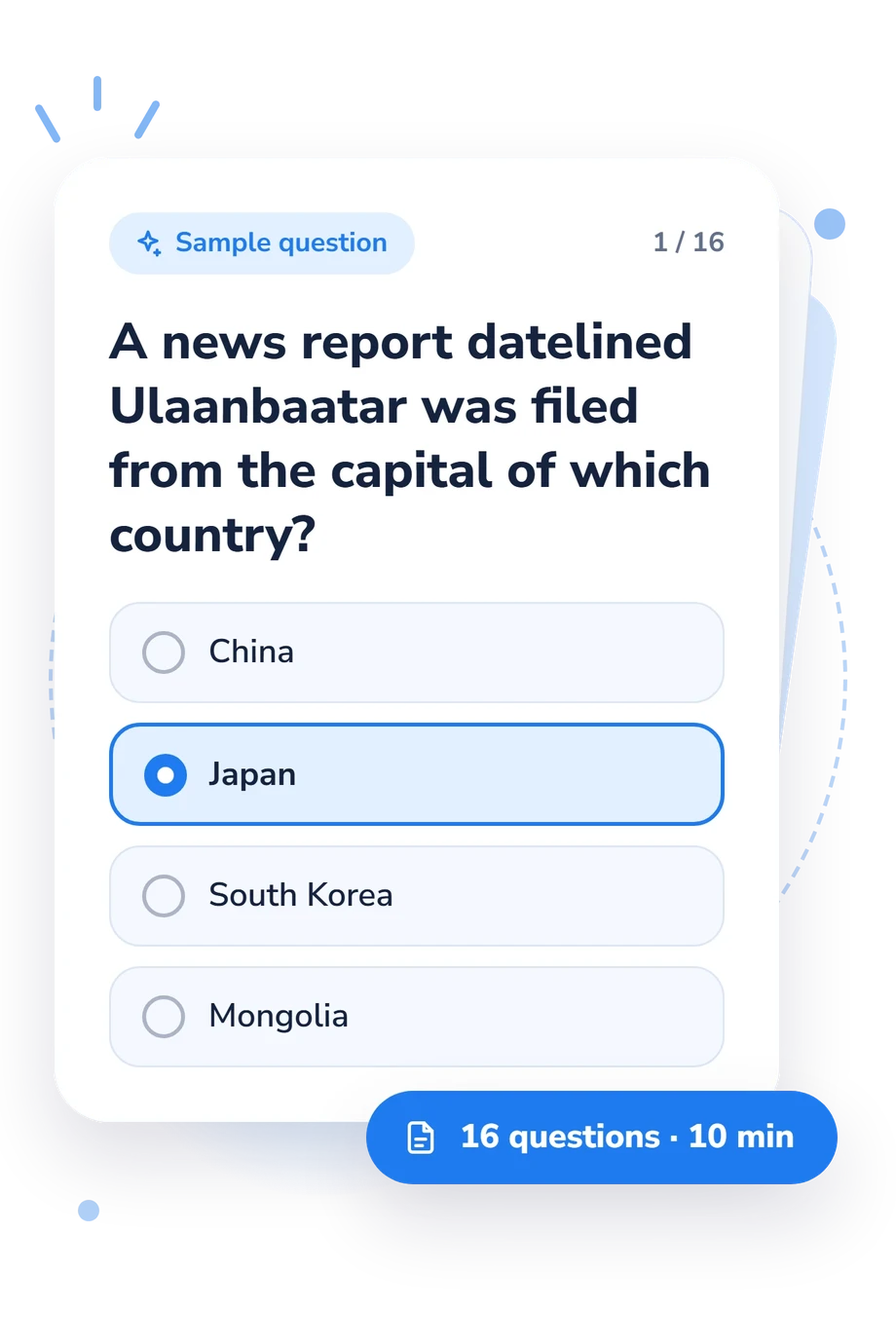
- China
- Japan
- South Korea
- Mongolia
- Seoul
- Astana
- Ulaanbaatar
- Pyongyang
- Hamhung
- Seoul
- Kaesong
- Pyongyang
East Asia Capitals Quiz - Description and methodology of the test
Students, travelers, and curious learners can use this focused geography check to examine how securely they connect East Asian countries with their national capitals. The East Asia Capitals Quiz offers a quick picture of recall, location reasoning, and confidence across familiar and less familiar places. For anyone wanting an East Asia map quiz with capitals, it also provides a practical starting point for targeted review.
What This Assessment Explores
The questionnaire focuses on five national capitals in East Asia: Ulaanbaatar, Beijing, Pyongyang, Seoul, and Tokyo. Its prompts move beyond isolated recall by asking you to use country links, borders, rivers, islands, government locations, and west-to-east relationships. As an East Asia geography quiz, it examines practical location knowledge alongside memorized capital-country pairings.
The result draws on four connected dimensions:
- Direct matching shows how accurately you pair each country with its capital.
- Geographic clues show whether physical and civic details help you identify a city.
- Spatial ordering shows how well you compare the capitals’ relative positions.
- East Asia Capitals Knowledge (0-16) summarizes all 16 items: Starting Point (0-6) signals review needs, Developing Knowledge (7-12) reflects many correct links, and Strong Knowledge (13-16) reflects accurate direct and applied identification.
Methodology and Evidence Base
For this East Asia capitals test, each of the 16 items offers four answer choices. Prompts cover direct country-capital matches, datelines, journeys, rivers, islands, borders, government institutions, and spatial sequences, so the result reflects recall plus the use of geographic clues.
Scoring produces one overall knowledge total from correct responses; no separate subscale results are shown. Read it as performance on these selected capitals, not a complete measure of geographic literacy. Schooling, travel, media exposure, and guessing can affect familiarity.
Methodologically, the format is conceptually consistent with Dunn (2011), which links location knowledge with spatial thinking and assessment. Turner and Leydon (2012) support online quizzes as a way to engage and check geographic learning, while Torrens (2001) shows that place-location knowledge varies with experience and context. These studies support the prompt design but do not make this questionnaire an adaptation of their instruments.
This online self-check has no population norms or independent diagnostic standardization stated. Use the result to target review of missed capitals and applied clues, not to generalize beyond this selected topic.
- Dunn, James M. "Location Knowledge: Assessment, Spatial Thinking, and New National Geography Standards." Journal of Geography 110, no. 2 (2011): 81-89. 10.1080/00221341.2010.511243
- Turner, Sally, and Joseph Leydon. "Improving Geographic Literacy among First-Year Undergraduate Students: Testing the Effectiveness of Online Quizzes." Journal of Geography 111, no. 2 (2012): 54-66. 10.1080/00221341.2011.583263
- Torrens, Paul M. "Where in the World? Exploring the Factors Driving Place Location Knowledge among Secondary Level Students in Dublin, Ireland." Journal of Geography 100, no. 2 (2001): 49-60. 10.1080/00221340108978417
Updated: