
Dolphin Quiz
How the Scales are Structured
Who Usually Takes This Test?
See How You Compare
Below is a preview of how scores are typically distributed across each scale.
Example Questions From the Test
- Pre-chewed fish stored near the mother's mouth
- Milk produced by the mother's mammary glands
- Plankton gathered along the mother's skin
- Nutrients filtered directly from seawater
- An echo that forms when clicks strike the ocean floor
- A sound used exclusively to stun prey
- A warning call produced only by newborn calves
- A distinctive whistle associated with an individual dolphin
- From rain caught in the blowhole
- From freshwater springs found beneath every ocean
- From their prey and from water produced during metabolism
- By filtering salt out through their teeth before swallowing
Dolphin Quiz - Description and methodology of the test
For readers who want a clear, low-pressure way to check marine-life knowledge, this dolphin quiz connects familiar facts with the biology behind them. It suits curious learners, families, and educators who want a focused knowledge check rather than a personality profile. A quiz for kids about dolphins can also support discussion, while the result points to confident areas and subjects worth revisiting.
What This Assessment Explores
The questionnaire measures factual understanding across dolphin anatomy, physiology, behavior, communication, ecology, classification, and conservation. It suits people who want to check marine-life knowledge rather than explore mood, personality, or symptoms.
The result shows how well a respondent connects facts with situations involving echolocation, nursing, breathing, cooperative hunting, food webs, species identification, strandings, and fishing-net entanglement. A dolphin knowledge test like this rewards understanding relationships among concepts rather than memorizing isolated labels.
The tested areas are:
- Biology and adaptations show how dolphins breathe, move, feed, rest, and function in water.
- Communication and social behavior indicate understanding of whistles, echolocation, cooperation, and group life.
- Ecology, classification, and conservation connect dolphins with prey, pollutants, related mammals, bycatch, strandings, and safe human responses.
Higher performance indicates stronger command of this content; lower results identify topics for further learning.
Methodology and Scientific Basis
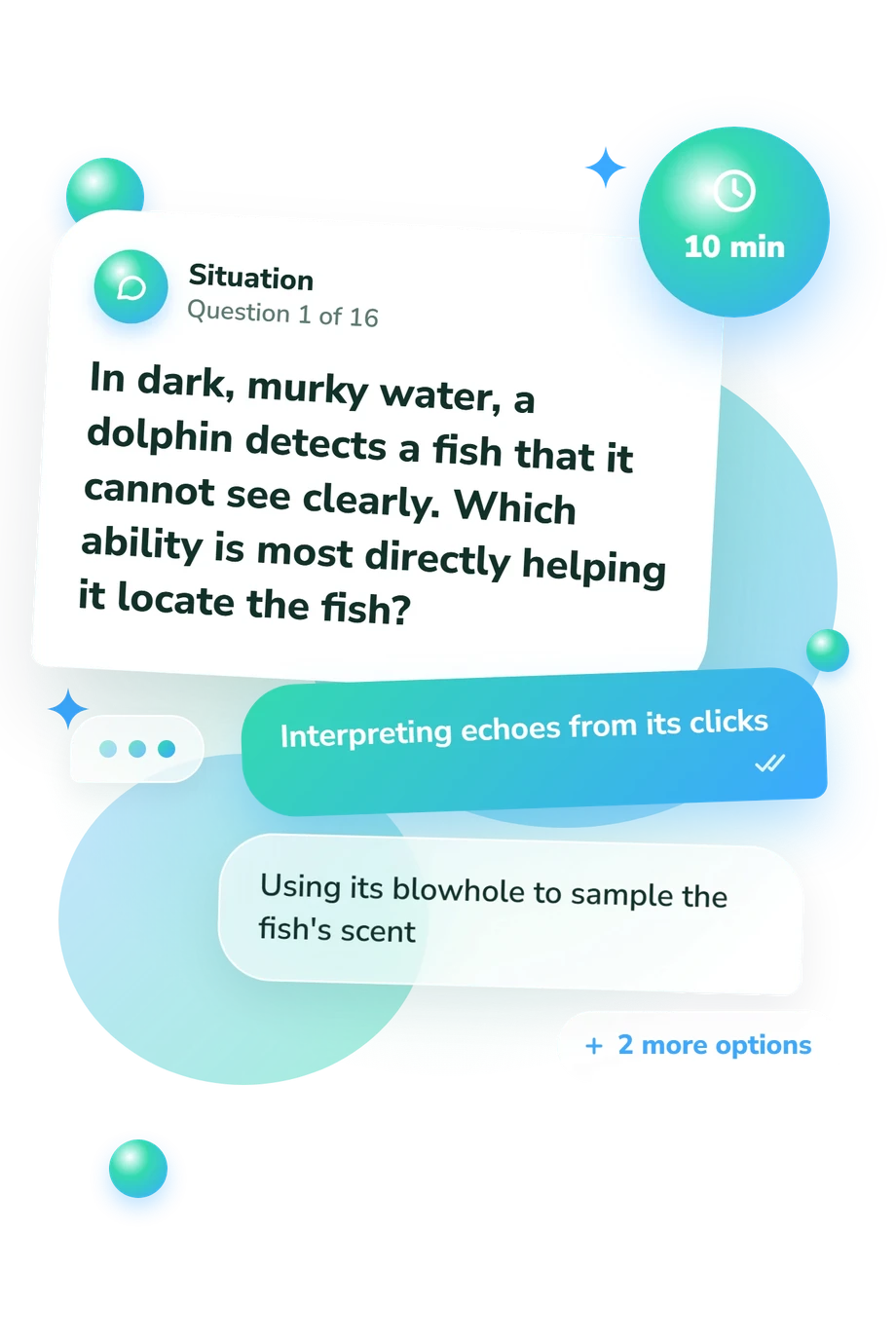
Each item uses a short prompt or scenario with four answer choices. The respondent selects the option that best matches dolphin biology, and answers are combined into the Dolphin Knowledge scale, scored from 0-16. Results are reported as Emerging Explorer (0-6), Developing Dolphin Expert (7-12), or Dolphin-Savvy (13-16).
The format is criterion-style and content-based: it summarizes performance on the facts tested here rather than general intelligence, scientific training, or commitment to marine protection. Dolphin trivia questions move from sensory systems and body adaptations to communication, food webs, classification, and conservation, so the score represents breadth across connected topics.
Its subject matter is conceptually consistent with Reynolds et al. (2013), which brings together bottlenose-dolphin biology and conservation. Echolocation content aligns with Au (1993), while signature-whistle material reflects Janik, Sayigh, and Wells (2006). These sources support the content framework; they do not make this online questionnaire a standardized adaptation.
Interpretation should stay tied to the tested material. Guessing, memory, wording, and current familiarity with marine science can influence performance, so the result is best read as a snapshot of present knowledge.
- Reynolds III, John E., Randall S. Wells, and Samantha D. Eide. The Bottlenose Dolphin: Biology and Conservation. Gainesville: University Press of Florida, 2013.
- Au, Whitlow W. L. The Sonar of Dolphins. New York: Springer-Verlag, 1993. 10.1007/978-1-4612-4356-4
- Janik, Vincent M., Laela S. Sayigh, and Randall S. Wells. “Signature Whistle Shape Conveys Identity Information to Bottlenose Dolphins.” Proceedings of the National Academy of Sciences 103, no. 21 (2006): 8293-8297. 10.1073/pnas.0509918103
Updated: