
Does My Boyfriend Like His Female Friend Quiz
How the Scales are Structured
Who Usually Takes This Test?
See How You Compare
Below is a preview of how scores are typically distributed across each scale.
Example Questions From the Test
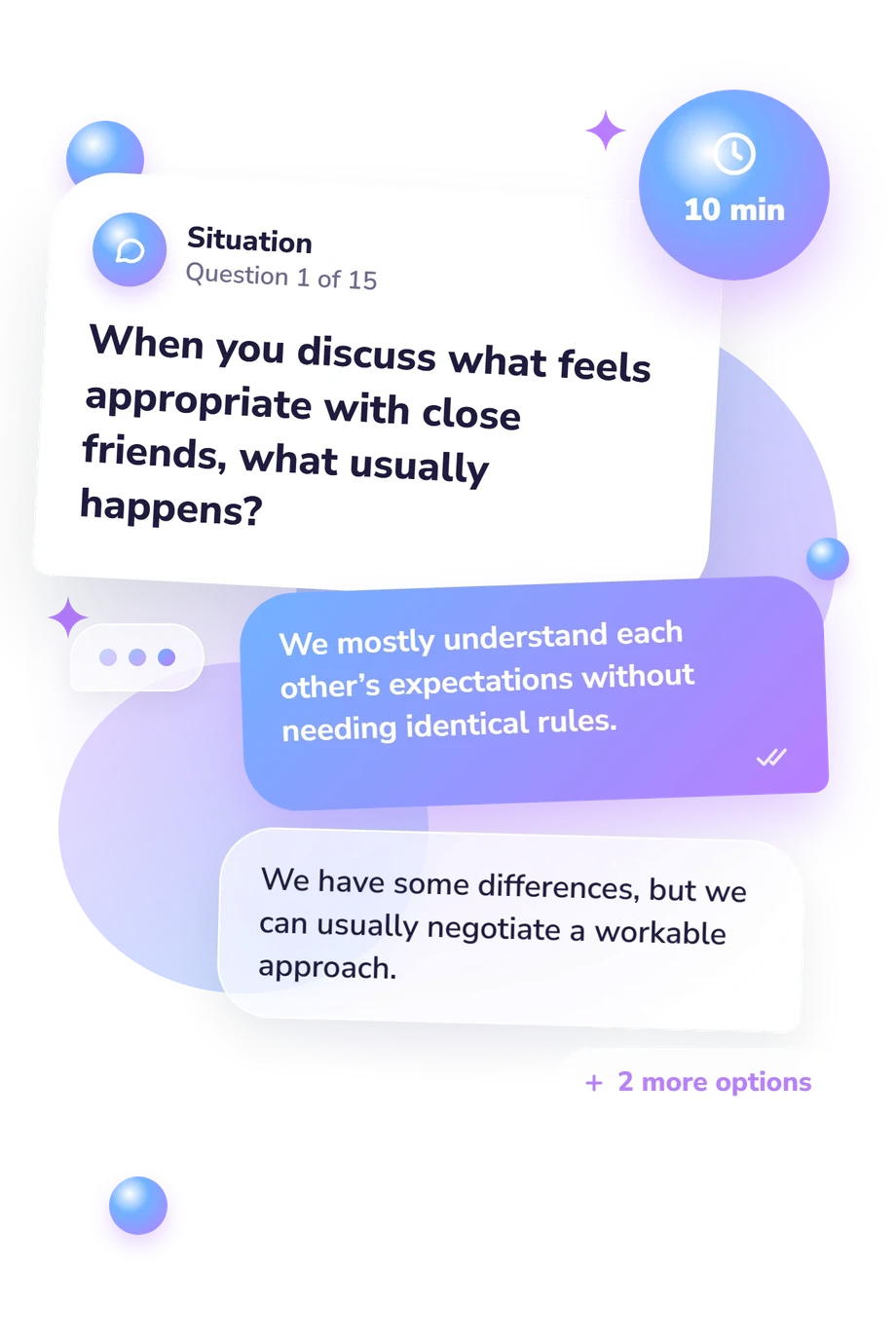
- We mostly understand each other’s expectations without needing identical rules.
- We have some differences, but we can usually negotiate a workable approach.
- We revisit the same disagreements without reaching a clear understanding.
- My concerns are mocked, dismissed, or treated as irrelevant rather than discussed.
- He naturally includes both of us and also talks with other people.
- He spends somewhat more time with her when they have something specific to catch up on.
- He repeatedly returns his attention to her, even when I try to connect with him.
- They form an intensely focused, pair-like bubble for much of the event.
- He includes us naturally when it makes sense, without forcing a friendship between us.
- He usually keeps the relationships separate, but gives understandable practical or personality-based reasons.
- He resists ordinary introductions or shared plans without offering a clear explanation.
- He actively prevents contact or tells each of us conflicting stories about the other.
Does My Boyfriend Like His Female Friend Quiz - Description and methodology of the test
For someone trying to make sense of discomfort around a partner’s close friendship, the Does My Boyfriend Like His Female Friend Quiz provides a structured way to examine observations and relationship impact. It is intended for a person considering this boyfriend female friend quiz who wants more clarity before raising a sensitive concern. It examines observed friendship behavior, relationship expectations, and the effect of uncertainty on communication and trust.
What This Assessment Explores
This assessment organizes friendship behavior, couple boundaries, and uncertainty. It suits someone uneasy about this situation who wants to examine patterns rather than one interaction. Someone using this does my boyfriend like my friend quiz can separate conduct from interpretation; the scores show boundary alignment, trust effects, and observed signal patterns. Current context and self-report shape impressions, which describe patterns, not proof of attraction.
The displayed dimensions are:
- Boundary Alignment (0-15) shows whether expectations are understood, negotiated, and honored: Broad alignment (0-5), Unsettled boundaries (6-10), or Significant mismatch (11-15).
- Communication and Trust Strain (0-15) shows how concern affects openness, reassurance, and trust: Manageable uncertainty (0-5), Ongoing strain (6-10), or Entrenched strain (11-15).
- Observable Friendship Signals (0-15) summarizes behavior that may seem exclusive, emotionally intense, or flirtatious: Limited signals (0-5), Mixed signals (6-10), or Recurring signals (11-15).
Methodology and Evidence Base
Each item offers four descriptions ranging from clear boundaries or limited concern to recurring signals, disrupted trust, concealment, or intense monitoring. Respondents choose the closest option, combining observation with self-report about interpretation and emotional impact.
Together, the questions bring boundary expectations and trust effects into three displayed scores, helping someone use this boyfriend trust issues quiz to examine observable behavior alongside observable behavior. The questionnaire does not state how individual options contribute to each score, and its listed bands should be read as descriptive result categories rather than inferred point weights.
Worley and Samp’s 2014 study of friendship-threat appraisals and jealousy examines how a partner’s friendships can be experienced as threatening. Another Worley and Samp study connects relational uncertainty with jealousy expression in dating relationships. The profile also reflects the cognitive, emotional, and behavioral perspective in Multidimensional Jealousy (Pfeiffer & Wong, 1989). This questionnaire is conceptually consistent with those works, not an adaptation of their instruments.
Results can highlight signals, boundary strain, or uncertainty for conversation. Read them alongside specific observations and recent interactions when deciding what to discuss.
- Worley, T. R., & Samp, J. (2014). Friendship Characteristics, Threat Appraisals, and Varieties of Jealousy About Romantic Partners' Friendships. Interpersona: An International Journal on Personal Relationships, 8(2), 231-244. 10.5964/ijpr.v8i2.169
- Worley, T., & Samp, J. (2014). Exploring the Associations between Relational Uncertainty, Jealousy about Partner's Friendships, and Jealousy Expression in Dating Relationships. Communication Studies, 65(4), 370-388. 10.1080/10510974.2013.833529
- Pfeiffer, S. M., & Wong, P. T. P. (1989). Multidimensional Jealousy. Journal of Social and Personal Relationships, 6(2), 181-196. 10.1177/026540758900600203
Updated: