
Diwali Quiz
How the Scales are Structured
Who Usually Takes This Test?
See How You Compare
Below is a preview of how scores are typically distributed across each scale.
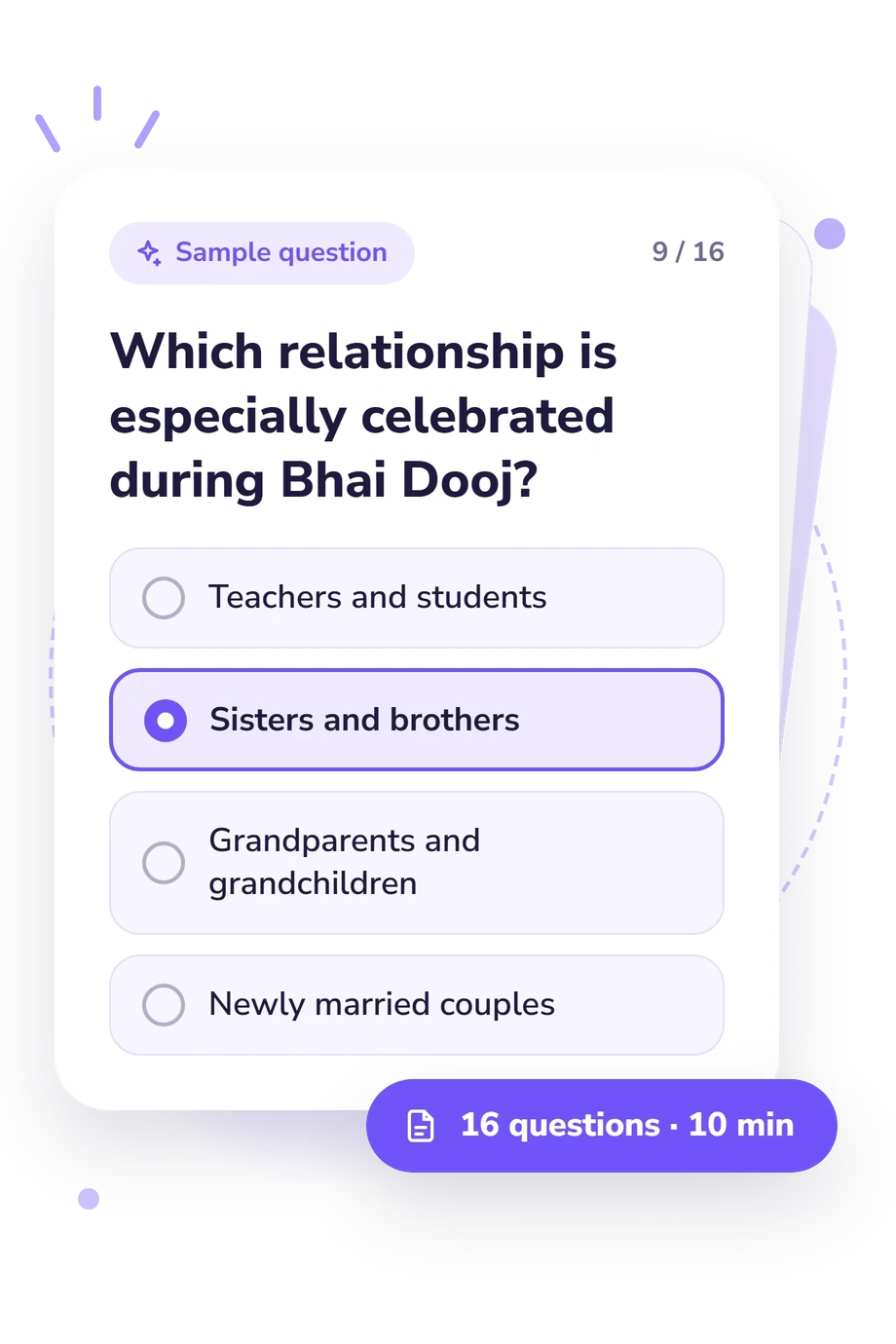
Example Questions From the Test
- Krishna lifting Govardhan Hill
- The descent of the River Ganga to Earth
- Arjuna winning Draupadi’s hand in marriage
- Rama returning after exile and the defeat of Ravana
- The composition of the Vedas
- The birth of Guru Nanak
- The beginning of the Kurukshetra war
- Mahavira’s attainment of nirvana
- A formal declaration that all debts are canceled
- A rule that festive food must remain within one household
- Shared celebration, hospitality, and goodwill
- A replacement for every religious observance
Diwali Quiz - Description and methodology of the test
For readers who want a culturally grounded way to check what they know, the diwali quiz turns familiar festival themes into a focused knowledge activity. Questions about Diwali in this quiz cover stories, observances, symbols, and regional practices across Hindu, Jain, Sikh, and related contexts. The result supports curiosity and discussion, while showing which areas may be worth exploring further rather than judging belief or devotion.
What This Assessment Explores
The assessment examines cultural and religious knowledge, not personal belief or participation. It asks respondents to connect narratives with observances, place festival days in sequence, and recognize meanings attached to lights, food, worship, family customs, and community celebrations. Regional variation matters because Diwali is not one uniform practice.
Short scenarios make the activity more applied than a list of definitions, and Diwali-themed quiz games can turn an answer into a prompt for context and discussion.
The question themes are:
- Sacred narratives link stories with religious meanings.
- Calendar observances test recognition of festival days and sequence.
- Symbols and customs explain lamps, rangoli, food, worship, and family practices.
- Regional variation includes Gujarati examples and Nepal’s Tihar.
The result shows how accurately the respondent recognizes the represented traditions. Strong performance reflects knowledge of the tested material; a lower result identifies subjects for further reading, not a judgment about identity or devotion.
Methodology and Evidence Base
This is a structured multiple-choice knowledge assessment: each item offers four choices, and one keyed answer earns one point. The format gives the activity a natural form for a quiz with answers about Diwali: families or classrooms can review why an option fits rather than treating the result as a simple score.
Its cultural frame is conceptually consistent with Singh et al. (2020), whose longitudinal study examined ritual participation around Diwali. Rina Singh (2016) supplies context for festival stories and observances, Cort (2001) supports the Jain material, and Shrestha (2006) situates Nepal’s related Tihar traditions. The questionnaire is not presented as an adaptation or validation of any one source.
Diwali Knowledge is scored 0-16, with one point for each correct answer: Foundations to build (0-6), Developing knowledge (7-12), and Strong knowledge (13-16). These bands describe performance on the content covered here rather than standardized population norms. Results can vary with education, regional familiarity, language, current attention, and guessing, so they are best read as a focused snapshot of knowledge.
- Singh, Purnima, Shruti Tewari, Rebekka Kesberg, Johannes Alfons Karl, Joseph Bulbulia, and Ronald Fischer. “Time investments in rituals are associated with social bonding, affect and subjective health: a longitudinal study of Diwali in two Indian communities.” Philosophical Transactions of the Royal Society B: Biological Sciences, 375(1805), 20190430, 2020. 10.1098/rstb.2019.0430
- Singh, Rina. Diwali: Festival of Lights. Orca Book Publishers, 2016. ISBN: 9781459810075
- Cort, John E. Jains in the World: Religious Values and Ideology in India. Oxford University Press, 2001. 10.1093/0195132343.001.0001
- Shrestha, Bal Gopal. “The Svanti Festival: Victory over Death and the Renewal of the Ritual Cycle in Nepal.” Contributions to Nepalese Studies, 33(2), 203-221, 2006.
Updated: