
Deuteronomy Quiz
How the Scales are Structured
Who Usually Takes This Test?
See How You Compare
Below is a preview of how scores are typically distributed across each scale.
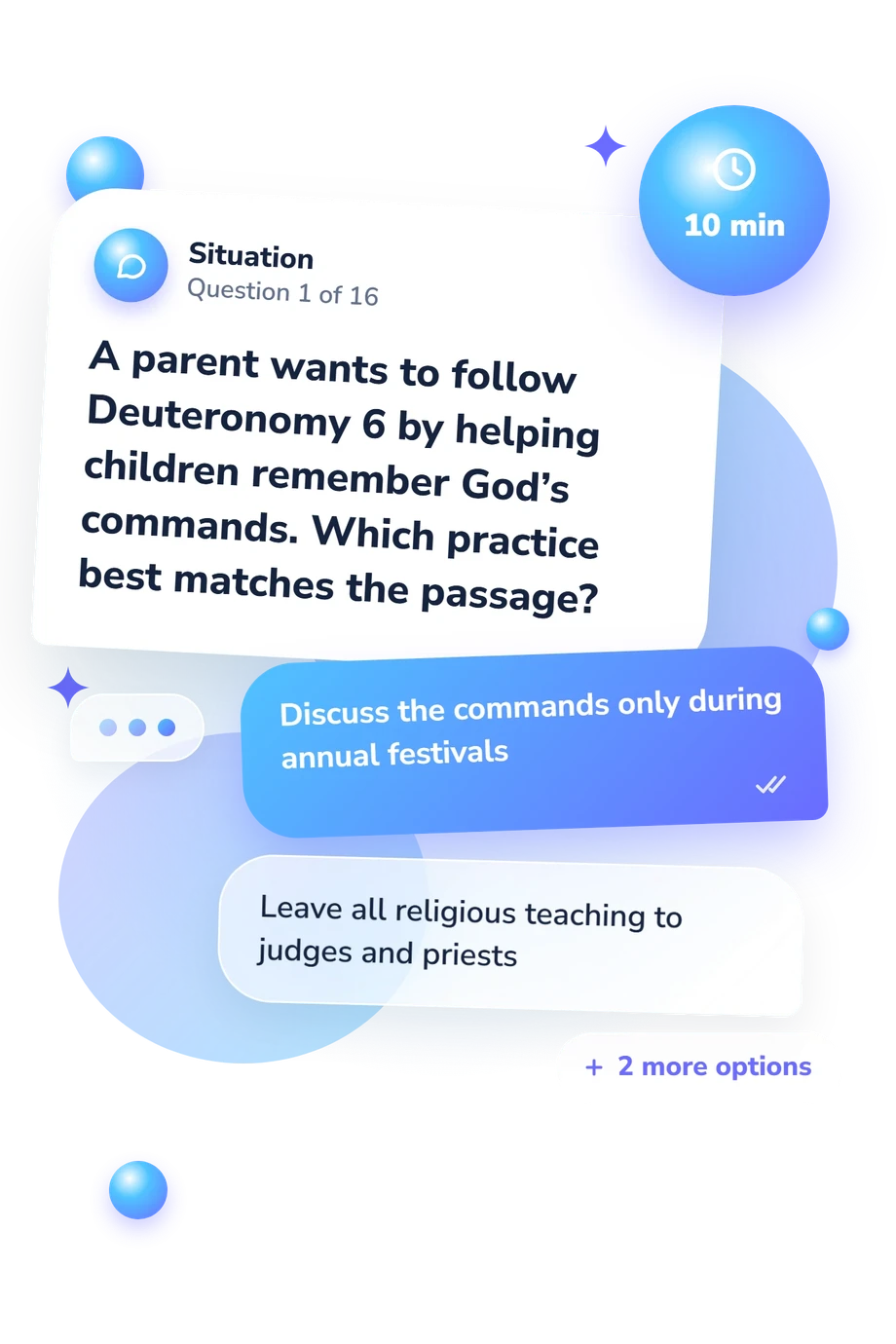
Example Questions From the Test
- Discuss the commands only during annual festivals
- Leave all religious teaching to judges and priests
- Wait until the children are adults before teaching them
- Speak about the commands throughout ordinary daily routines
- “Let justice roll down like waters”
- “In the beginning God created the heavens and the earth”
- “The LORD is my shepherd; I shall not want”
- “Hear, O Israel: The LORD our God, the LORD is one”
- A prophet like Moses from among the Israelites
- A judge chosen from a neighboring nation
- A warrior who will replace the covenant law
- A priest-king descended from Aaron
Deuteronomy Quiz - Description and methodology of the test
Readers who want to examine how well they understand Deuteronomy can use this Deuteronomy Quiz as a focused self-check of the book’s arguments, laws, and narrative turning points. It functions as a Bible quiz on Deuteronomy for students, teachers, study groups, and independent readers checking overall familiarity with the book. The result offers an overall knowledge indication rather than a theological judgment.
What This Assessment Explores
The questionnaire tests knowledge of Deuteronomy through its speeches, covenant renewal, legal instructions, worship practices, leadership questions, and closing events. Some items test recall, while others ask the reader to connect a passage with its purpose or distinguish a key detail from a plausible alternative.
The questions cluster around these content areas:
- Covenant and instruction show how Moses’ speeches frame remembrance, teaching, and loyalty.
- Law and social responsibility cover family duty, debt release, justice, refuge, and care for vulnerable people.
- Worship and festivals examine the chosen place, annual celebrations, Sabbath reasoning, and resistance to rival worship.
- Leadership and history connect prophecy, kingship, the wilderness generation, Moab, and Moses’ succession.
The displayed scale is Deuteronomy Knowledge (0-16). Its bands are Foundations to Build (0-6), Developing Understanding (7-12), and Strong Understanding (13-16), describing increasing familiarity with the book’s content, themes, and practical logic.
Methodology and Scientific Basis
Each item presents four multiple-choice answers. Some prompts check direct recall, while others ask the reader to apply a teaching, identify a setting, or recognize the response Deuteronomy calls for. One point is awarded for each correct answer, and the total is interpreted through the displayed bands.
The method is closest to a structured Bible knowledge assessment. The Bible Knowledge Scale provides the named measurement reference for treating correct answers as indicators of knowledge. McConville’s Deuteronomy commentary supplies the literary and theological framework for the book’s speeches, laws, festivals, and ending; his study of singular address clarifies the direct style of several legal instructions. The questionnaire is conceptually consistent with these works, not an adaptation or validation of them.
Used alongside reading or group discussion, this quiz can support Deuteronomy study by showing whether broader review may be useful. The bands are descriptive categories for this questionnaire rather than population norms. Prior exposure, translation familiarity, teaching context, and short-term recall may affect performance, so the score describes responses to these items rather than the whole of a person’s biblical understanding.
- Krull, Douglas S., and Rodney A. McCloy. “Add to Your Faith Virtue and to Virtue Knowledge: A Bible Knowledge Scale.” Journal of Psychology and Christianity, vol. 41, no. 2, 2022, pp. 106-117.
- McConville, J. Gordon. Deuteronomy. Apollos Old Testament Commentary, vol. 5, Apollos and InterVarsity Press, 2002.
- McConville, J. Gordon. “Singular Address in the Deuteronomic Law and the Politics of Legal Administration.” Journal for the Study of the Old Testament, vol. 26, no. 3, 2002, pp. 19-36. 10.1177/030908920202600302
Updated: