
Danganronpa Character Quiz
How the Scales are Structured
Who Usually Takes This Test?
See How You Compare
Below is a preview of how scores are typically distributed across each scale.
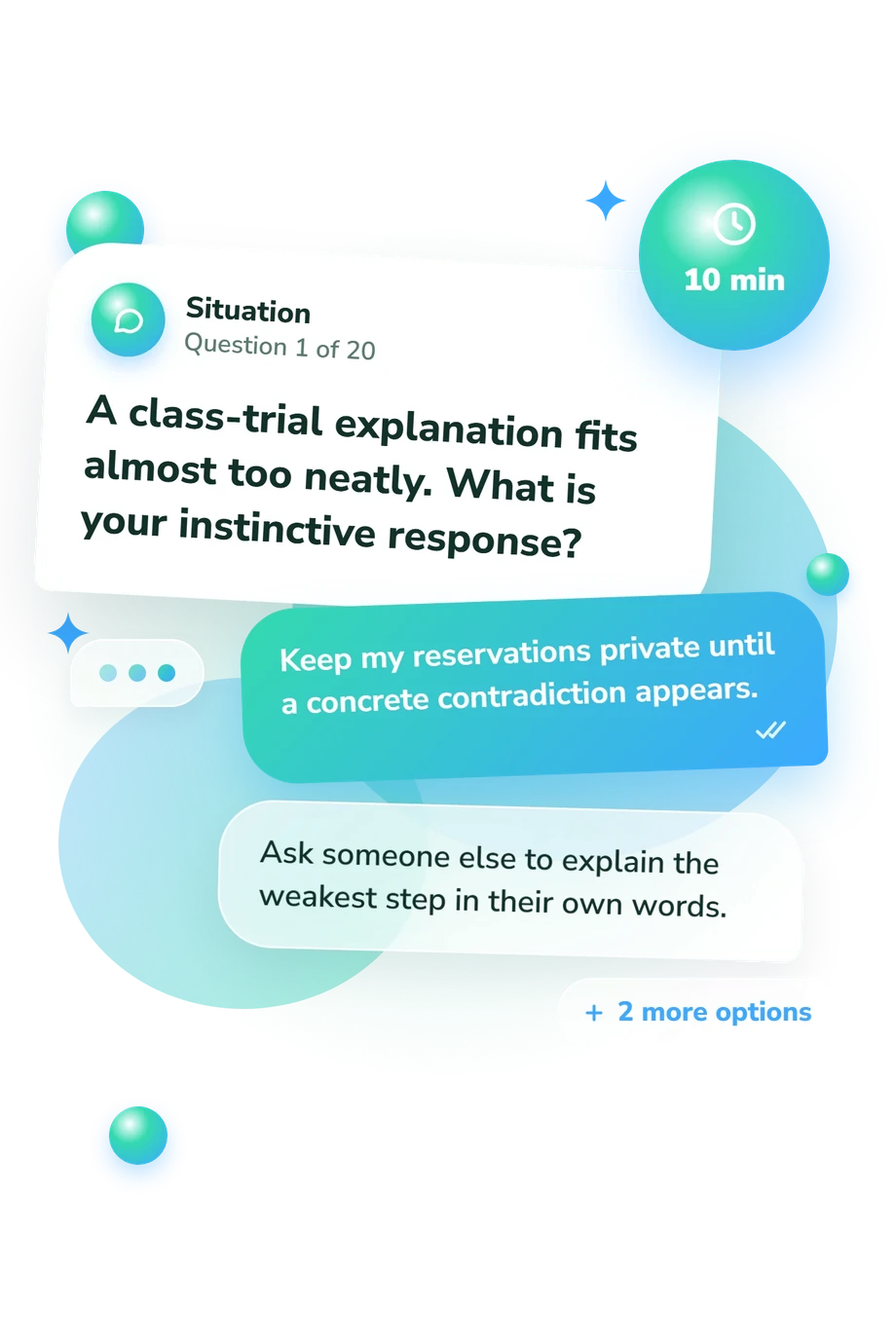
Example Questions From the Test
- Keep my reservations private until a concrete contradiction appears.
- Ask someone else to explain the weakest step in their own words.
- Point out the suspicious assumption and request an alternative.
- Make an unexpected claim to provoke the theory’s defenders into revealing its limits.
- Support someone whose useful point was being ignored.
- Ask pointed questions that gradually narrow the possibilities.
- Wait for an opening, then deliver a concise argument.
- State my conclusion firmly and make the discussion confront it.
- Give a plain, accurate description.
- Answer honestly but add a joke to keep the mood light.
- Reveal part of it through a playful story.
- Offer several teasing, contradictory hints and let them guess.
Danganronpa Character Quiz - Description and methodology of the test
Fans who want to connect everyday instincts with the Danganronpa cast can use this assessment to examine responses to uncertainty, evidence, cooperation, and pressure. The Danganronpa Quiz Which Character Are You turns those choices into a character-affinity profile rather than a fixed identity. It also serves as a What Danganronpa Character Am I Quiz by showing which character your choices most resemble, while keeping the focus on patterns rather than identity.
What This Assessment Explores
It examines reasoning, leadership, persistence, trust, and playfulness across trials, investigations, competition, and boundaries. As a Danganronpa personality quiz, it shows character affinity, not permanent identity. The dimensions are:
- Byakuya Togami (0-12) measures strategy and ambition: Collaborative Orientation (0-4), Selective Strategist (5-8), Strong Byakuya Affinity (9-12).
- Chiaki Nanami (0-12) reflects calm persistence, systems thinking: Higher-Intensity Style (0-4), Calm Problem Solver (5-8), Strong Chiaki Affinity (9-12).
- Kokichi Oma (0-12) captures playful unpredictability, provocative questioning: Straightforward Style (0-4), Playful Challenger (5-8), Strong Kokichi Affinity (9-12).
- Kyoko Kirigiri (0-12) reflects evidence-led composure, privacy: More Open or Instinctive (0-4), Quietly Analytical (5-8), Strong Kyoko Affinity (9-12).
- Makoto Naegi (0-12) measures hopeful persistence, social trust: Different Energy (0-4), Shared Streak (5-8), Strong Makoto Affinity (9-12).
Methodology and Scientific Basis
Each item presents a concrete situation and four response options, asking which reaction feels most natural. Themes include class-trial reasoning, evidence checking, leadership, support, privacy, competition, learning through repeated attempts, and group trust.
The result compares five character-aligned scores. The highest score indicates the strongest affinity; any score within one point of the highest belongs to a blended result, so the questionnaire has no forced single winner or hidden tie-breaker.
The structure is conceptually consistent with the work of Park and Henley, who examined connections between personality and preferences for fantasy game characters; this questionnaire is not an adaptation of their instrument. The official Danganronpa game material supplies the fictional setting and character context, while the work of Paulhus explains how self-report can be influenced by response bias.
This Danganronpa character test is an online fandom profile, so results are best read as reflective comparisons between your responses and character-aligned patterns rather than fixed labels. Current mood, familiarity with the cast, self-awareness, and choosing an appealing answer can all shift the outcome.
- Park, Anna E., and Tracy B. Henley. "Personality and Fantasy Game Character Preferences." Imagination, Cognition and Personality, vol. 27, no. 1, 2007, pp. 37-46. 10.2190/IC.27.1.d
- Spike Chunsoft. Danganronpa Decadence. Spike Chunsoft, 2021.
- Paulhus, Delroy L. "Measurement and Control of Response Bias." In Measures of Personality and Social Psychological Attitudes, edited by John P. Robinson, Phillip R. Shaver, and Lawrence S. Wrightsman, pp. 17-59. Academic Press, 1991. 10.1016/B978-0-12-590241-0.50006-X
Updated: