
Country Girl Quiz
How the Scales are Structured
Who Usually Takes This Test?
See How You Compare
Below is a preview of how scores are typically distributed across each scale.
Example Questions From the Test
- Switch to an indoor plan and save the outing for a drier day.
- Choose a paved or sheltered outdoor option instead.
- Put on suitable shoes and accept that the outing may be messy.
- Pull on boots and carry on; the mud is simply part of the day.
- Buy smaller portions in the future so there is less to manage.
- Offer the extra produce to someone who can use it.
- Freeze some using a straightforward method I can learn quickly.
- Turn it into preserves, pickles, or another shelf-ready staple.
- I seldom notice unless someone points them out.
- I notice the most obvious changes from one season to another.
- I regularly pick up on several signs as the seasons shift.
- I follow subtle changes and often use them to guide my plans.
Country Girl Quiz - Description and methodology of the test
People who want to understand whether their everyday preferences lean toward rural life can use this assessment as a structured self-reflection exercise. The country girl quiz focuses on choices involving belonging, nature, and practical action, showing how preferences can coexist in one profile. The result clarifies whether your preferences lean toward country or city life, which is the distinction this am i country or city girl quiz is designed to explore.
What This Assessment Explores
This questionnaire measures lifestyle affinity rather than geography, background, or worth. Its situations involve gatherings, customs, weather, wildlife, seasons, repairs, tools, gardening, and resource use. These items describe recognizable country-lifestyle preferences, not residence or rural experience, while giving this country lifestyle quiz a concrete focus.
The result separates three dimensions, so a preference in one area does not imply the same pattern elsewhere:
- Community & Traditions (0-15) measures attraction to neighborly ties, gatherings, customs, and carrying stories forward; Self-Directed (0-5), Warm Participant (6-10), and Community Keeper (11-15) describe connection.
- Outdoor Connection (0-15) measures how strongly settings, weather, wildlife, and seasons shape enjoyment; Indoor-Centered (0-5), Fresh-Air Friendly (6-10), and Seasonally Rooted (11-15) describe lifestyle affinity, not knowledge or virtue.
- Practical Know-How (0-15) measures preference for hands-on problem-solving and making do; Delegating Planner (0-5), Capable Learner (6-10), and Hands-On Improviser (11-15) describe preferred involvement, not competence or worth.
Methodology and Scientific Basis
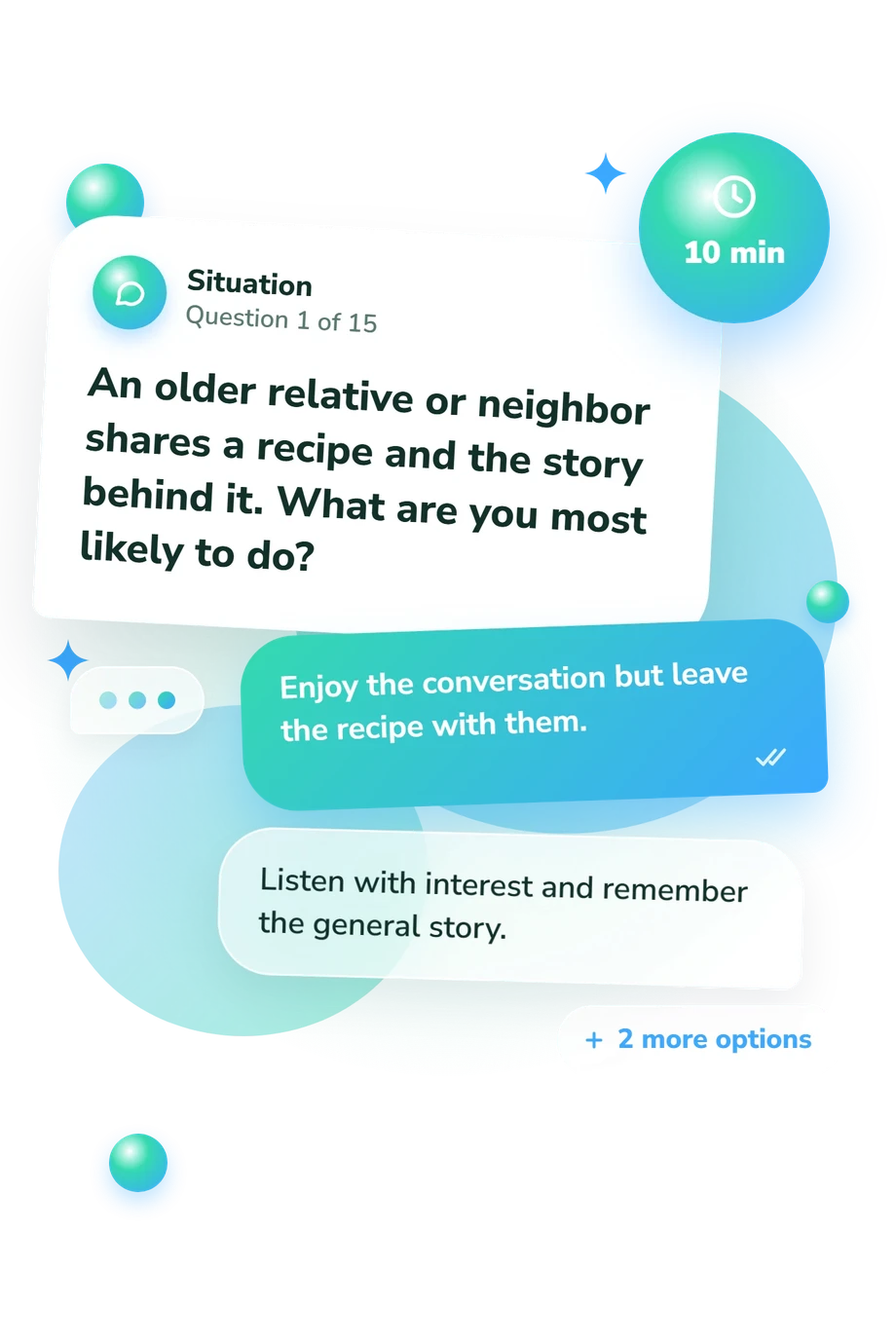
Each item presents a situation with four response choices. The options often move from less to more involvement, attention, or readiness, so you select the response that matches your usual approach. The questionnaire reports a separate total for each dimension and assigns it to a displayed band; it does not turn the profile into a single rural-versus-urban verdict. The profile supports reflection on country and city preferences without forcing a single identity; this city-girl-or-country-girl quiz helps you explore that distinction.
Conceptually, the questionnaire is consistent with the Rural Identity Scale, which links rural identity with meanings of rural life, and the Rural Perception Scale, which examines perceptions of rural settings. Its outdoor dimension also connects with nature relatedness described by the Nature Relatedness Scale. It is conceptually consistent with these works, not an adaptation of them.
Because the format is self-report, answers can be influenced by current context, self-awareness, social desirability, and familiarity with practical tasks; read each dimension as a flexible snapshot, since preferences in one area may not predict another.
- Oser CB, Strickland J, Batty EJ, Pullen E, Staton M. The Rural Identity Scale: Development and Validation. Journal of Rural Health. 2022;38(1):303-310. 10.1111/jrh.12563
- Kim SJ, Alford-Teaster J, Schiffelbein JE, Onega T. Development of the Rural Perception Scale (RPS-18). Journal of Rural Health. 2024;40(2):348-367. 10.1111/jrh.12795
- Nisbet EK, Zelenski JM, Murphy SA. The Nature Relatedness Scale: Linking Individuals’ Connection With Nature to Environmental Concern and Behavior. Environment and Behavior. 2009;41(5):715-740. 10.1177/0013916508318748
Updated: