
Coronary Artery Disease Quiz
How the Scales are Structured
Who Usually Takes This Test?
See How You Compare
Below is a preview of how scores are typically distributed across each scale.
Example Questions From the Test
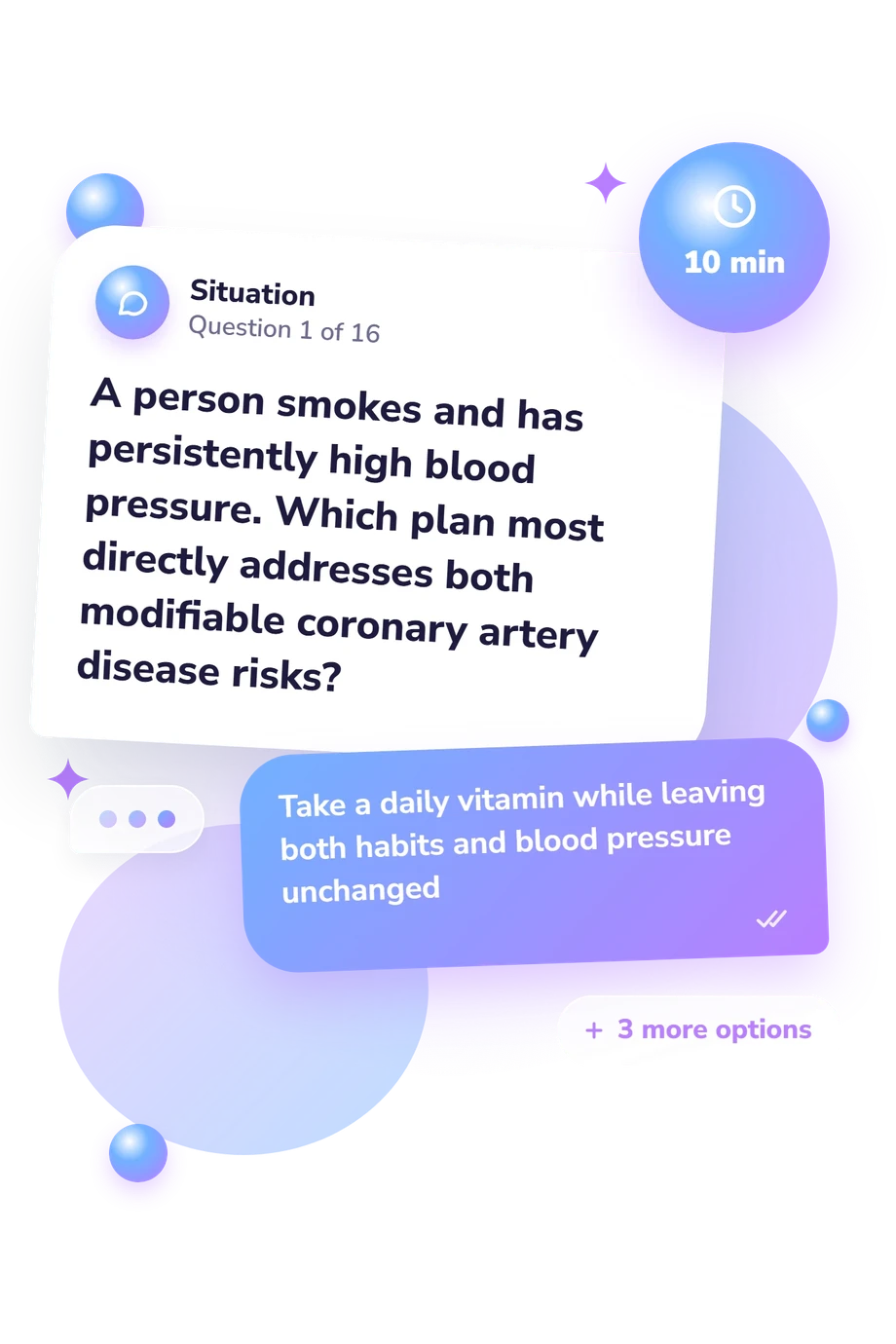
- Switching cigarette brands while smoking the same amount
- Exercising only on days when no cigarettes are smoked
- Stopping smoking, using evidence-based support when needed
- Taking supplements to offset the effects of smoke exposure
- Physical inactivity
- Cigarette smoking
- A diet high in saturated fat
- A family history of premature coronary artery disease
- The amount of oxygen stored inside the lungs
- The electrical activity of the brain during chest discomfort
- The location and extent of narrowing in the coronary arteries
- The strength of the rib cage surrounding the heart
Coronary Artery Disease Quiz - Description and methodology of the test
People who want to check how well they understand coronary artery disease can use this coronary artery disease quiz as an educational exercise. It is suited to readers reviewing cardiovascular health information, preparing for a clinical conversation, or identifying topics that need clarification. As a coronary heart disease quiz, it organizes core concepts into questions and guides targeted review of unfamiliar topics.
What This Assessment Explores
Questions examine understanding of atherosclerosis, oxygen supply to heart muscle, modifiable and nonmodifiable risks, symptom patterns, diagnostic tests, treatment procedures, and emergency responses. This makes the assessment useful as a coronary artery disease knowledge test for readers identifying gaps in health knowledge.
The displayed scale is Coronary Artery Disease Knowledge: 0-16. Its bands are Foundation to build (0-6), Developing knowledge (7-12), and Strong knowledge (13-16): Foundation to build calls for reviewing core facts; Developing knowledge marks topics to revisit; Strong knowledge reflects solid coverage.
The topic groups are:
- Disease mechanisms explain how plaque-related narrowing can limit blood flow to heart muscle.
- Risk factors show which influences can be changed and which cannot.
- Symptoms and emergency action distinguish patterns that need evaluation or immediate help.
- Testing, treatment, and prevention cover what cardiac assessments and risk-reduction steps are intended to do.
Methodology and Scientific Basis
Each item uses four response options. The alternatives distinguish accurate explanations from plausible but incorrect interpretations, covering facts and applied situations such as exertional chest pressure, test selection, and emergency action. The result is reported on the displayed knowledge scale and shown in its three bands; because this is an unvalidated educational score, it is not a personal risk estimate but a snapshot of recalled information.
The content is conceptually consistent with CADE-Q, an education-focused coronary artery disease questionnaire, and the later English CADE-Q development study by Ghisi, Oh, Thomas, and Benetti. It also aligns with Bergman and colleagues' broader heart-disease knowledge approach. The overlap is conceptual; these studies do not establish the authorship, scoring, or validation of this online questionnaire.
Viewed as a coronary artery disease knowledge assessment, the tool can highlight subjects for further learning or discussion with a clinician. Interpretation may be influenced by guessing, wording, current attention, health literacy, and personal experience, so missed answers can point to topics worth reviewing. Sudden or severe possible heart-attack symptoms require urgent action regardless of the score.
- Gabriela Lima de Melo Ghisi, Adriana Durieux, Waldomiro Carlos Manfroi, Artur Haddad Herdy, Tales de Carvalho, Alexandre Andrade, Magnus Benetti. Construction and validation of the CADE-Q for patient education in cardiac rehabilitation programs. Arquivos Brasileiros de Cardiologia. 2010;94(6):813-822. 10.1590/S0066-782X2010005000045
- Gabriela Lima de Melo Ghisi, Paul Oh, Scott Thomas, Magnus Benetti. Development and validation of an English version of the Coronary Artery Disease Education Questionnaire (CADE-Q). European Journal of Preventive Cardiology. 2013;20(2):291-300. 10.1177/2047487312437061
- Hannah E. Bergman, Bryce B. Reeve, Richard P. Moser, Sarah Scholl, William M. P. Klein. Development of a Comprehensive Heart Disease Knowledge Questionnaire. American Journal of Health Education. 2011;42(2):74-87. 10.1080/19325037.2011.10599175
Updated: