
Castle Quiz
How the Scales are Structured
Who Usually Takes This Test?
See How You Compare
Below is a preview of how scores are typically distributed across each scale.
Example Questions From the Test
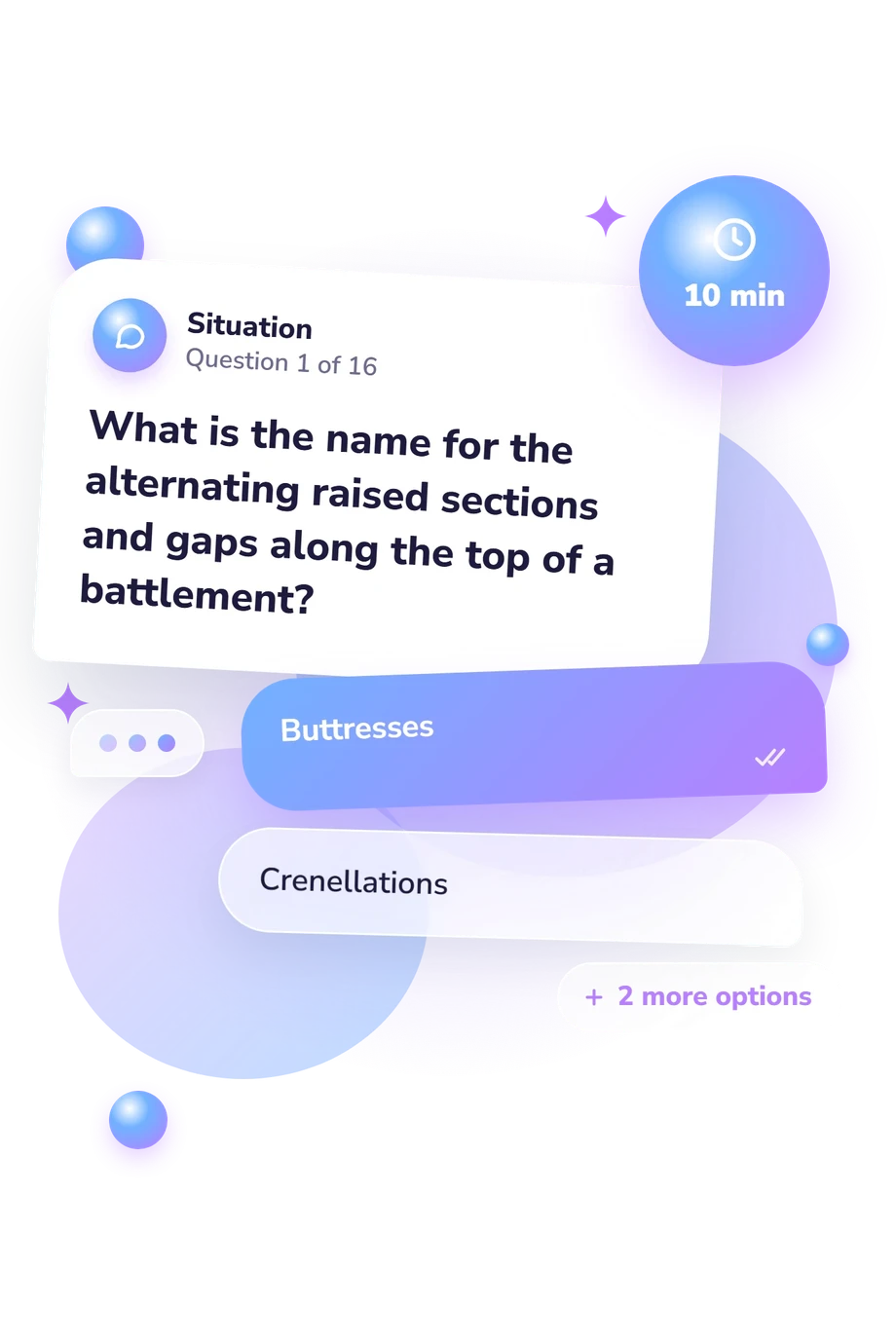
- Buttresses
- Crenellations
- Ramparts
- Corbels
- A garderobe
- An arrow slit
- A postern gate
- A wall walk
- The herald
- The minstrel
- The chaplain
- The steward
Castle Quiz - Description and methodology of the test
Readers checking medieval fortification and castle life can use this castle quiz as a focused exercise.
Using castle trivia quiz material in context, it suits casual learners, history enthusiasts, and students who want to connect terms with the buildings, people, and military choices that shaped a stronghold.
The result indicates overall command of the tested castle material, while these topic groups can suggest subjects for independent review.
What This Assessment Explores
Castles appear as working places, not monuments.
Items ask you to identify features by function, connect locations with strategy, and match rooms or offices with users.
That combination makes its castle architecture quiz questions useful for learning through relationships, not just labels.
The questions cover three thematic groups, not separate scores:
- Architecture and defenses test whether you recognize features such as arrow slits, keeps, machicolations, and portcullises by function.
- Site and strategy test whether you connect bridges, passes, concentric walls, and countermine tactics with surveillance or siege defense.
- Household life and change test whether you recognize how halls, officers, castle forms, and gunpowder affected fortified places.
Castle Knowledge runs from 0-16: Building the Foundations (0-6), Capable Castellan (7-12), and Castle Authority (13-16). These bands describe overall command of the tested material; topic groups suggest subjects to revisit, not separate scores.
Methodology and Scientific Basis
Each item presents a definition, practical situation, or historical distinction followed by four choices. You select the option that best fits the term or scenario, and the result summarizes performance across the knowledge set. The questionnaire presents an overall knowledge result, but its scoring information does not specify individual-answer weighting or conversion.
Stokstad (2005) supplies the historical and architectural frame for terms including the keep, great hall, gatehouse, and defensive works. Dixon and Marshall’s study of Norham’s great tower supports treating the principal tower as both residence and defensive refuge. Creighton (2002) supports attention to landscape, routes, authority, and fortification’s relationship with surrounding communities. The quiz is conceptually consistent with these works, but it is not an adaptation of any one published instrument.
In practice, this castle history test measures historical knowledge and provides a descriptive snapshot, not a population-based estimate of expertise. Performance may reflect prior reading, classroom exposure, guessing, and familiarity with historical vocabulary. Use the result to guide review of unfamiliar structures, roles, or strategies rather than treating it as a complete measure of expertise.
- Stokstad, Marilyn. Medieval Castles. Westport, CT: Greenwood Press, 2005. ISBN 9780313325250.
- Dixon, Philip, and Pamela Marshall. “The Great Tower in the Twelfth Century: The Case of Norham Castle.” Archaeological Journal 150, no. 1 (1993): 410-432. 10.1080/00665983.1993.11078060.
- Creighton, Oliver Hamilton. Castles and Landscapes: Power, Community and Fortification in Medieval England. London and New York: Continuum, 2002. ISBN 0826458963.
Updated: