
Brain Quiz
How the Scales are Structured
Who Usually Takes This Test?
See How You Compare
Below is a preview of how scores are typically distributed across each scale.
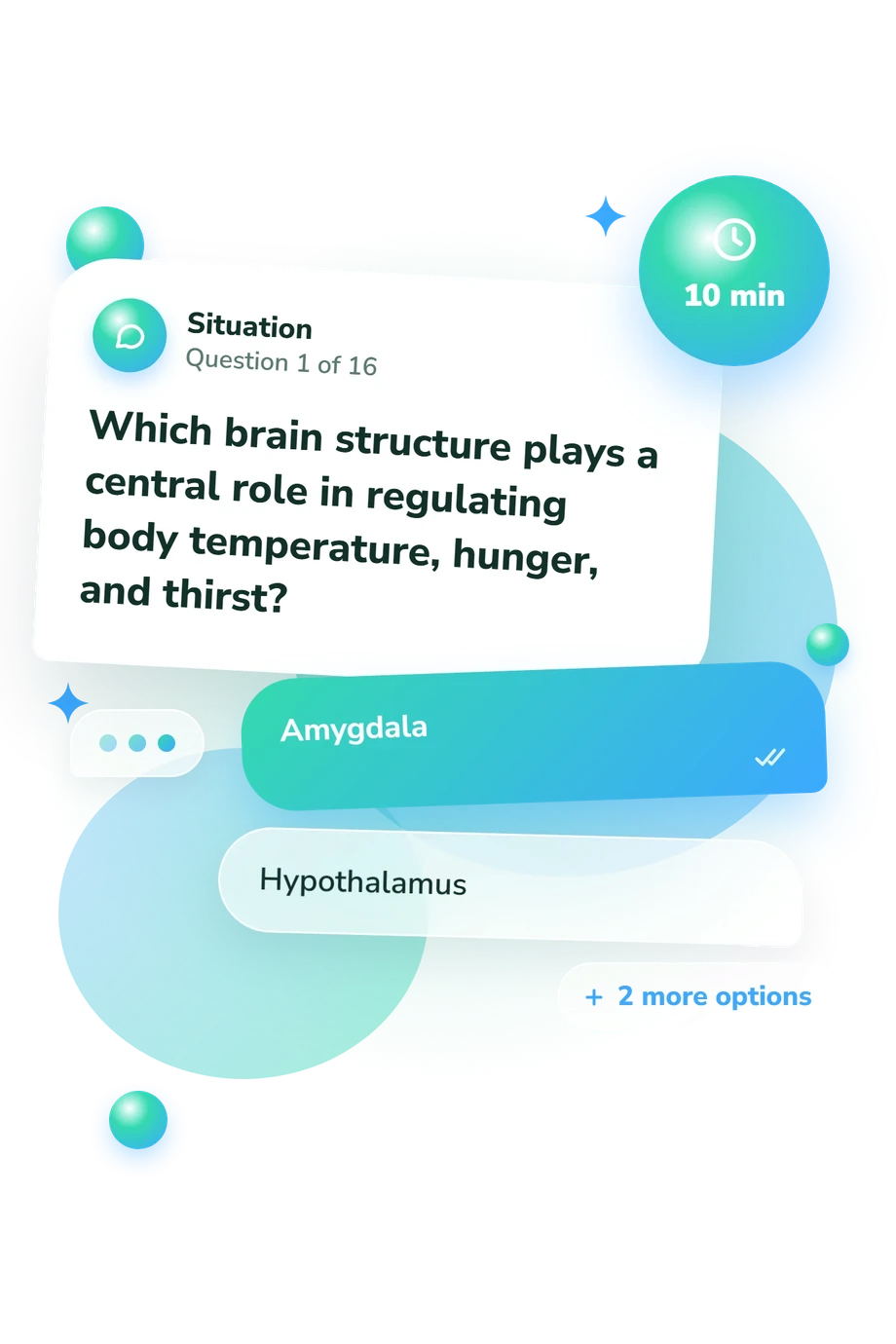
Example Questions From the Test
- Amygdala
- Hypothalamus
- Corpus callosum
- Occipital cortex
- The right hemisphere
- Both hemispheres receive it identically at the same instant
- The left hemisphere
- Neither hemisphere; touch is processed only in the spinal cord
- Pituitary gland
- Corpus callosum
- Thalamus
- Brainstem
Brain Quiz - Description and methodology of the test
Those who want a quick check of their current knowledge can use this assessment to see which areas deserve more attention. Results from the brain quiz questions provide an educational snapshot across several kinds of brain science. As a fixed-choice brain knowledge quiz, it offers a result that can guide what to revisit next.
What This Assessment Explores
This questionnaire connects brain anatomy, physiology, and behavior. The questions ask you to match structures with functions or processes with consequences, such as linking the hypothalamus with regulation and the hippocampus with new memory formation. These brain anatomy and physiology questions focus on recognition and application rather than open-ended ideation.
The items fall into four themes:
- Structures and functions show whether you can identify major regions and roles.
- Neural communication tests understanding of dendrites, myelin, synapses, barriers, and metabolic support.
- Brain-body regulation covers autonomic responses, planning, inhibition, and network coordination.
- Neuroplasticity and changing brain activity show whether you can apply concepts from rehabilitation and sleep-stage questions.
Brain Knowledge is reported on a 0-16 scale: Foundations to build (0-6), Developing knowledge (7-12), or Strong knowledge (13-16). It is an unvalidated educational score, not a measure of intelligence, brain health, or neurological function.
Methodology and Scientific Basis
Each item offers four answer choices and asks for the best response to a factual or applied scenario. It ranges from identifying structures to interpreting brief cases about injury, memory, autonomic arousal, and sleep. These neuroscience multiple-choice items check recall and basic application, while some challenge common misconceptions rather than presenting separate answers or demanding open-ended reasoning.
The questionnaire produces the displayed educational score without a stated standardized weighting or scoring method.
Conceptually, the content is consistent with Bear, Connors, and Paradiso (2016), and also aligns with the broader physiology in Kandel, Koester, Mack, and Siegelbaum (2021) and Betts and colleagues (2022). Dienel (2019) offers a relevant framework for the glucose item. These sources support the tested concepts, but do not make this questionnaire a validated adaptation of a published instrument.
Prior coursework, guessing, wording familiarity, and current concentration can influence performance, so the result is best read as a prompt for selecting review topics rather than a stable estimate of knowledge.
- Bear, Mark F., Barry W. Connors, and Michael A. Paradiso. Neuroscience: Exploring the Brain. 4th ed. Wolters Kluwer, 2016.
- Kandel, Eric R., John D. Koester, Sarah H. Mack, and Steven A. Siegelbaum. Principles of Neural Science. 6th ed. McGraw Hill, 2021.
- Betts, J. Gordon, Kelly A. Young, James A. Wise, Eddie Johnson, Brandon Poe, Dean H. Kruse, Oksana Korol, Jody E. Johnson, Mark Womble, and Peter DeSaix. Anatomy and Physiology 2e. OpenStax, 2022.
- Dienel, Gerald A. "Brain Glucose Metabolism: Integration of Energetics with Function." Physiological Reviews, vol. 99, no. 1, 2019, pp. 949-1045. 10.1152/physrev.00062.2017
Updated: