
Boyfriend Test
How the Scales are Structured
Who Usually Takes This Test?
See How You Compare
Below is a preview of how scores are typically distributed across each scale.
Example Questions From the Test
- No, not at all
- Probably not
- Not sure / sometimes
- Yes, definitely
- No, not at all
- Probably not
- Not sure / sometimes
- Yes, definitely
- Definitely not
- Probably not
- Not sure
- Definitely yes
Boyfriend Test - Description and methodology of the test
People seeking a playful way to see how well a boyfriend’s answers match the respondent’s answer key across preferences, habits, opinions, and shared memories can use this assessment as a conversation starter. The boyfriend test reflects familiarity which may grow through communication and attention without measuring attention itself. In this bf test, strengths and gaps in familiarity are easier to discuss with curiosity.
What This Assessment Explores
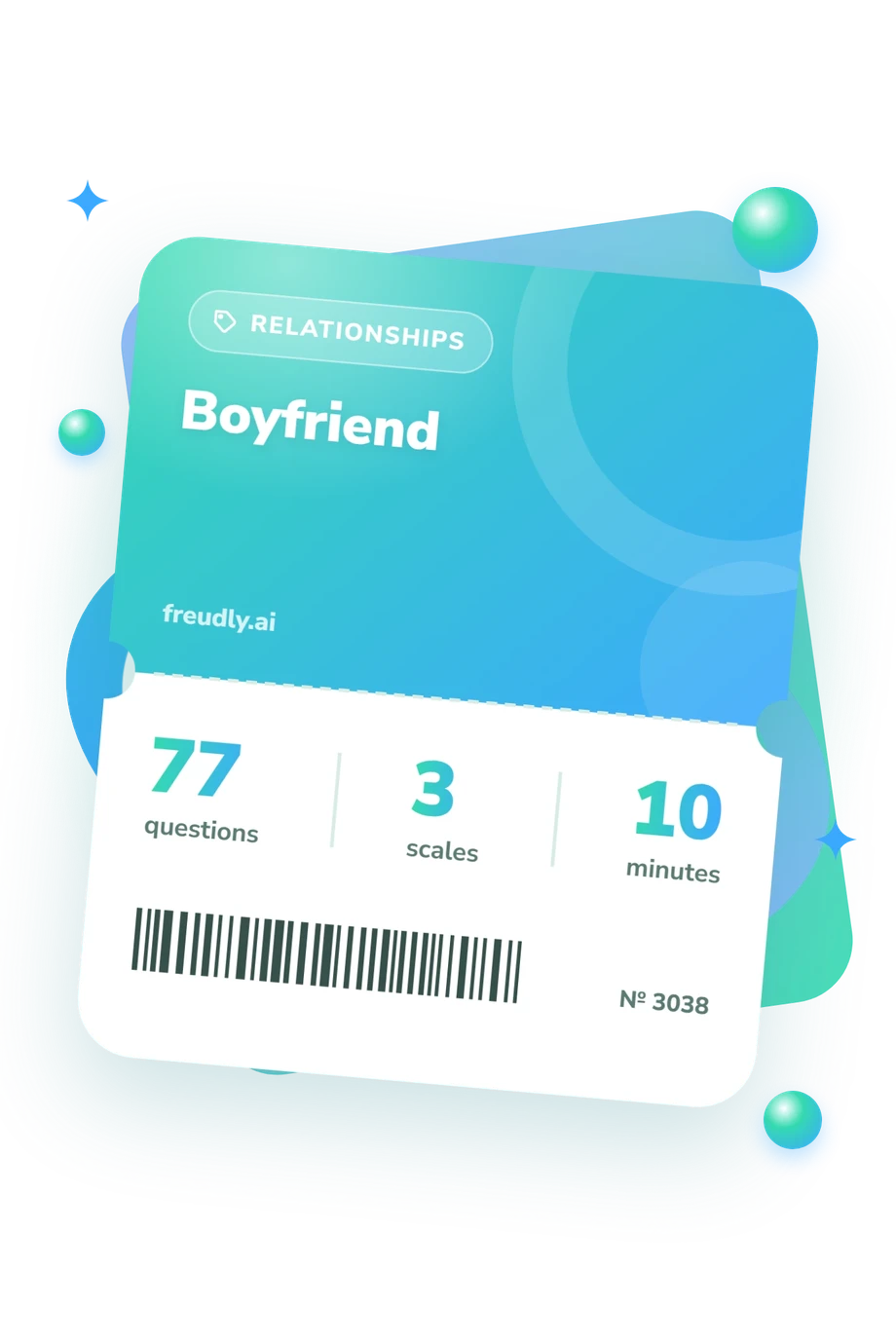
Rather than measuring general relationship satisfaction, the questionnaire looks at how accurately one partner knows the other’s everyday patterns and shared history. Items cover preferences, routines, pet peeves, comfort, goals, appreciation, date styles, and meaningful moments. The three displayed dimensions are:
- Overall Knowledge Score (0-20) summarizes correct-answer matches across the quiz: Getting to Know You (0-6), Fairly In Sync (7-13), and Nailed It (14-20) mark increasing familiarity with preferences, habits, opinions, and shared memories.
- Personal Preferences & Habits (0-10) captures everyday likes and patterns: Still Learning (0-3), Mostly Knows (4-7), and Very Familiar (8-10) indicate increasing familiarity.
- Relationship Memories (0-10) captures recall of shared experiences: Spotty Recall (0-3), Some Memories (4-7), and Strong Recall (8-10) indicate stronger relationship-history recall.
Discussing a bf quiz result can help partners distinguish familiarity with current habits from recall of shared memories.
Methodology and Evidence Base
Each item asks whether the boyfriend knows or remembers a detail, or whether the respondent knows a partner-related fact. Four choices move from definite lack of knowledge through uncertainty to definite knowledge or agreement. This self-report format captures perceived accuracy, not memory under controlled conditions.
Responses are matched with the respondent’s answer key and reported on the displayed scales. The result summarizes the boyfriend’s familiarity with preferences, habits, opinions, and shared relationship memories, while the self-report format means mood, relationship stage, recent conversations, self-awareness, and candor can affect the snapshot of perceived relationship familiarity.
The conceptual fit is clearest with Showers and Kevlyn (1999), whose work examines organized partner knowledge. Wegner, Erber, and Raymond (1991) provide the transactive-memory perspective, while Showers and Zeigler-Hill (2004) connect partner knowledge with relationship outcomes and change. This boyfriend quiz is conceptually consistent with those studies, not a validated adaptation of them.
- Showers, C. J., & Kevlyn, S. B. (1999). Organization of knowledge about a relationship partner: Implications for liking and loving. Journal of Personality and Social Psychology, 76(6), 958-971. 10.1037/0022-3514.76.6.958
- Wegner, D. M., Erber, R., & Raymond, P. (1991). Transactive memory in close relationships. Journal of Personality and Social Psychology, 61(6), 923-929. 10.1037/0022-3514.61.6.923
- Showers, C. J., & Zeigler-Hill, V. (2004). Organization of partner knowledge: Relationship outcomes and longitudinal change. Personality and Social Psychology Bulletin, 30(9), 1198-1210. 10.1177/0146167204264077
Updated: