
Bible Quiz Competition
How the Scales are Structured
Who Usually Takes This Test?
See How You Compare
Below is a preview of how scores are typically distributed across each scale.
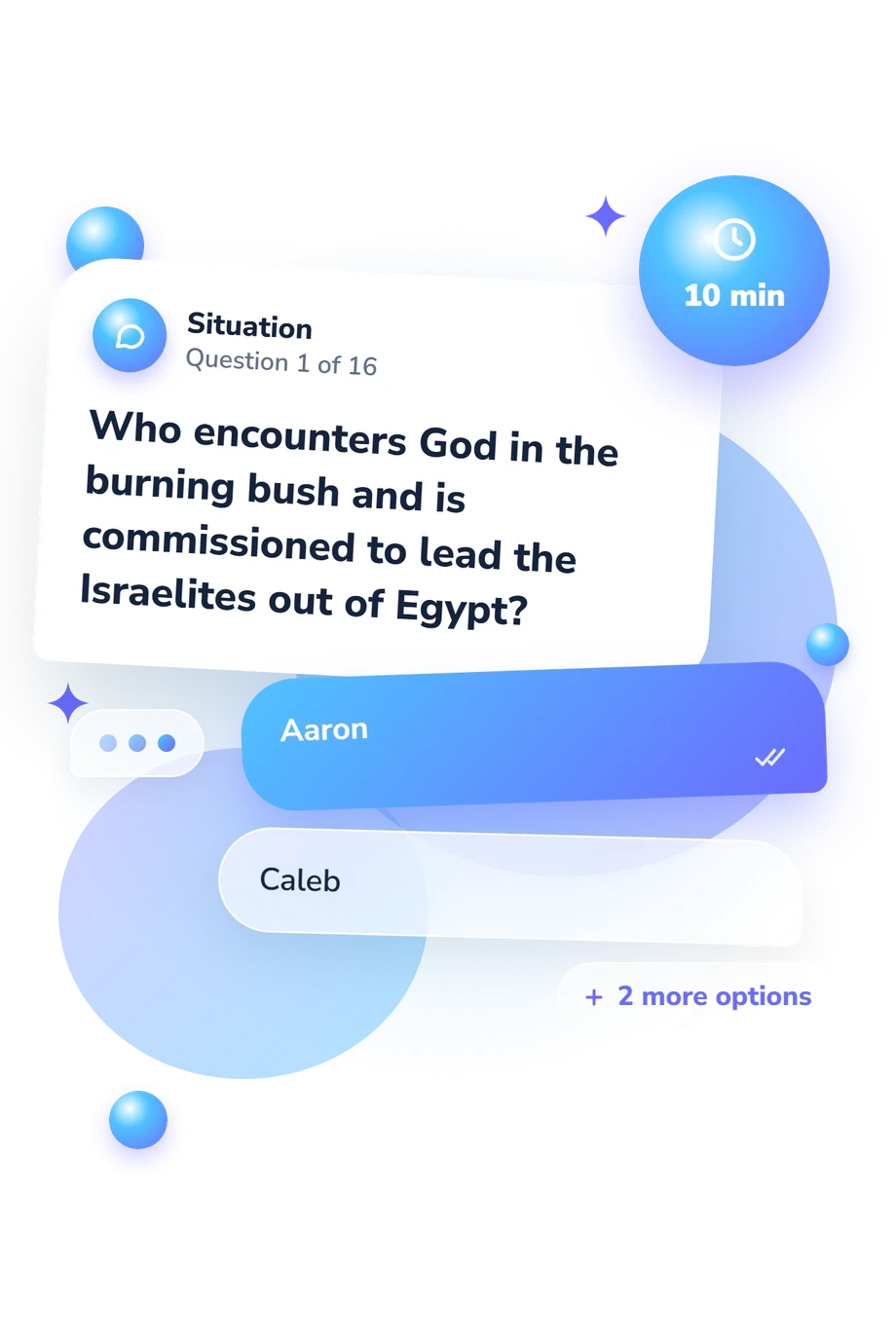
Example Questions From the Test
- Aaron
- Caleb
- Joshua
- Moses
- He performs a sign to end each challenge
- He asks his disciples to respond for him
- He responds by citing Scripture
- He answers with sayings attributed to Roman law
- Esther
- Naomi
- Deborah
- Miriam
Bible Quiz Competition - Description and methodology of the test
For readers deciding what to review next, the Bible Quiz Competition offers an individual result that can guide a study plan, discussion, or choice of passages. Its format can support a Bible quiz contest or group review, while each score remains tied to the participant’s own answers. The result can help readers choose where to focus without treating one performance as a complete picture of religious understanding.
What This Assessment Explores
Questions move between biblical narratives, named people, teachings, and situations requiring a practical response. Some items test recognition of a person, event, place, or symbol; others ask which interpretation or action best expresses a passage’s meaning. Together, they examine knowledge as something usable, not merely memorized.
The result is organized around one displayed scale:
- Bible Knowledge (0-16) indicates how broadly and accurately the respondent identifies biblical content and applies key scriptural ideas. Foundations to revisit covers 0-6, Developing command covers 7-12, and Strong command covers 13-16.
Learners can use the result of this Bible knowledge quiz to identify gaps in narratives, teachings, or practical interpretation and choose material for further study. A band describes performance on this questionnaire rather than a person’s faith, character, or religious understanding.
Methodology and Scientific Basis
Each item presents four answer options, and the respondent chooses the one that best fits the account or teaching. The items combine recall across both Testaments with applied interpretation, asking about people, events, places, symbols, and practical meanings. Because it is an online Bible quiz with four-option items, the questionnaire records recognition and interpretation through a direct choice rather than an open-ended explanation.
The questionnaire is conceptually consistent with the Bible Knowledge Scale described by Krull and McCloy, which treats biblical knowledge as an assessable construct. It is not presented as an adaptation or standardized administration of that scale. The Association for Biblical Higher Education’s Bible Knowledge Exam offers another example of organized Bible-knowledge assessment, not the scoring model used here.
The displayed total is interpreted only through the three bands shown with it; no additional scoring rule is specified. Results can shift with memory, familiarity with the translation used, recent study, divided attention, or hurried selection of an option. The assessment is a focused snapshot for guiding reading and discussion, not a complete measure of religious understanding.
- Douglas S. Krull and Rodney A. McCloy. (2022). Add to Your Faith Virtue and to Virtue Knowledge: A Bible Knowledge Scale. Journal of Psychology and Christianity, 41(2), 106-117.
- Daniel Nelson. (2004). Bible Knowledge and Moral Judgment: Knowing Scripture and Using Ethical Reasoning. Journal of Research on Christian Education, 13(1), 41-57. 10.1080/10656210409484959
- Association for Biblical Higher Education. (2020). Bible Knowledge Exam: An ABHE Bible Knowledge Assessment Tool.
Updated: