
Basketball Rules Quiz
How the Scales are Structured
Who Usually Takes This Test?
See How You Compare
Below is a preview of how scores are typically distributed across each scale.
Example Questions From the Test
- Any unsuccessful shot attempt
- A mistake involving only court position
- A request by a coach to stop play
- Illegal contact with an opponent, such as holding or pushing
- Two points
- Its value depends on where the foul occurred
- Three points
- One point
- Double-dribble violation
- Traveling violation
- Personal foul
- Held ball
Basketball Rules Quiz - Description and methodology of the test
For readers who want to check how confidently they apply everyday basketball decisions, this basketball rules quiz turns familiar plays into a focused knowledge assessment. It suits players, coaches, officials, students, and curious fans who want a clearer picture of their current rule knowledge. As a basketball rules assessment, it can show which fundamentals are secure and which situations deserve another look.
What This Assessment Measures
Questions present practical decisions about traveling, dribbling, pivot feet, throw-ins, boundaries, contact, free throws, three-point attempts, and shots released before the period ends. The result reflects applied recognition for players, coaches, officials, students, and fans. Readers revising school-level basketball rules can use this quiz for high school basketball rules practice; it is not tied to one competition code.
The Basketball Rules Knowledge scale runs from 0-16. Starting Lineup (0-6) marks core ideas needing review; Developing Game Sense (7-12) reflects sound fundamentals with some misses; Rules-Savvy (13-16) reflects accurate application across varied situations. League and local rulebooks may differ in specific procedures.
Recurring question themes include:
- Ball control shows how you identify traveling, pivot, and double-dribble decisions.
- Boundaries and contact show whether you recognize restarts, possession changes, fouls, and violations.
- Scoring and timing show how you apply point values and period-ending rules.
Methodology and Evidence Base
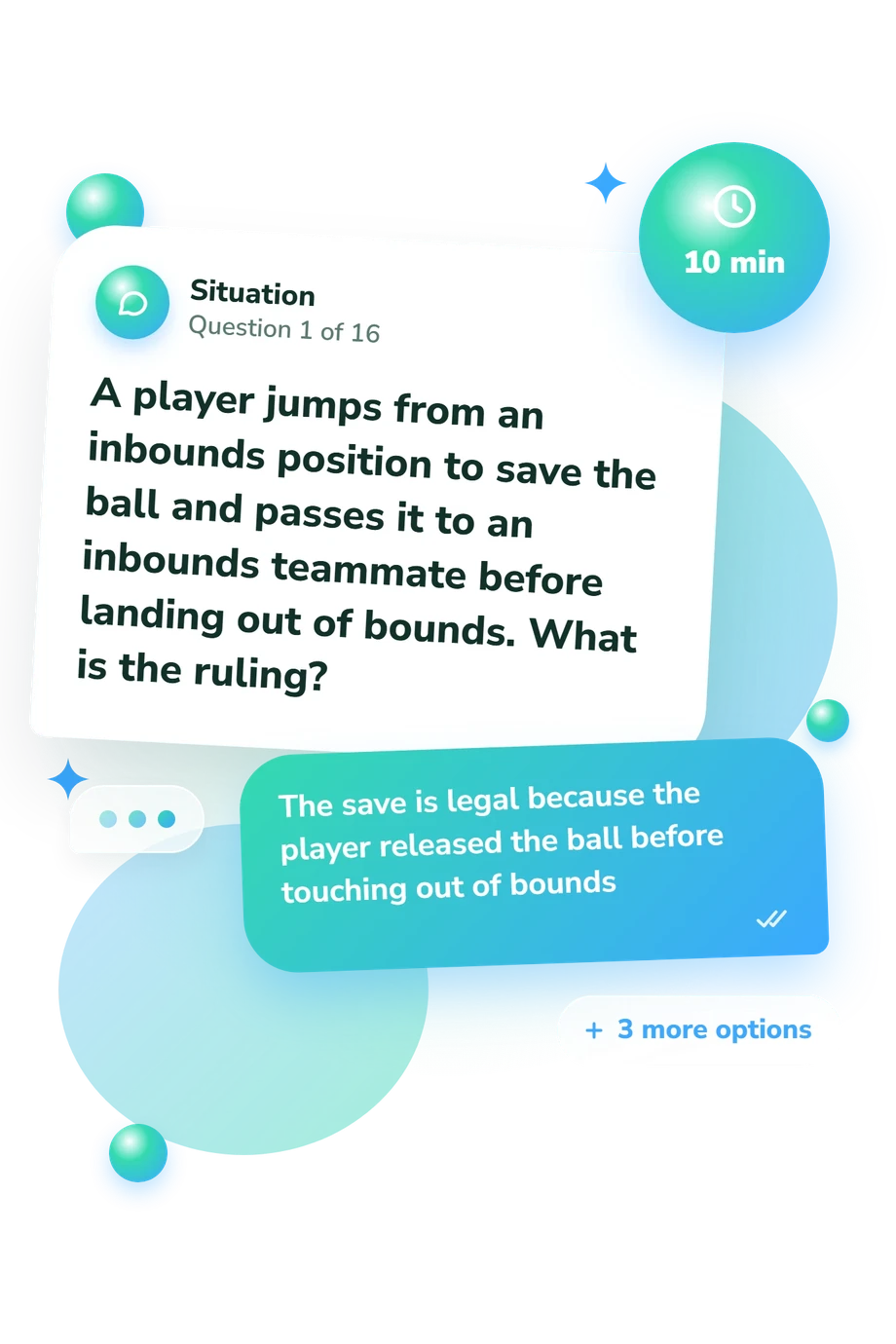
Each item presents a game situation with several answer choices. The respondent selects the ruling that best fits the play, so the format tests recognition and application rather than written explanation. Results summarize correct answers across the questionnaire; the displayed score is descriptive, with no separate weighting stated.
Conceptually, the content is closest to knowledge-focused basketball assessment work. The basketball-rule knowledge study by Dubru and colleagues examined sport-participant categories, while Tsuda and colleagues reported validation work for the Basketball Common Content Knowledge Instrument. FIBA’s Official Basketball Rules 2024 and the 2024-25 NFHS Basketball Rules Book provide rulebook benchmarks. These sources support the subject matter, but do not show that this online basketball knowledge quiz is one of those instruments or has their validation statistics.
Read the result as a snapshot of knowledge of the broadly shared rules represented in the questions, not as a norm-referenced certification. This online version displays no standardized norms or independent validation claim. Memory, wording, and familiarity with a particular rulebook can affect performance, so official decisions should be checked against the applicable local code.
- Dubru, Gilles, Marc Cloes, Lionel Dauby, and Martin Van Hoye. “Analysis of the Level of Knowledge of Basketball Rules: Comparison Between Different Categories of Sport Participants.” 9th ARIS Biennial Conference, 2016, p. 108.
- Tsuda, Emi, Phillip Ward, James D. Ressler, James Wyant, Yaohui He, Insook Kim, and José A. Santiago. “Basketball Common Content Knowledge Instrument Validation.” International Journal of Kinesiology in Higher Education, vol. 7, no. 1, 2023, pp. 35-47. 10.1080/24711616.2021.2010624
- FIBA. Official Basketball Rules 2024. FIBA, 2024.
- National Federation of State High School Associations. 2024-25 NFHS Basketball Rules Book. NFHS, 2024.
Updated: